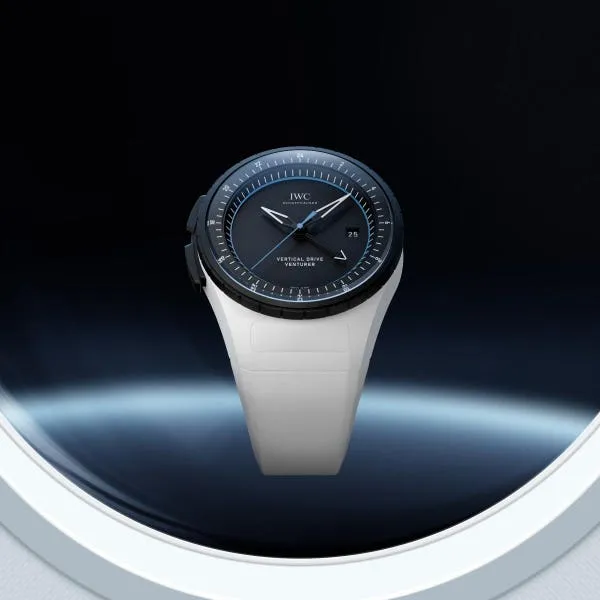
IWC Schaffhausen designed the Pilot's Venturer Vertical Drive (Ref. IW328601) specifically for the unique demands of human spaceflight, rethinking traditional watch controls for use beyond Earth.
Inspired by astronauts operating in bulky space spacesuits, the watch eliminates the conventional crown entirely. Instead, all functions are controlled via a patent-pending rotating bezel system, while a rocker switch on the side of the case allows the wearer to alternate between modes -- such as winding the movement or setting home and mission times. The system is engineered for full operability while wearing gloves during extravehicular activities (EVAs).
Developed in partnership with Vast, a company that develops next-generation space stations, the watch has been spaceflight-qualified for use aboard Haven-1, the company's planned first commercial space station expected to be launched sometime in 2027.
"When our engineering division, XPL, developed the Pilot's Venturer Vertical Drive, they did not simply adapt an existing watch design for use in space. They took a blank sheet of paper and worked to define from scratch what a tool watch for astronauts would have to offer in terms of functionality, ease of operation, time display and material execution," said Chris Grainger-Herr, CEO of IWC. "Every single detail of this watch has been single-mindedly optimized for the unique requirements of human spaceflight and timekeeping in space."
The timepiece is constructed from white zirconium oxide ceramic and Ceratanium -- an IWC proprietary material that combines the lightweight strength of titanium with the hardness of ceramic -- ensuring durability and resistance to extreme temperature fluctuations. It is designed to withstand the intense vibrations of liftoff, the vacuum of space and drastic thermal shifts. The caseback features an engraving that symbolically evokes a space vehicle, "reflecting humanity's curiosity and spirit of exploration," IWC said.
Visually, the watch embraces a distinctly futuristic aesthetic. One that could be home on the set of "2001: A Space Odessey." Its matte-black dial is stripped to essential information and features a 24-hour display, eliminating ambiguity between day and night -- an important consideration in orbit, where astronauts experience up to 16 sunrises and sunsets every 24 hours.
The bezel's movements are transmitted to the winding stem through a "vertical drive" clutch system. The watch can be wound either automatically by an oscillating mass or manually by rotating the bezel counterclockwise, a hybrid approach designed to ensure reliable performance in both terrestrial and microgravity environments.
The dial displays two time zones: mission reference time is indicated by central hour and minute hands, as well as a dedicated 24-hour hand on the outer scale. While the watch is typically synchronized to Coordinated Universal Time (UTC), the hour hand can be adjusted in one-hour increments to track a second time zone -- useful for astronauts monitoring time back on Earth. The GMT feature can be used on Earth for its traditional function of displaying a second time zone.
Legibility is enhanced with luminous detailing: the black triangular hour and minute hands are coated with green Super-LumiNova; while the arrow-tipped 24-hour hand glows blue. The blue seconds hand aligns with an inner ring in the same hue, evoking the Earth's horizon as seen from space.
Powering the watch is IWC's in-house caliber 32722 automatic movement, offering a 120-hour power reserve and an integrated GMT function along with a date display at 3 o'clock.
Tested and certified by Vast, the Pilot's Venturer Vertical Drive represents a purpose-built instrument for space -- one that reimagines mechanical watchmaking for life in orbit.