HORNBROOK, Calif. -- The expeditionary force, a squad of officers from the Los Angeles Police Department, deployed to this rugged little mountain town near the Oregon border with a singular mission.
Stationing themselves along the Southern Pacific Railroad tracks, the officers eyeballed passengers on California-bound trains, looking for hints of poverty: dirty clothes, worn luggage, or, simply, a weary expression.
If the riders looked shabby? The police stopped them from entering the Golden State.
This country has long argued over who should be allowed in. It still does. But nine decades ago here in this speck of a town called Hornbrook, an extraordinary episode in U.S. immigration history unfolded: Americans trying to stop fellow Americans from crossing state lines.
"The officers took our fingerprints, wrote detailed descriptions of our clothing and baggage and asked us many questions," James Taylor, a longtime Californian detained in Hornbrook, told the Medford (Oregon) Mail Tribune at the time. "As each was questioned, the policemen made frequent motions as if to strike us with blackjacks."
It was February 1936. Dust Bowl refugees from Oklahoma, Texas and elsewhere -- lumped together under a single pejorative: "Okies" -- were flocking to California, drawing the ire of Los Angeles power brokers: a scandal-plagued police chief, a notoriously corrupt mayor, the Chamber of Commerce, and the staunchly anti-union, pro-police Los Angeles Times.
Enter: The Bum Blockade.
The LAPD dispatched 136 officers to 16 ports of entry in California counties that bordered Arizona, Nevada and Oregon. Their mission, per one front-page story in The Times, was to turn back "migratory indigents, among whom are believed to be scores of criminals and disease-carrying ne'er-do-wells."
The Bum Blockade, as the public and press dubbed it, is now mostly forgotten. But it "is a warning to us" of the perils of scapegoating the downtrodden, said Bill Lascher, author of "The Golden Fortress: California's Border War on Dust Bowl Refugees."
There are chilling parallels, he said, between the LAPD officers, who were deputized by county sheriffs, and the federalized National Guard troops, U.S. Marines, and federal border agents deployed to American cities in President Trump's aggressive immigration crackdown.
And the "hostility toward houselessness, toward poverty," Lascher said, is as potent a force in L.A. today as it was then.
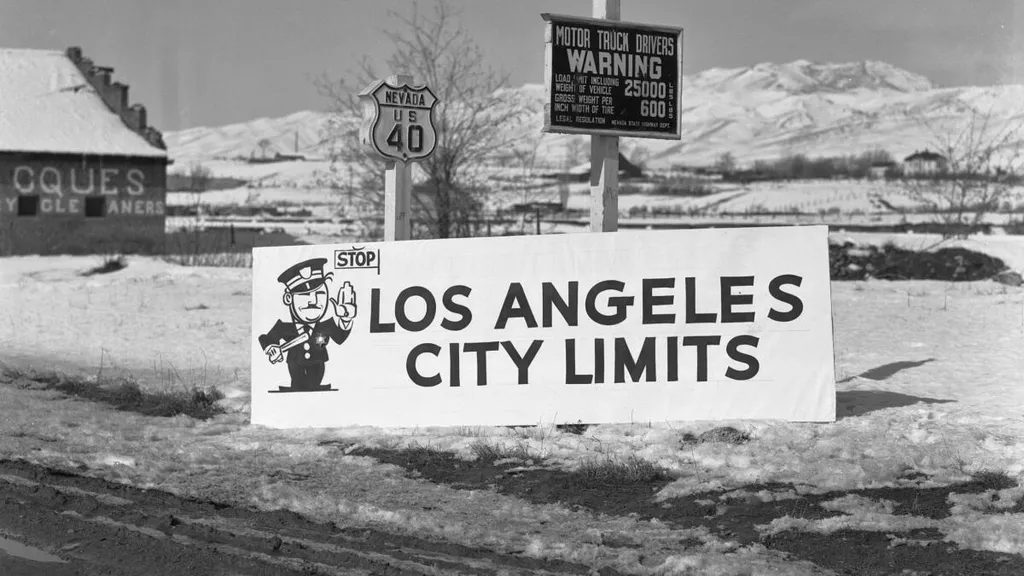
Amid the 1936 crackdown, a satirical billboard was erected at the California-Nevada state line near Reno, with a baton-wielding cartoon cop and the warning: "STOP. LOS ANGELES CITY LIMITS."
Rural places like Hornbrook -- a remote Siskiyou County town of some 260 people between the Klamath and Cascade mountain ranges -- tend to have a long memory for significant events.
In 1919, a train carrying President Wilson, who was traveling from Portland, Ore., to San Francisco, paused in Hornbrook. A plaque by the railroad tracks commemorates the stop to this day.
But the LAPD officers whose arrests here garnered front-page headlines across the West have faded from memory.
Gary Mellon, a gregarious 60-year-old carpenter and local history buff, said he had never heard of the blockade. If he had lived in Hornbrook back then and crossed into Oregon, "I don't know if I'd be able to get back in," he said.
"I look like a bit of a bum sometimes," said Mellon, who has a bushy gray beard and wore a plaid shirt and well-worn work boots.
On Feb. 6, 1936, eight men traveling through Hornbrook were rounded up and forced to stay overnight in an abandoned hotel that had been turned into a makeshift jail, the Medford Mail Tribune reported.
They were made to sleep on the floor and given half a loaf of bread each. The next day, they were "herded aboard a freight car" and sent back to Oregon.
Among them was a professional wallpaper hanger traveling to Southern California to visit his sister and nephew, a gardener at the San Diego Zoo.
Another traveler was Taylor, who insisted to a reporter that he resided at 1274 Normandie Ave. (misidentified in the Medford newspaper as "Normandy Street") in Los Angeles, a city his mother had called home for 30 years.
Taylor said he and his wife had left California two months earlier to visit an ailing relative in Washington state. Trying to get home cheaply, he had hopped aboard a boxcar.
Taylor told officers he was a veteran of both the Spanish-American War and World War I, drawing disability benefits because he had contracted tuberculosis during the latter conflict. He showed papers to prove his military service, to no avail.
"I have never been arrested or in trouble before in California and am anxious to return to my home," Taylor said, "but now I don't know what to do or where to go."
In the 1920s, Los Angeles civic boosters lured tourists and new residents by bragging of a veritable paradise filled with orange groves and eternal sunshine. The city's population surged from 576,000 to 1.2 million that decade, thanks to the burgeoning film industry and an oil boom.
But in the 1930s, jobs dried up. Migrants were blamed.
People of Mexican descent -- many of them American citizens -- were swept up in mass deportations or coerced to leave the country in order to save jobs for "real Americans," as President Hoover's administration put it. Okies, too, were accused of stealing jobs, sucking up public resources and being communist sympathizers.
The Bum Blockade was the brainchild of then-Los Angeles Police Chief James E. Davis, an expert marksman nicknamed "Two Guns," who gave his officers broad discretion in how to suss out transients. He also encouraged L.A. residents to report beggars to police.
Davis had "a huge ego" and little oversight from corrupt city leaders who, like him, viewed impoverished migrants as undesirables, said John Thomas, a retired LAPD lieutenant, former UCLA police chief and amateur historian.
In a Feb. 5, 1936, editorial, The Times blasted then-California Atty. Gen. Ulysses S. Webb and other state officials for calling the just-launched blockade illegal. It might be halted by the courts, the editorial read, but until then "a lot of undesirables can be turned back and a lot more discouraged from even starting in this direction."
Many in Northern California chafed at the presence of L.A. lawmen. This area, after all, is the site of the mythical State of Jefferson, a breakaway state proposed in the early 1940s by small-town denizens fed up with big-city influence and deteriorating roads they deemed "not passable, hardly jackassable." Residents today still fly the green Jefferson flag with its pair of X's, called a "double cross," that represent a sense of rural abandonment.
The sheriff of Modoc County refused to deputize the LAPD officers. In Siskiyou County, the district attorney called the blockade unconstitutional.
"If you look at what was happening back then, it was about 'We don't want certain people here; these people are a threat and they don't represent what we see as American,'" Thomas said. "I think that if we're not careful, we can find ourselves in the same place. All it takes is one leader, in this case James E. Davis, willing to compromise his oath to the Constitution."
Thomas' interest in the blockade was piqued by one of his favorite books, John Steinbeck's classic "The Grapes of Wrath."
In it, an unnamed character warns an Okie about to travel west: "Ever hear of the border patrol on the California line? Police from Los Angeles -- stopped you bastards, turned you back. Says, if you can't buy no real estate we don't want you. Says, got a driver's license? Le’s see it. Tore it up."
Woody Guthrie immortalized the blockade, too, in his song "Do Re Mi," a cheeky but furious warning to Dust Bowl refugees that if they had no "do" -- as in: "dough," or cash -- they would not be welcome in California. He sang:
'Cross the desert sands they roll,
getting out of that old dust bowl
They think they're goin' to a sugar bowl,
but here's what they find
Now, the po-lice at the port of entry say:
"You’re number fourteen thousand for today"'
In the Great Plains, California was seen as a wonderland at a time when "people were dying, starving, getting black lung from the dust in the wind," said Cady Shaw, director of the Woody Guthrie Center in Tulsa.
Guthrie was "letting them know there are harsh realities" in California, Shaw said,and that "this isn't the promised land we were told."
As for James Taylor, he tried to get back into California without success despite obtaining a letter from a Medford attorney who said the L.A. police had no right to block him.
"They beat my ribs with police clubs and knocked my teeth out as they chased me into Oregon," Taylor said in an account published in the Bend (Oregon) Bulletin.
He said the officers tore up his driver's license and registration slips for two California vehicles. He hitched a ride to Portland and sought out a U.S. attorney who claimed to have no authority to interfere with a state matter. He told Taylor his best option was a civil suit -- which would have to be filed in California.
Taylor said he would hitchhike to his wife in Olympia, Wash., and had given up on California.
His story disappeared from the headlines. The statewide Bum Blockade, an expensive legally challenged caper fizzled out after a few months with Davis calling his officers home. A smaller local effort that autumn in which officers threatened poor migrants headed into L.A. with jail or forced labor was short-lived.
There is debate about how many people the LAPD officers actually arrested Lascher said but they are believed to have encountered thousands -- and likely discouraged thousands more.
Nine decades after the expulsion of poor travelers from Hornbrook the town is better known for its generosity.
There is a lot of need in Hornbrook where the median household income of $32,222 is a third of the statewide median.
Inside the former-diner headquarters of the nonprofit Hornbrook Community Assn., one word is painted in huge, bright yellow letters: WELCOME.
Every Friday, volunteers host a free community breakfast of pancakes and French toast. Most weeks, there are more than 40 people — a huge number in this little town — and for many seniors, it’s their only social outing.
"Nobody is turned away," said Helene Blazier, the nonprofit's treasurer.
Last Thanksgiving, the volunteers had planned to take the holiday off. But when a few people at the pancake breakfast the week before said they had nowhere to go and no family, “all of us just flipped, and we had Thanksgiving dinner here, and we served 20 people,” Blazier said.
For Christmas, the group bought a new pair of sneakers for every student at Hornbrook Elementary — all 25 of them. One boy declared it the best Christmas he’d ever had.
On a recent Monday, the volunteers who had gathered at their headquarters for a board meeting said they couldn’t fathom the LAPD being stationed in Hornbrook.
"There's always a little bit of suspicion of outsiders here" because it's an impoverished town with no local police," said Mellon,the carpenter."But there's also a very generous spirit.If you break down,p eople will help you."
Just outside the headquarters is a bus stop with a covered shelter recently added by the nonprofit.Every few weeks,a person passes through who,because of their appearance,surely would have been nabbed by the Bum Blockade.