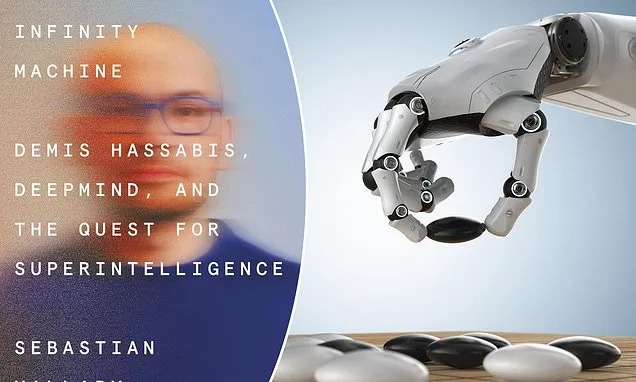
Demis Hassabis, the man at the heart of this revealing book, is not modest in his ambitions. 'Solving physics and the nature of reality... is my long-term goal.' In his early career, he worked on creating a computer game called Evil Genius. To his rivals, he may sometimes seem exactly that. To his many admirers, he's just a 'genius'.
Hassabis was born in north London in 1976. As a chess player, he was competing in tournaments at the age of five and beating players much older than him. He had to sit on chairs stacked with telephone directories to bring him face to face with taller opponents. As an adult, he is a five-time world champion at the International Mind Sports Olympiad.
DeepMind, Hassabis's AI led company designed a machine that mastered the Chinese game of Go.
After graduating from Cambridge, he worked on computer games, running his own company, Elixir, before research into AI beckoned. In 2010, with two colleagues, he founded DeepMind. The advent of powerful AI, he thought, would be 'bigger than the Industrial Revolution'.
Within a few years, at a gathering of tech bros for Elon Musk's birthday, where the men were, for some reason, dressed as samurai warriors and the world sumo wrestling champion was a guest, Hassabis and Google's Larry Page fell into conversation. The result? Google bought DeepMind for $650 million, Hassabis netting $136 million.
The north Londoner seems to have been genuinely not interested in the money so much as in what it enabled him to do. 'I just thought, look, I'll go to Google. I'll get a s*load of computers and then I'll solve intelligence.' Appropriately for a man fascinated by games, DeepMind's first major triumph came with a machine designed to play the Chinese game of Go.
Go is mind-bogglingly complex. The number of possible board states during the course of a game is estimated at more than the number of atoms in the universe. Hassabis said that, in two years, they would create a computer that could beat a world champion.
They did just that. In South Korea, champion Lee Sedol was beaten by DeepMind's AlphaGo. 'I am quite speechless,' Lee reported and later retired from playing.
In the years since AlphaGo's success, AI has grown ever more powerful. ChatGPT became the fastest growing computer application ever.
DeepMind has had to work hard to keep up with its rivals. Hassabis has been knighted and won a Nobel Prize but has lost none of his drive.
There are concerns about the dangers of creating intelligence greater than our own.
It's not reassuring that researchers think the likelihood of AI eventually destroying us is quite high.
Hassabis remains an optimist. He may not have solved the nature of reality but he is still working on it.