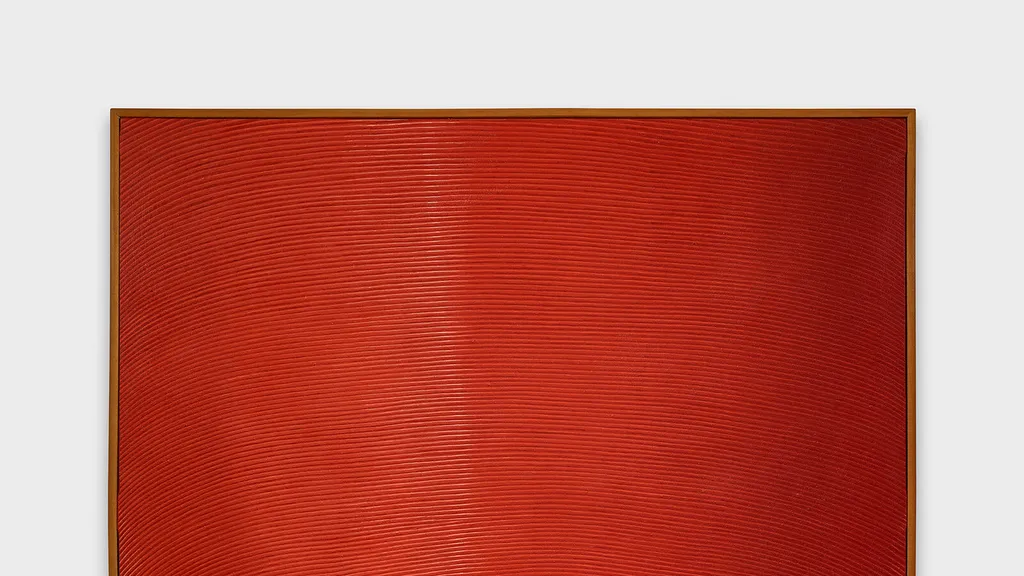
Lévy Gorvy Dayan gallery offers new glimpses of the perfectionism and hidden goofiness of Domenico Gnoli, whose caricatures of reality captured la dolce vita.
In the five years before his death, just as he was hitting what curators call maturity, the Roman-born artist Domenico Gnoli (1933-70) created some of the politest, most methodical and humane paintings of life's forgettables that Pop Art could have asked for.
Seventeen late Gnolis are now at the Lévy Gorvy Dayan gallery in Manhattan. Large and tightly-cropped, the canvases zoom in on trouser pleats, upholstery piping, a starched shirt collar, an embroidered duvet and other vaguely moneyed items so deliberately attained, then so easily overlooked by those who enjoy them, conveyed through a painterly scholarship that absolutely enthralls without trying to be photographically real.
"The Adventure of Domenico Gnoli" is his latest reappearance in New York, where the painter died at age 36, after his breakout show at the gallery of Sidney Janis, who made Claes Oldenburg famous.
Gnoli mixed sand into his oil paint. This makes these paintings feel like objects. One gets seduced by the canyon-like weaves of his silk "Red Tie Knot" (1969), the grout of his brick "Corner" (1968), a slice from his epic "Apple" (1968). Even the skin of that fruit has its own heft; its surface pocked and flecked with varnish as if it were stone that might last a millennium. Had cancer not intervened, you feel, Gnoli could easily have attained the New York cred of an Oldenburg or a Vija Celmins.
In Italy he is well known, especially following a generous retrospective at the Fondazione Prada in 2024. Stateside, much less. Despite the totemic command of his objects, these paintings, by far Gnoli's best, are inviting in a way that makes you want to know who you're looking at. They suggest an aloof, deeply serious observer with the dry wit of Giorgio de Chirico.
In fact Gnoli was goofy and almost universally endearing, at least according to the ephemera on view. Although the new show has one fewer painting and six repeats from the last time the dealer Amalia Dayan tried to revive his star to New York -- in 2012, at the Luxembourg & Dayan galley -- Dayan compensates you here with humorous and self-effacing papers from Gnoli's archive.
During installation, Dayan let me see papers lent by Gnoli's widow, Yannick Vu, from Majorca, where the couple lived and where Gnoli sourced his sand. (Some made it on view, some did not.)
The first impression was of a young set designer of great charm. (He made his name on the London stage.) "Dear Dominic," the actress Vivienne Leigh addressed him in a letter in 1955, after seeing Gnoli's rococo, anti-austerity costumes and set for "As You Like it" at the Old Vic Theatre in London, "I cannot tell you how delighted we are to have one of your beautiful drawings."
Gnoli left the West End (and more stable pay) for illustration, with a linework and shapeliness probably influenced by his friend Maurice Sendak, and for more gallery exhibitions of his paintings. (He'd been exhibiting since age 19.) Charm helps one hop among careers. So does a casual relation to truth: The birth date on his driver's license, also among his papers, made him five years younger than he was.
Whether his philosophically-minded illustrations or his soft cartoon-realist canvases were his main event is an open question. In the archive, back issues of Show and Holiday contain his precise ink drawings from the aerial view of Jerusalem and Warsaw, accompanying travel stories.
In a Paris Review of 1960, alongside four whimsical drawings of his hometown, he wrote that they were "done with care, with pedantic precision -- a sort of inventory of the elements of the Rome in which I grew, possibly more a Rome I remember than a Rome I know."
Raised comfortably there and in family country homes in Umbria and Spoleto, Gnoli knew the dolce vita. His father, the art historian Umberto Gnoli, seemed to recognize its preciousness. He tasked Domenico with daily written observations of "what you do and what you see."
The "pedantic precision" Gnoli employed may have owed to Umberto's handwritten "Architettura" for his son, a document that goes on for pages with pen diagrams of column capitals; the anatomy of the basilica; the joinery of roofs.
Yet Gnoli's ink studies for the monumental paintings are quick, even flippant. You can tell Gnoli did his real planning on canvas.
Dashed-off cartoons are here too, the kind one leaves one's spouse on the counter when leaving early for a flight. Here is Gnoli, with his signature pronounced nose and sad-boy eyes, as a grasshopper. Gnoli as a gladiator beside Asterix, the French cartoon. (Gnoli lived for a time in Paris.) Then Vu, his wife, “mon cher petit,” as a chicken. Vu waving from across the ocean while Gnoli frowns bereft on the opposite shore. Vu as a small animal of prey in the beak of a Gnoli-faced bird. Then Vu as a bird stomping Gnoli to the ground. On paper it looked to me like love.
One sparse drawing has them in bed, covers pulled up to their cartoony noses. On canvas, his sleepers are hidden. The embroidery in “Letto Bianco” (1966), on view here, feels extraordinarily real. But it is also a caricature of reality. This is his sweet double standard, and it rises to the surface of Lévy Gorvy Dayan’s museum-grade slice of biography. (Only two paintings in the show are for sale.)
That sleight of hand seems to reinforce something of Gnoli’s world: the discovery that reality is a figment of the brain as much as a fact of the eye, and that humor can bridge the difference.
The Adventure of Domenico Gnoli
Through May 23; Lévy Gorvy Dayan; 19 East 64th St., Manhattan; 212-772-2004; levygorvydayan.com.