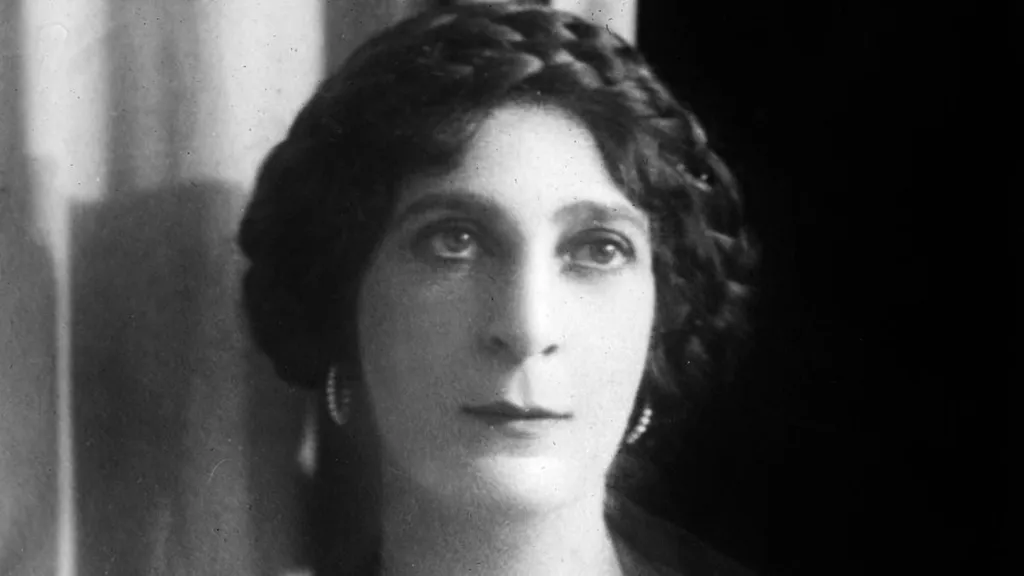
She was born a princess in a vast marble palace. She died, penniless, in a 'horrible shack' in Hampshire.
Related to our Royal Family through the Duchess of Kent, the tragic Princess Catherine Yourievsky was the daughter of a Tsar. She survived the Russian Revolution by walking unrecognised for days and days through her war-torn country.
Her fall from grace was spectacular. 'Staggeringly beautiful' when she married her first husband Prince Baryatinsky, overnight she'd become the richest woman in Russia.
But Princess Catherine could not understand - like Princess Diana could not - that rich princes see no reason not to have a mistress. And her husband was in love with a beautiful opera singer called Lina Cavalieri.
Just 23 and unworldly despite her exalted birth - her father was the assassinated Tsar Alexander II; home was the vast Tsarskoye Selo, five times the size of Buckingham Palace - in a desperate attempt to win her husband back Catherine forced herself to copy Lina's clothes, jewels and even deportment.
And as a ploy it was a success - when the prince died unexpectedly at the young age of 39, she inherited the bulk of his colossal fortune.
But before she could enjoy her riches, the Russian Revolution broke out. 'She lost everything,' wrote her friend, the MP Henry Channon. 'She managed to escape to London with just a few odd jewels.'
In Knightsbridge she set up home in a house behind Harrods, sharing it with the exiled King Manuel of Portugal, Prince Paul of Yugoslavia, and another Russian prince, the Oxford-educated Serge Obolensky.
The pair had met in Yalta where Obolensky, fighting for the White Russians against the Bolsheviks, had ended up in a field hospital run by Catherine. Before long he proposed marriage; she accepted.
It was another tragic mistake. The swashbuckling Obolensky was 12 years younger, and almost immediately fell in love with sexy Australian-born Sheila, Countess of Loughborough, whose affair with the future King George VI had just come to an end. He dumped Catherine, claiming she was 'too old, too ill, and too querulous' to live with.
The poor princess - now penniless and growing ever more pernickety - was on the shelf.
No other suitor came calling - and within a year Catherine was borrowing money from friends, and trying to make ends meet by establishing herself as an opera singer. She took to the platform of the Queen's Hall before moving on to top the bill at the London Coliseum, but people came to watch because of her title, not her voice.
The Royal Albert Hall and charity matinees at the Adelphi Theatre and Aeolian Hall followed, but interest in an opera-singing Russian princess with an unpronounceable surname lasted only a short time - despite the fact that she'd worked hard at her new career, learning and rehearsing upwards of 200 songs in Russian, French and English.
A concert she gave in Mayfair's Claridge's Hotel drew barely a handful of paying customers, and now she was obliged to downgrade her act to appearing in music-halls.
For a Serene Highness it was humbling and mortifying.
The work dried up, and the price of living in London - and keeping up appearances as the daughter of a Russian Tsar - became too much.
She lent her name to newspaper adverts for a patent medicine called Phosferine, which claimed to cure everything from neuralgia to exhaustion and frayed nerves, but whose commercial success mostly relied on the fact that each bottle contained a hefty whack of alcohol.
By the time she was in her fifties she was broke and living on Hayling Island in a development close to Portsmouth
The income from the adverts wasn't enough. She needed more money, and needed it desperately. Queen Mary, who nursed a guilty conscience over her husband King George V's refusal to allow Catherine's nephew Tsar Nicholas and his family to escape to Britain after the Revolution - directly leading to their murder at Yekaterinburg - granted her a small pension.
But the only answer was to leave London and find somewhere cheap to live in the country. Catherine remained so desperate for cash she even stooped to humiliatingly accepting monthly payments from her ex-husband Obolensky.
Except it wasn't his money - it was his new wife's. The prince had married one of the richest women in America - Alice Astor, who on her 21st birthday inherited the present-day equivalent of £150million - and it was Alice who doled out the cash to her husband's ex.
By the age of 55 Catherine was living at Northney on Hayling Island, an insalubrious development close to Portsmouth, in 'a ghastly villa called The Haven with a midget garden - peace, poverty, and Pekinese,' reported her friend Channon after paying a visit.
'Ever since Serge left her she has been increasingly poorer and poorer,' he wrote in his diary, 'more and more abandoned and forgotten, until now she lives in this forgotten villa where she lies in the sun and dreams of Tsarkoye Selo, where she was born.
'From all that great beauty, that incalculable wealth, to her loneliness and penury on Hayling Island! She has not tasted wine for years.'
Soon she was to move to an even smaller property on Havant Road - her life's journey had almost come to an end.
Her Serene Highness the Princess Catherine Alexandrovna Yurievskaya died aged 84 in December 1959, leaving just £1,000 in her will.
Once, her family had reigned over a population topping 100million people in the vast, sprawling, Russian Empire.
A mere six people turned up to her funeral.