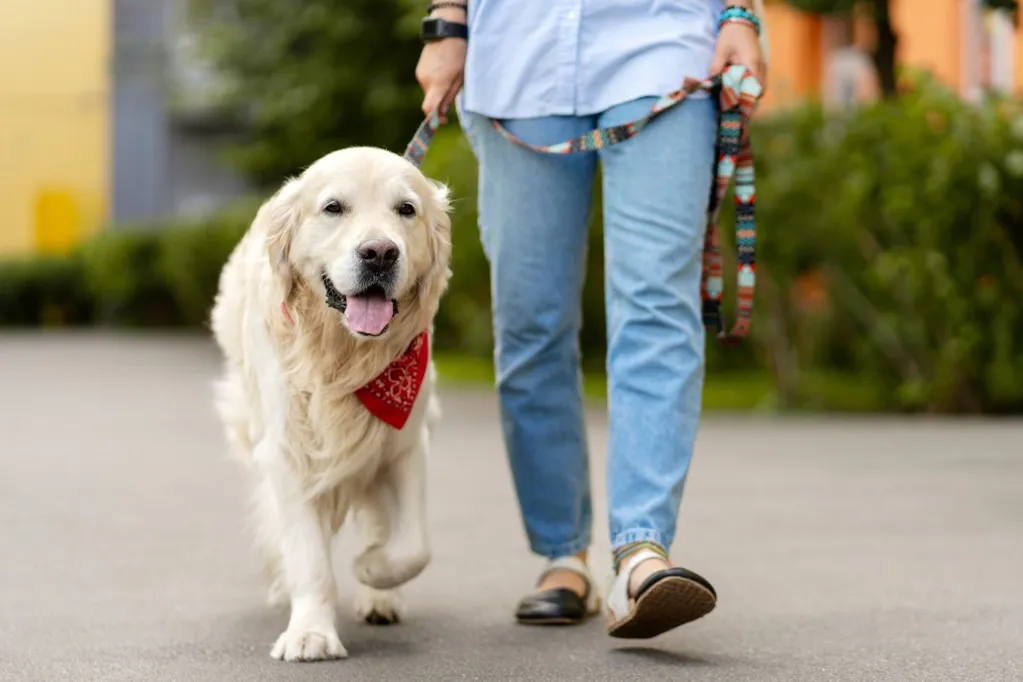
Walking your dog is a daily routine for owners, sometimes going out several times a day, but certain canines are racking up far more steps than others, new tracking data shows.
Fi, a GPS‑enabled smart collar company, transforms a dog's movement into a measurable step count. With the release of the Fi Mini, the company's data set has expanded dramatically, giving a more accurate picture of how dogs of all sizes live and move, CEO and co-founder Jonathan Bensamoun told Newsweek in a statement.
Newly released data from active Fi subscribers in the United States -- shared in honor of National Walk Your Dog Day -- showed dogs logged more than 17 million walks and took over 334 billion steps over the past 90 days. The company only included breeds with at least 500 active dogs to ensure the data set reflected reliable activity patterns.
But the leader of the pack for average daily steps? German shorthaired pointers.
This active dog breed logged the highest average daily steps at 20,808, edging past Brittany spaniels with 19,848 and vizslas at 19,176.
All three of these breeds topping Fi's activity rankings trace their roots back to hunting traditions, which helps explain their sky-high step counts and need to exercise.
Rounding out the top 10 most active dog breeds are miniature schnauzers, English springer spaniels, Belgian Malinois, Yorkshire terriers, toy poodles, cavapoos, and English setters, all of which averaged roughly 17,500 to 18,600 steps per day.
The top 10 breeds averaged about 18,709 steps per day, with a 3,283-step spread between the lowest, English setters at 17,525, and German shorthaired pointers at 20,808.
But as Fi continues to collect data, the results might vary. Bensamoun said: "The breeds rising to the top have also shifted as Fi's reach has grown beyond the obvious popular breeds into working dogs, sporting dogs, etc."
Bensamoun said the deeper value of the data goes beyond rankings and step counts because it isn't meant to be a competition. Instead, it acts as a communication tool.
"Dogs can't tell us how they feel, so we build the technology to tell us for them," he said. "What this data really shows is that dogs are living our lives with us -- our schedules, our rhythms. The bond isn't just emotional; it's behavioral."
He added that this kind of insight takes the guesswork out of how much exercise dogs are actually getting, giving owners a reliable benchmark for their specific breed, what's normal and where their dog fits in that picture. And with a clearer understanding of their pet's needs, owners can meet them where they are and strengthen the bond that already exists.
Fi also shared national walking trends from the last 90 days, revealing when dogs across the country are most active. Saturday emerged as the busiest day for walks, accounting for 14.81 percent of all activity, while Thursday was the slowest at 13.73 percent.
When it comes to time of day, dogs overwhelmingly hit their stride in the late afternoon. The single most popular walking window was 4 p.m. to 5 p.m., which made up 9.21 percent of all daily walks. A second peak followed from 5 p.m. to 6 p.m., and mornings saw their own surge between 8 a.m. and 9 a.m.
Overall, the patterns reflect just how closely dogs' routines mirror their owners' -- from weekend activity bursts to after‑work strolls and morning commutes.
And while the specific time of day may not drastically change a dog's overall activity, Newsweek previously reported that they benefit most from keeping a consistent schedule -- going out around the same times each day helps them feel secure, builds confidence and reinforces predictable rhythms.