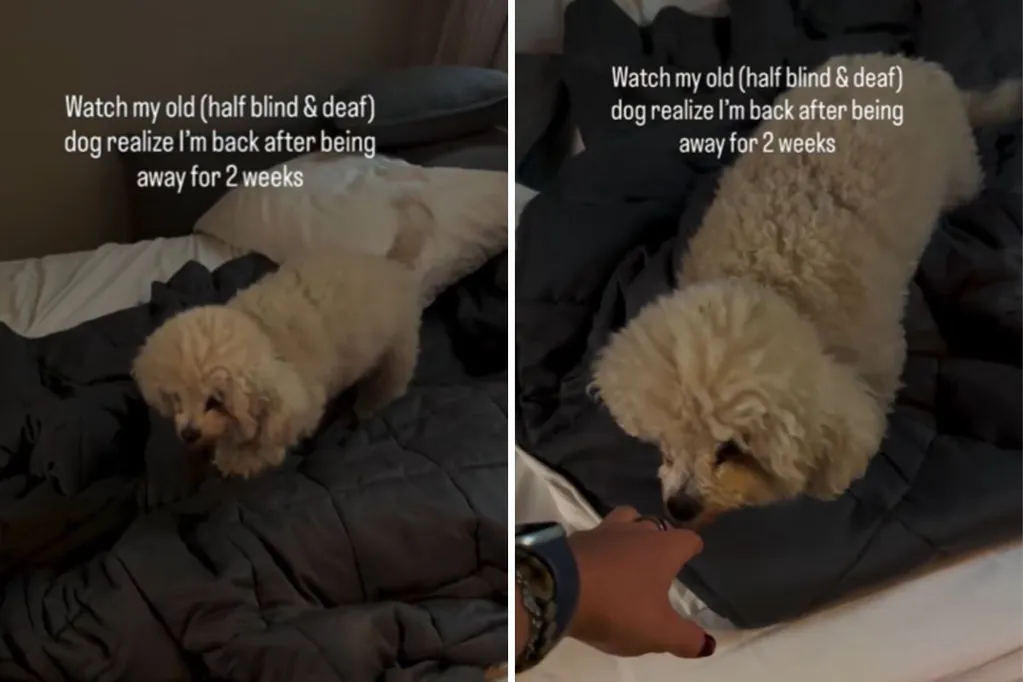
A senior dog, partially blind and deaf, captured widespread online attention after gradually realizing her owner had returned home from a two-week trip.
The March 5 Instagram video posted to the account @emma.the.pilot showed the moment owner Emma Bryan walked into her home to greet her 14-year-old dog, Coconut. Her dog is accustomed to Bryan being away for long stretches, especially because Coconut has been with her since Bryan was 11 years old, she told Newsweek via Instagram.
"I'm a pilot, so I am gone quite often," she said. "I think about her every day I'm gone, so I always get excited to see her..."
But as Coconut has aged, her hearing and sight have started to decline, which has made reunions take longer. In the clip, Coconut was sleeping with Bryan’s brother early in the morning. Bryan said it took her dog about five minutes to finally recognize the scent floating into the room.
From that point on, it was tail wags and “happy taps” from Coconut, who followed Bryan around the house and asked for much-needed belly rubs.
Bryan wrote in the caption that seeing this expressive reaction from Coconut, even in the dog’s senior years, helps her recover from post-trip blues. And the feeling is mutual for Coconut.
“She’s very much a Velcro dog, doesn’t really like anyone else,” she said. “I don’t even need a leash most of the time because she doesn’t want to be anywhere but next to me all the time.”
Even moments like this, which seem purely heartwarming, are rooted in how dogs recognize and perceive humans. As dogs age and their senses decline, they often rely more on scent than sight or sound.
In a 2014 study using functional MRI, researchers at Emory University found that dogs’ brains showed a distinct reward response in the caudate nucleus—a region associated with positive expectations—when exposed to the scent of a familiar human, even when the person was not present.
For older dogs like Coconut, who is partially blind and deaf, scent becomes an especially important cue. The study helps explain why it took Coconut several minutes to recognize Bryan after a two-week absence: Her brain’s reward system responded to the familiar scent, allowing her to gradually realize her owner was back.
Dogs experiencing vision or hearing loss rely on scent, touch and consistent routines as essential tools for navigating their world. Creating predictable environments and safe home layouts helps these canines feel secure. The American Kennel Club notes that dogs without full sight or hearing can still thrive when owners provide clear cues, like floor vibrations, positive reinforcement and proximity-based reassurance, allowing pets to maintain their bonds and daily routines.
Owners of dogs with sensory decline often find that a few supportive adjustments make a big difference. Non-slip rugs and mats can make it easier for older dogs to walk confidently on smooth floors, while scent-based enrichment toys keep them mentally engaged when vision fades. For dogs with hearing loss, gentle vibration-based collars can help maintain communication, and orthopedic beds provide comfort for aging joints.
The Instagram reel had reached over 2 million views and 581 comments as of Thursday, with people falling head over heels to Coconut’s joyful reunion.
“That nose is definitely still working!” pointed out a viewer, while another said: “Half blind, half deaf, full tail wag.”
A third person commented: “The dog was like, ‘Am I dreaming or is this real!??’”