Ivan Taylor is a bilingual, award-winning TV journalist who is a seasoned reporter with extensive live and breaking news experience from local and national news outlets.
After nearly two decades, the murder trial in the 2006 killing of former University of Miami football player Bryan Pata is now in the hands of the jury.
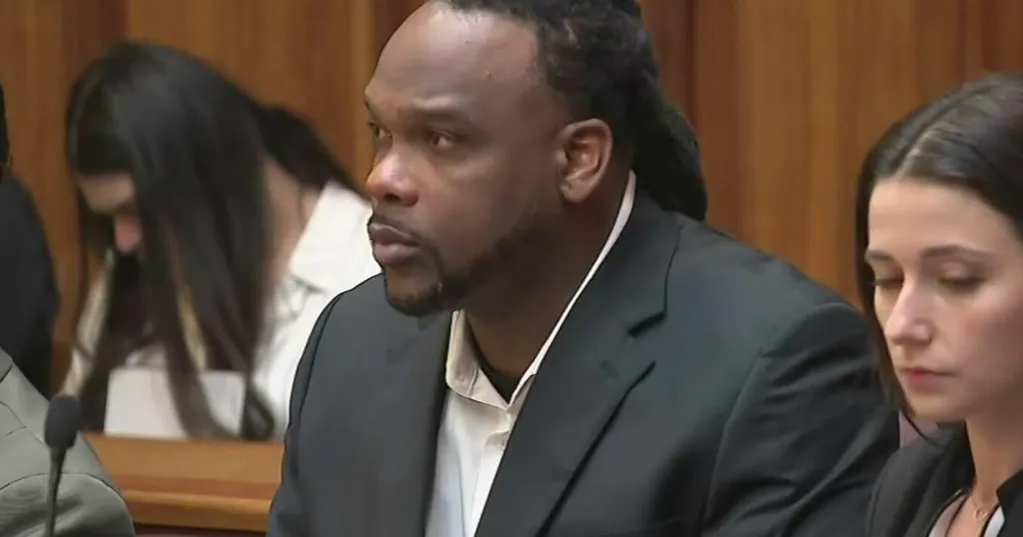
Prosecutors and defense attorneys delivered their closing arguments this week in the trial of Rashaun Jones, another former Hurricanes player accused of fatally shooting Pata outside his Kendall home on November 7, 2006. Jones, now 40, was arrested in August 2021 in Ocala following a recorded interview with investigators. He has pleaded not guilty.
On Wednesday, the state called its final two witnesses, including Dr. Emma Lew, a forensic pathologist with the Miami-Dade Medical Examiner's Office who conducted Pata's autopsy.
"The pathway of the bullet to Mr. Pata's body was from his left side," Lew testified.
Using a mannequin, she demonstrated that the bullet traveled slightly from front to back and slightly upward through Pata's body. Lew also told jurors that Pata suffered a penetrating gunshot wound to the head and that the bullet remained lodged in his body.
Relatives of Pata were present in the courtroom during the testimony. Some family members closed their eyes as Lew described the fatal wound.
The murder weapon was never recovered.
During cross-examination, defense attorney Christian Maroni challenged the forensic conclusions, asking whether the bullet's trajectory could determine the shooter's exact position.
"There is nothing about the trajectory of the bullet or anything else that you observed on your autopsy that can tell you the position of the shooter at the time he was shot, correct?" Maroni asked.
"That is correct," Lew responded.
Jurors also heard testimony about cell phone records tied to Jones.
Detective Juan Segovia, who took over as lead investigator in 2020 but also worked the case in 2006, previously testified that phone records placed Jones near the Kendall crime scene.
On Wednesday, Sergio Cremisini, a phone records expert with the Miami-Dade Sheriff's Office, said he analyzed Jones' 2006 cell phone data and identified calls routed through two towers near the area where Pata was killed.
"Given the fact that the tower is so close to the crime scene, I would expect somebody who is at the crime scene," Cremisini testified.
But under questioning from the defense, Cremisini acknowledged limitations in the data.
"Simply because his phone is connected to a tower doesn't mean he's at the crime scene, correct?" Maroni asked.
"I would not be able to say he was standing at the crime scene," Cremisini replied.
Jones declined to testify in his own defense, and attorneys for the defense did not call any witnesses.
The case now heads to jury deliberations, which are scheduled to begin Thursday.
If convicted, Jones faces a potential life sentence in prison.
The verdict will determine whether a nearly 20-year-old case that has lingered in South Florida finally reaches a legal conclusion.