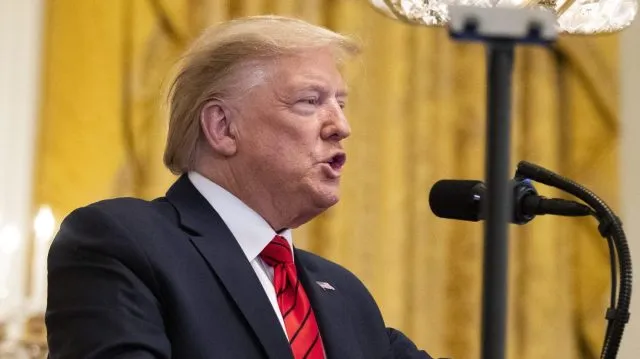
Governors will descend on Washington this weekend for the National Governors Association's (NGA) winter meeting, a typically bipartisan gathering that has been overshadowed this year by President Trump's escalating attacks on two Democratic governors.
After initially inviting only Republican governors to meet at the White House on Friday, Trump later extended invitations to Democratic governors. But he has singled out Colorado Gov. Jared Polis and Maryland Gov. Wes Moore, excluding only those two Democrats from a black-tie White House dinner on Saturday.
Democrats are split in their responses, with some governors planning to use the NGA weekend to advocate for their states and others dismissing the run-up as political "drama" and opting out altogether.
"Individual governors need to make decisions about whether the meeting with the president is going to be productive," Jared Leopold, former communications director at the Democratic Governors Association (DGA), told The Hill. But he called Trump's decision to exclude governors "a massive departure from precedent."
Kentucky Gov. Andy Beshear (D), the chair of the DGA, led a group of 18 Democratic governors in warning they would skip any White House event this weekend -- including Saturday's dinner -- if not all governors were invited.
Even after Democrats received invitations, Beshear and others objected that Moore, the NGA vice chair, and Polis, the previous NGA chair, remained barred from the Saturday dinner.
"It's just a lot of drama. And it's unnecessary," Beshear said in an interview Sunday on CNN's "State of the Union," adding that the weekend "no longer looks like it's going to be productive at all," and, "At this point, I'm not going."
Polis said he will attend the conference, which runs Thursday through Saturday, but did not say whether he will attend the White House meeting on Friday. In a statement to The Hill, Polis called the NGA "an important resource" and said he looks forward to working with Democratic and Republican governors.
California Gov. Gavin Newsom (D) said last week he won't attend the conference, even after the White House "obviously flip-flopped" on whether to invite Democrats.
Moore, meanwhile, said he is prepared to work with the Trump administration but would not attend the meeting if the president's rhetoric persisted.
"If the point of the meeting ... is to turn it into name-calling," Moore said in a CBS News interview last week, nodding to Trump's social media post, "then my answer to the president is very clear: Nah, I'm good."
Some Democrats, including Connecticut Gov. Ned Lamont and Maine Gov. Janet Mills, said they plan to attend the White House meeting but not the dinner. Others, like Hawaii Gov. Josh Green and Washington Gov. Bob Ferguson, will skip the whole weekend, though Ferguson's office said he made the decision "quite some time ago."
The split in responses also offers an early window into the Democratic Party's emerging 2028 landscape, with some governors' choices about whether to show up -- and how publicly to engage with Trump -- likely to be seen as signals amid mounting presidential speculation.
The annual NGA winter conference typically includes policy sessions, side meetings among governors and a White House meeting.
Thad Kousser, a political science professor at the University of California, San Diego, said the conference rarely produces sweeping policy doctrines but can build relationships that matter when crises cross state lines.
"They strengthen the personal bonds, and they get each other connected on speed dial, so that the next time a hurricane comes that moves across state lines ... the governors, whether Democratic or Republican, will have a familiarity and a reservoir of good feeling," Kousser said.
Leopold similarly said the White House session is "the most high-profile event of NGA weekend," but added that "a lot of what gets done happens" in smaller meetings, either with other governors or with senior agency officials in Washington.
But many Republicans and Democrats question whether the weekend can stay insulated from national politics.
For Democrats, cross-party cooperation began unraveling last year when Trump targeted Maine's governor at the meeting over a disagreement on transgender athletes.
Republicans, meanwhile, say the break began under the Biden administration when they claim the White House repeatedly declined to engage with GOP governors on immigration and border concerns.
"Trump's just playing by the rules that have been set for some time now," Jesse Hunt, a former Republican Governors Association (RGA) communications director, told The Hill. "I think it's been very partisan. Go back and look, and there were multiple joint efforts from Republican governors to get the Biden administration to engage."
"This has been coming," he added.
Hunt also said the incentive structure has changed over the past few years, and -- especially ahead of the 2028 election cycle -- Democrats are no longer rewarded for trying to work with a Republican administration.
"What are they going to get out of it? I think that's something that has to be taken into consideration," Hunt said, noting if Democratic governors "have any ambition whatsoever, they're going to use every opportunity to attack the President that they have available to them."
"Trump's instinct on this is correct that most of these Democrat governors ... are looking to score political points while they're in there with him because no one animates Democrats like Donald Trump," Hunt said.
Leopold said the dynamic may elevate Democratic governors' national profiles regardless of presidential ambition.
"Democratic governors are rising in prominence and have been rising in prominence for the past decade, largely thanks to one man, the man in the White House," he said. "Trump has picked fights over the years with Gretchen Whitmer and JB Pritzker and Gavin Newsom, and I think the petty fights that he's picking with Moore and Polis over this are only going to elevate their stature nationally."
Against conflicting political pressures, Kousser said he's hopeful the NGA can be an example of bipartisan cooperation. He pointed to the warning last week from the Republican NGA chair, Oklahoma Gov. Kevin Stitt, that he would cancel the White House meeting if Democrats were not also invited. Two days later, Democrats got their invites.
"The fact that governors banded together last week, led by a Republican taking on the top leader of his party, at great political risk and potentially political cost, that I think, has got to bring some cross-party unity for governors that will help in a meeting like this and beyond," Kousser said.