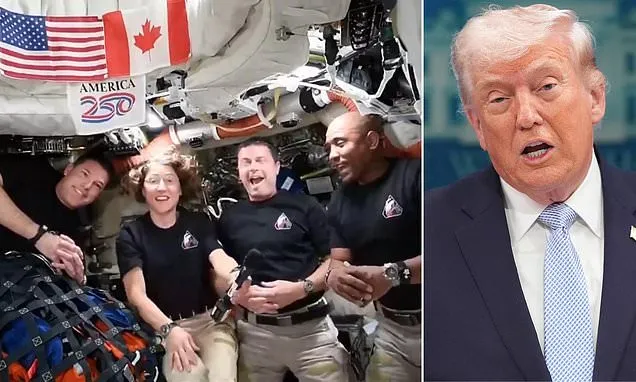
Donald Trump stunned Artemis II's Canadian astronaut Jeremy Hansen by sharing some praise from hockey legend Wayne Gretzky.
During a call with the president after the crew had completed their staggering lunar flyby, Trump called them 'modern-day pioneers'.
Hansen, the only Canadian in the crew, grabbed the microphone to answer one of Trump's questions about the mission and then took a moment to thank him 'on behalf of Canada'.
'The space leadership you spoke of, from America, is truly extraordinary. I've said this many times before. A nation that leads like that creates and sets big goals for humanity and brings other countries along with it is truly incredible.
'I know that's a very intentional, not necessary, decision to lead by example and to allow other countries, like Canada, to share our gifts and help you achieve these mutually beneficial goals, like establishing a presence on the moon and potentially going to Mars. Canadians are so proud to be a part of this program.'
Trump then stunned Hansen by revealing he had spoken to Gretzky and Canadian prime minister Mark Carney about Artemis II and shared some words of praise from 'The Great One'.
Trump replied: 'Well, I have to say, I spoke to a very special person, Wayne Gretzky, who I think you know - the Great One, and I spoke to your prime minister... they are so proud of you.'
There was a slight delay but when the crew heard Trump's response they immediately started smiling and Hansen was nodding his head in delight.
The crew, which also includes commander Reid Wiseman, pilot Victor Glover and mission specialist Christina Koch, have now started their journey home after creating history on their pass behind the Moon.
The four astronauts on the first manned Moon mission in more than 50 years reached 252,756 miles from Earth.
The record was achieved during a seven-hour lunar flyby which included a 40-minute communication blackout as they passed around the far side of the Moon from Earth.
In the blackout, the crew reached their closest point to the Moon at 4,067 miles.
Trump added that further lunar exploration would lead to 'the whole big trip to Mars'.
Before the flyby, Hansen said: 'It is blowing my mind what you can see with the naked eye from the Moon right now. It is just unbelievable'.
During the flyby, the crew used professional cameras to take detailed photos of the moon's surface, usually hidden from view, and enjoy the rare sight of their distant home planet.
Artemis II is using the same manoeuvre that Apollo 13 did after its famous 'Houston, we've had a problem' incident, when an oxygen tank explosion ended hope of a moon landing and became a fight for survival.
Using the Moon's gravity for a 'free' return journey, it will take the crew four days to get back, with a splashdown in the Pacific on Friday.
While the astronauts did not touch down on the Moon, the mission paves the way for a future lunar landing and also lays the foundation to send a crew to Mars.
The launch previously had to be postponed by two months because of hydrogen fuel leaks and clogged helium lines.
The last time Nasa sent astronauts to the Moon was as part of the Apollo 17 mission in 1972.
The agency is seeking to return a crew to the lunar surface by 2028, before China does in about 2030.