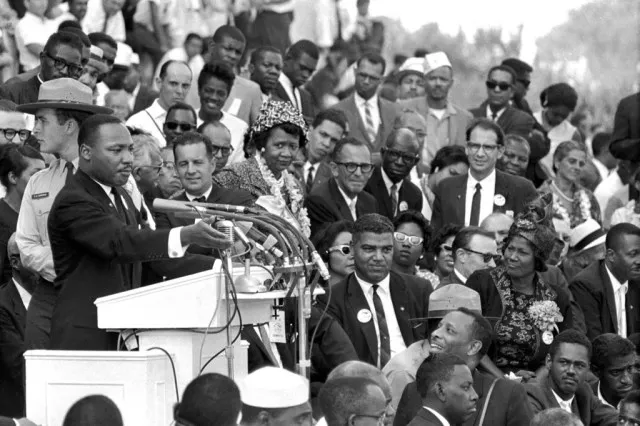
The Rev. Martin Luther King Jr. changed America for the better by helping our nation make progress toward achieving his dream of ending racism and ensuring equality for all. But as we honor King with a national holiday, President Trump is doing all he can to reverse the great civil rights leader's historic accomplishments.
Unfortunately, King's dream, which he eloquently expressed in his speech at the March on Washington for Jobs and Freedom in 1963, has yet to come true. Systemic racism has been diminished but still exists. Black Americans are suffering unjustly as a result.
For example, according to federal statistics, about 20 percent of Black households lived in poverty in 2024, compared with about 9 percent of white households. The median Black household annual income was about $56,000 in 2024, compared with about $88,000 for white households. The Black unemployment rate in November was 8.3 percent, compared with 3.9 percent for whites.
Yet instead of trying to narrow the gaps separating Black and white Americans, as King advocated, Trump is focused on eliminating supposed discrimination against white people -- especially white men.
Trump issued three executive orders at the start of his second term declaring diversity, equity and inclusion programs to be "illegal and immoral discrimination." This ended such programs in the federal government and successfully pressured many businesses, nonprofits and colleges to scale them back or end them.
DEI is essentially what King advocated, before the term came into widespread use. DEI doesn't discriminate against anyone, but rather opens the doors to the American Dream wider for Black people and others long locked out.
In addition, Trump's Justice Department has shamefully withdrawn from legal actions designed to enforce the Voting Rights Act of 1965, which removed discriminatory barriers that had kept millions of Black Americans in the South from voting. Enactment of the Voting Rights Act was one of King's major achievements.
King also campaigned for federal anti-poverty initiatives enacted as part of President Lyndon Johnson's Great Society program. But the Big Beautiful Bill Act passed by the Republican Congress in 2025 and signed into law by Trump cut more than $1 trillion in funding for anti-poverty and health care programs over 10 years. "Black communities will be among the hardest hit by these funding cuts," according to the NAACP Legal Defense Fund.
King wanted the ugly truth about slavery to be told and wanted our nation to help Black Americans overcome its long-lasting damage. By contrast, Trump has demanded changes at the Smithsonian Institution museums to paint a more positive -- and inaccurate -- portrait of America, including slavery.
Trump posted on social media in August: "The Smithsonian is OUT OF CONTROL, where everything discussed is how horrible our Country is, how bad Slavery was, and how unaccomplished the downtrodden have been -- Nothing about Success, nothing about Brightness, nothing about the Future."
In fact, Smithsonian museums are filled with exhibits showcasing American successes. For example, the National Museum of African American History and Culture chronicles the achievements of King and many other Black Americans, and tells the stories of people of all races who fought against racism. But yes, the museum contains exhibits about "how bad slavery was." There is nothing good to be said about the immoral practice that victimized millions of Black people, including my own ancestors. Slavery shouldn't be whitewashed or ignored.
Trump has long denied being a racist. In 2019 he absurdly called himself "the least racist person anywhere in the world" and in 2024 said he was "the best president for the Black population since Abraham Lincoln."
Yet Trump has admitted complaining that too many non-white immigrants are entering the U.S. from "shithole countries" and asked: "Why can't we have some people from Norway, Sweden ... from Denmark .... Send us some nice people." Nice, as in white.
The president recently called Black immigrants from Somalia "garbage" and halted the entry of nearly all refugees from around the world into the U.S., except for white South Africans, whom he falsely claimed were being "brutally killed" in a "genocide" in the Black-majority nation. King didn't call any human beings "garbage" and never expressed hostility toward refugees.
I was only five years old when King was tragically assassinated in 1968, but I had already attended civil rights marches and protests with my late parents, who I'm proud to say were activists in the movement. As an attorney, I've taken up the cause of racial justice and handled civil rights cases, following in the footsteps of my father, who worked on civil rights cases as a lawyer and served as president of the local NAACP chapter in Joliet, Ill., in the 1960s. We have played our small part in advancing King's life work.
Less than a week before he was assassinated, King said that "the arc of the moral universe is long, but it bends toward justice." I believe he was right and that the harm Trump has caused by repudiating King's great legacy will eventually be reversed. In the words of the famous civil rights anthem, "We shall overcome, someday" -- but only after Trump leaves office.
A. Scott Bolden is an attorney, NewsNation contributor, former chair of the Washington, D.C. Democratic Party and a former New York state prosecutor.