President Donald Trump has issued a new ultimatum in the Iran war, telling the press while aboard Air Force One, "we'll have to stop dropping bombs again" if a deal is not reached by the end of the ceasefire.
Trump has said that the U.S. and Iranian negotiators are likely to meet this weekend to finalize a deal to end the war, as the fragile two-week ceasefire nears its end.
Iran has now reopened the Strait of Hormuz, but uncertainty over the conflict continues to percolate, as while Trump has said he believes an agreement could come in the "next day or two," officials have cautioned that major gaps remain.
On February 28, the U.S. and Israel launched strikes on Iran in what has been dubbed Operation Epic Fury. Since the war began, thousands have been killed across the Middle East, mainly in Iran and Lebanon but also in Iraq and Israel. As of early April, the U.S.-based rights group HRANA said that 3,450 people had been killed in Iran since the war began.
The war has brought significant economic consequences and threatened instability across the globe, with the International Monetary Fund having said that the world will suffer an oil shortfall this year and warned the war could tip the world into a recession.
A temporary two-week ceasefire was announced on April 8 and came hours before a deadline imposed by the White House was set to expire, and followed days of escalating rhetoric from the president over potential military action. Trump said a "whole civilization will die tonight, never to be brought back again," unless Iranian officials consented to fully reopen the Strait of Hormuz.
While on Air Force One, a reporter asked Trump, "If you don't have a deal by Wednesday when the ceasefire ends, will you extend the ceasefire or will you start attacks?"
"I don't know," the president replied.
"Maybe I won't extend it," he said. "But the blockade is gonna remain. But maybe I won't extend it. So you have a blockade, and unfortunately, we'll have to start dropping bombs again."
Iran said on April 17 that it had fully reopened the Strait of Hormuz to commercial vessels. Trump said on Truth Social that "THE STRAIT OF HORMUZ IS COMPLETELY OPEN AND READY FOR BUSINESS AND FULL PASSAGE."
Trump, though, has said that the American blockade on Iranian ships and ports will remain, writing on Truth Social, "THE NAVAL BLOCKADE WILL REMAIN IN FULL FORCE AND EFFECT AS IT PERTAINS TO IRAN, ONLY, UNTIL SUCH TIME AS OUR TRANSACTION WITH IRAN IS 100% COMPLETE."
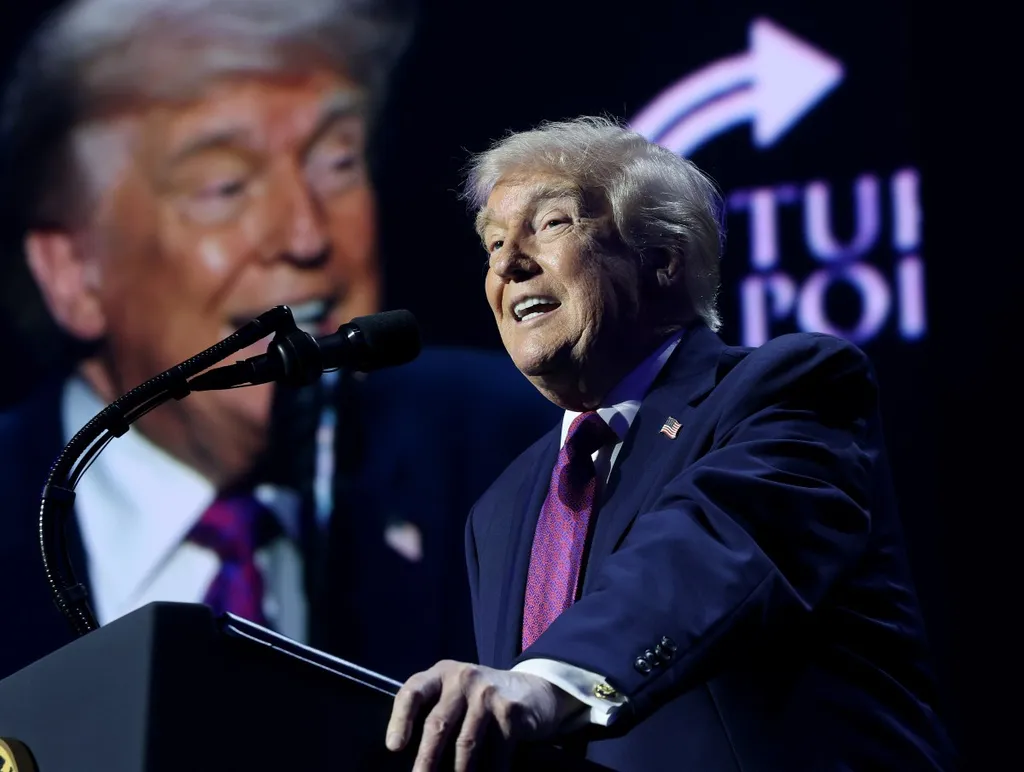
The president also addressed the ongoing Iran war and the reopening of the Strait while speaking at a Turning Point USA event in Phoenix, Arizona. "This will be a great and brilliant day for the world," he said.
"This process, we're getting along well," he said, adding that it "should go very quickly," and that most points had been "negotiated and agreed to."
The deal between the U.S. and Tehran will include a deal on Iran's nuclear program. On April 17, Trump said in an interview with CBS that Iran has agreed to "everything" and will work with the U.S. to remove its uranium. While speaking at the Turning Point USA event, he said that the U.S. will "get all the nuclear dust."
Trump has previously used the term "nuclear dust" to refer to Iran's stockpile of highly enriched uranium.
Precise details of a deal though, remain unclear ahead of negotiation talks, and the blockade has been described as a violation of the ceasefire by Iranian officials. Iran's parliamentary speaker, Mohammed Bagher Qalibaf, said on X early on April 18 that the Strait will "not remain open" if the blockade is to continue.
A spokesperson for Iran's foreign ministry later released a statement that said transferring uranium to the U.S. "has not been an option," and that "enriched uranium is as sacred to us as Iranian soil and will not be transferred anywhere under any circumstances," per CBS.
Trump also said on Friday that one way or another, the U.S. would obtain Iran's stockpile of uranium, and said that this would come in a "much more unfriendly form," if negotiations were to fail," per CNN.