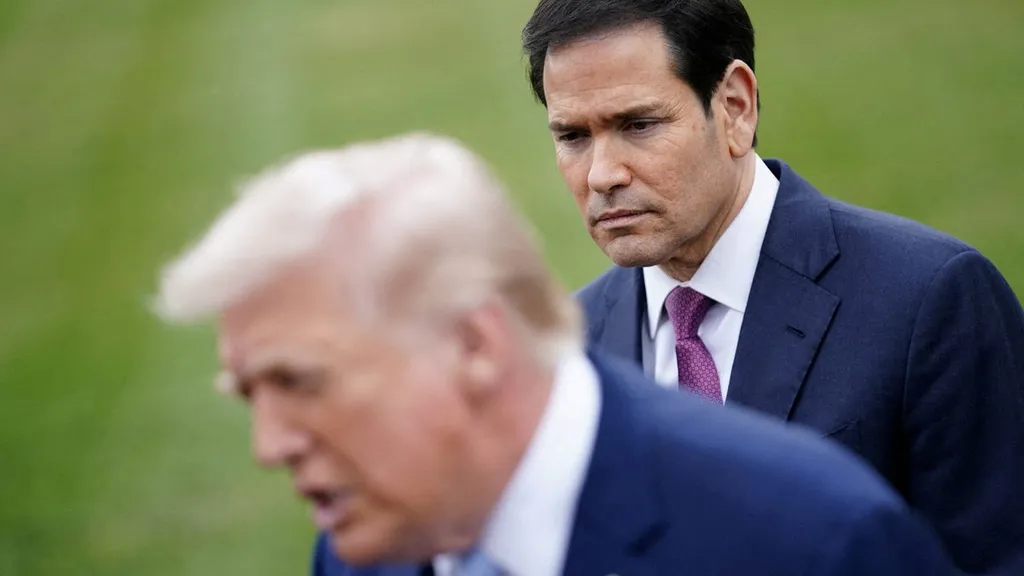
President Donald Trump told The Telegraph that he is strongly considering pulling out of NATO.
President Donald Trump's "little excursion" into war with Iran has morphed into a more than a month-long slog, despite his nonstop assertions that his ill-defined mission has been accomplished and that the hostilities will wrap up soon.
And there are two easy predictions to make when Trump is in a bind: He will never accept responsibility for the consequences of his actions, and he'll always blame a familiar nemesis instead.
That's why Trump wants you to focus your fury about the rising cost of gasoline on the North Atlantic Treaty Organization, the 32-nation pact known as NATO that he has spent a solid decade trashing as obsolete.
In an interview published April 1, Trump told British newspaper The Telegraph that NATO is a "paper tiger" and that he's considering withdrawing America from the alliance. That's because our allies, whom Trump didn't consult before bombing Iran, aren't eager to help him reopen the Strait of Hormuz for oil shipments.
This should make for an awkward scene when NATO Secretary General Mark Rutte visits Washington, DC, on April 8 to meet with Trump, Secretary of State Marco Rubio and Secretary of Defense Pete Hegseth.
Before that meeting, Trump should really check in with Rubio about walking away from NATO.
And the president might also want to talk to his Republican allies in the U.S. Senate. Because as much as talk of dropping out of NATO might thrill Trump's old pal, Russian President Vladimir Putin, there's a serious question of whether he can simply make that call.
Who needs 'the most successful military alliance in history' anyway?
Rubio, as a Republican senator from Florida, had a documented history of showing strong support for NATO. He successfully pushed in 2022 for passage of a bipartisan joint resolution that he said in a news release would "explicitly prohibit any President of the United States from withdrawing" from NATO "without the Senate's advice and consent."
That became law in 2023, requiring any president to get support from two-thirds of the Senate's members or an act of Congress to quit NATO.
The Senate did not sound eager this past week to leave NATO, founded in 1949 to keep in check the post-World War II expansion ambitions of what was then the Soviet Union and now Russia.
U.S. Sen. Chris Coons, a Delaware Democrat, and U.S. Sen. Mitch McConnell, a Kentucky Republican, used their posts as ranking members of the Senate Appropriations Subcommittee on Defense to stand by NATO in response to Trump's threat, calling it "the most successful military alliance in history."
They noted that NATO's Article 5, which says an attack on any member "shall be considered an attack against them all," has only been invoked once, after the terrorist attacks on Sept. 11, 2001, on America.
"Alliance disputes are as old as the alliance itself," Coons and McConnell wrote in a joint statement issued April 1. "Americans are safer when NATO is strong and united."
U.S. Sen. Thom Tillis, a North Carolina Republican who cochairs the Senate NATO Observer Group, and U.S. Sen. Jeanne Shaheen of New Hampshire, the ranking Democrat on the Senate Foreign Relations Committee, issued their own joint statement in support of NATO on April 2.
"Let us be clear, Congress will not allow the United States to withdraw from NATO," they wrote, citing Rubio's 2023 law, which they noted "clearly states that only Congress can authorize the President to withdraw the U.S. from NATO. That will not happen."
NATO isn't to blame for Trump's warmongering
Trump also ranted and raved during his first term about abandoning NATO. The Department of Justice's Office of Legal Counsel in 2020 published an opinion that said a president has "exclusive power over treaty withdrawal and that Congress is constitutionally prohibited from intruding on this power," according to a report published this Feb. 27 by the Congressional Research Service.
That report noted the Congress and the courts are not bound to consider that opinion as "authoritative," and that there is no "directly controlling judicial precedent" for this kind of fight.
Right-wing publications were cheering on Trump's threat to NATO this past week. And Russia's government has sounded thrilled that a war with their ally, Iran, was driving a wedge between America and NATO.
Iran shutting down the Strait of Hormuz to cause economic pressure in response to U.S.-Israeli bombs was completely predictable. And Trump, because he needs to keep claiming victory in a war he has not won, can't help but contradict his own arguments here about who is to blame.
In his national address on April 1, Trump tried to sell the Strait of Hormuz as a problem for other countries but not America. He urged our allies to "take care of that passage" and to "grab it and cherish it."
But in the next breath, Trump tried to assure Americans that his war in Iran is coming to a close, and that "when this conflict is over, the strait will open naturally."
So he's demanding that NATO fix a problem, but also that it's about to fix itself? Even by Trump's standards, this is absurd.
About 20% of the world's oil transits the Strait of Hormuz and about 80% of it goes to Asian countries. That's a fifth of a product priced in a global market. It doesn't matter where it comes from or where it goes. If it stops flowing, the price of oil goes up everywhere for everyone.
That's the problem Trump created. He didn't have a plan for it. And now he has no solutions. NATO is not to blame for any of that. Trump owns the consequences, no matter what he says.