Hello and welcome to Bloomberg's weekly design digest. I'm Kriston Capps, staff writer and editor for Bloomberg CityLab and your guide to the world of architecture and the people who build things.
This week a federal court ordered a temporary stop to construction on the White House ballroom, while the president posted a video with the design for a presidential library skyscraper.
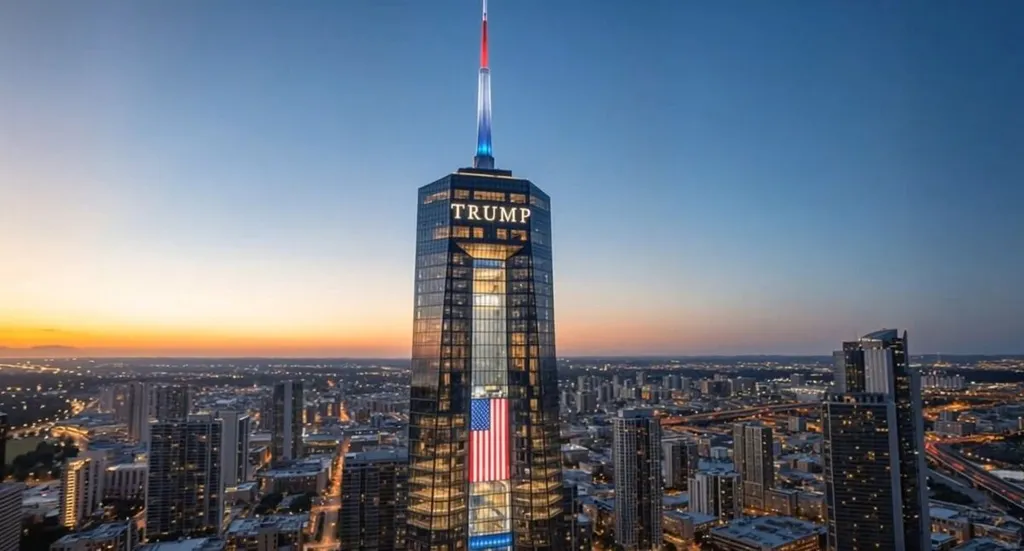
On Monday, President Donald Trump posted a video on Truth Social showing his future presidential library in Miami, a waterfront skyscraper on Biscayne Bay more in keeping with a Trump hotel than any historical archive.
The president later elaborated that his library would most likely include a hotel, and also that he didn't much care for building libraries or museums, raising the question of what exactly Trump's presidential library will be.
With a gold statue of Trump in its auditorium and Air Force One parked in its lobby, the Donald J. Trump Presidential Library -- shown as taller than any other building on the Miami skyline -- doesn't fit the mold of a presidential library.
But that mold was broken by Gerald Ford: Arguably it was America's 38th president, Mr. Nice Guy, who set off a library arms race in 1981 by opening two presidential centers -- a Gerald Ford library in Ann Arbor and a Gerald Ford museum in Grand Rapids.
Trump is taking things a lot further, although aspects of his library look familiar. The video he shared shows a tower whose crown bears an unmistakeable resemblance to that of One World Trade Center, aka Freedom Tower, designed by David Childs of SOM. The design's podium is another matter, with a jumble of architectural elements that include an entrance topped with a gold awning, a Richard Rogers-esque portal framing a series of escalators and still another gold statue of Trump. Inside there appears to be a replica of the White House ballroom, perhaps guaranteeing that the design will be completed somewhere.
Parts of the design strain credulity (to put it mildly). The lobby could be the size of the National Air and Space Museum, with an empty, open atrium filled with various aircraft from Trump's time in office. Such an enormous facility -- literally the size of an aircraft hangar -- could hardly serve as the base of a skyscraper. At the very least, any of the structural or mechanical columns you'd expect to find are missing in this video.
The video is the work of Bermello Ajamil & Partners, an architecture firm with a broad range of residential, commercial and retail projects in southern Florida, and it appears to have been generated using AI. The firm has other business before the Trump administration: Bermello Ajamil partnered with Zaha Hadid Architects for a proposal to build a Trump terminal at Dulles International Airport in response to a solicitation from the Department of Transportation. (The firm did not return a request for comment.)
In his remarks about his library tower this week, Trump blasted the presidential library center for Barack Obama, which opens later this year in Chicago. That project, designed by Tod Williams and Billie Tsien Architects and deemed ugly by Trump (and criticized by others as well)), also flies in the face of a sober Greek Revival-style library made with red brick and white columns.
In truth, few of the 16 presidential libraries follow in the mold of college campus architecture. Edward Neild, a traditional architect who designed the Harry S. Truman Presidential Library, delivered a restrained, almost minimalist interpretation of neoclassicism, giving Truman a building that he hated. Ronald Reagan’s Spanish Mission-style library fits the California coast, while a modern hangar bay addition to house Air Force One suits his administration. IM Pei’s library for John F. Kennedy could double as a contemporary art museum. Gordon Bunshaft’s Lyndon B. Johnson Presidential Library in Austin is top-tier Texas Brutalism.
Around the same time that Ford was splitting up the programming of presidential centers into two facilities, negotiations over two other presidential libraries were strained. In the early 1980s, Reagan struck an agreement for his library to be hosted by the Hoover Institution, a conservative think tank within Stanford University, which irked Stanford faculty; at the same time Duke University professors rebelled against a motion to host Richard Nixon’s presidential library. Today’s presidential libraries are no longer subordinate to the universities that host them. The University of Chicago will support the Barack Obama Presidential Center, but the Obama Foundation is building its 19-acre campus within Jackson Park.
It’s hardly fair to point the finger at poor Gerald Ford for Clinton’s high-tech cantilever, the huge footprint of the Obamalisk or Trump’s library-scraper (or to give Ford credit if you’re so inclined). But all these projects point to a more expansive vision of the presidential library and museum center that started with Ford. Today’s presidential centers are closer to cultural anchors than historical archives—and Trump’s future facility may not be a library at all.
Design stories we're writing
The National Capital Planning Commission, the agency with final authority over federal design and construction projects in the nation's capital, voted to give final approval to the White House ballroom on Thursday. The vote came despite a federal court ordering an injunction to temporarily stop construction on the ballroom, and even after Trump indicated earlier in the week that he is still tinkering with the building's design. I wrote about how Washington's normally laborious federal design review process turned into a rubber stamp for the ballroom -- notwithstanding tens of thousands of complaints from the public over the ballroom. (Key quote: "We are not some sort of free-ranging ballroom justice commission," NCPC chair Will Scharf said.)
In 1755, a powerful earthquake devastated Lisbon, leaving city planners with an enormous area of the city to rebuild essentially from scratch. That year marked a turning point in urban planning, according to Harvard scholar Bruno Carvalho: Marquis de Pombal designed the central Baixa district as a street grid organized around a central square, an Enlightenment scheme that broke from centuries of planning based on divine order. Linda Poon talked to Carvalho about his new book The Invention of the Future: The History of Cities in the Modern World, which considers key moments in the development of the city as a modern concept.
Design stories we're reading
- James S. Russell zeroes in on the proposed White House visitor screening facility, a bunker-like change to the historic campus, this one designed by AECOM. (Architecture and the City)
- Christopher Hawthorne counts all the different tells that show that the video of Trump's presidential library is AI slop. (Punch List)
- Mark Lamster writes about the 13-ton bronze by Henry Moore, maybe the most important public artwork in Dallas, and how the city has failed to mention it in discussions about razing its City Hall. (The Dallas Morning News)
- It's time to rethink open design calls, Diana Budds writes: "Across architectural practice, many are calling for terms that support vigorous competition, ethical labor practices, and, of course, exceptional and innovative architecture." (The Architect's Newspaper)
- God loves a tiny project with big material ambitions, like this copper-clad garden suite in Toronto designed by Fabrication Studio. (Azure)
- SO-IL describes its design for the Cleveland Public Library's Martin Luther King Jr. Branch, the firm's first library project, as "the opposite of shush." (Architectural Record)
- Wood, light, texture and plants are the key ingredients in Pelletier de Fontenay's design for downtown Montreal's Sanaaq Centre, which Alex Bozikovic describes as "the most beautiful and comfortable public building to open in Canada." (The Globe and Mail)