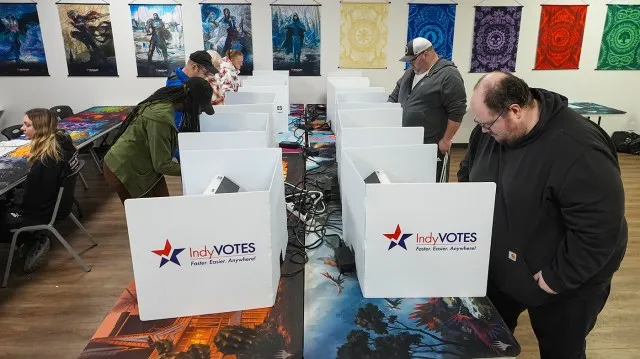
A slate of primary elections for the state Legislature in Indiana on Tuesday offer a key test of President Trump's influence as he seeks to oust the Republican state senators who resisted his redistricting push.
Trump has endorsed primary challengers against seven Republicans in Indiana's upper chamber who voted against a new GOP-favored congressional map in the state last year, despite pressure from national Republicans for the Hoosier State to take part in the redistricting war brewing across the country.
With millions spent by pro-redistricting groups to help topple those state lawmakers, the primaries will test the weight of Trump's endorsement and Indiana voters' appetite for redrawing district lines while setting the stage for key congressional primaries in Indiana amid a high-stakes fight for the House.
"A lot of these senators took a very pointed stand against what the president wanted to have in redistricting. This is on the heels of VRA, Virginia -- so it's even more in tune," said Scott Tranter, Decision Desk HQ's director of data science, noting the Supreme Court's recent Voting Rights Act decision and Democrats' successful redistricting referendum in the Old Dominion.
"It's a test," he added.
After a GOP-friendly map in Texas kickstarted national conversations about mid-decade redistricting ahead of the midterms last year, Missouri, North Carolina and Ohio joined in -- and Trump put public pressure on Indiana Republicans to move forward with a district redraw, aiming to help Republicans minimize their losses in a challenging election cycle.
The Trump-backed map would have redrawn Indiana's two Democratic-held U.S. House districts in favor of the GOP, potentially boosting Republicans to a 9-0 monopoly in the lower chamber delegation. And as tensions over redistricting grew across the country, Trump threatened to primary state lawmakers who opposed the map.
"Anybody that votes against Redistricting, and the SUCCESS of the Republican Party in D.C., will be, I am sure, met with a MAGA Primary in the Spring," Trump wrote in a lengthy Truth Social post back in December. He bashed Indiana Senate President Pro Tempore Rodric Bray (R) as the "only person in the United States who is against Republicans picking up extra seats, in Indiana's case, two of them."
The Indiana House passed the map, but the Indiana Senate ultimately voted against it, with 21 of 40 Republicans joining 10 Democrats to kill the plan.
Trump said the Republicans involved "should be ashamed of themselves" and that "every one of these people should be 'primaried,' and I will be there to help!"
Heading into Tuesday's primaries, Trump has endorsed primary challengers against seven of the state Senate incumbents who bucked his wishes. Only one anti-redistricting state senator trying for renomination avoided a Trump-backed challenger.
The president's high-profile involvement has supercharged what would normally be sleepier downballot contests for the state Senate.
"I wouldn't be surprised if you know, several of [the incumbents] go down. I would not be surprised if several of those who the president opposes win pretty handily," Tranter said.
Pro-redistricting groups alone have spent more than $6 million on ads against the seven vulnerable state lawmakers, according to AdImpact data analyzed by NBC News. Indiana Gov. Mike Braun (R) is supporting Trump's primary efforts, and national groups like Turning Point and Club for Growth have also jumped in.
Paula Copenhaver was among the Trump-backed challengers who snagged a photo op at the White House earlier this year. She criticized incumbent state Sen. Spencer Deery and fellow Indiana Republicans back in January for having "rolled over without a fight while Democrats added seats" through redistricting in other states, arguing that "we need a conservative fighter who puts Indiana and our Republic first."
But with virtually no polling on the contests at hand, it's unclear just how much of a chance the challengers have. DDHQ notes that incumbents have significantly outraised their rivals despite outside support -- and some observers note that the issue of redistricting, while a recruiting tool for candidates, hasn't been a major topic for voters on the campaign trail.
"Challengers who are successful absolutely 100 percent have Donald Trump to thank, and that is not because they are unqualified or unworthy of running for office, but most of them are unknowns," said Pete Seat, a former White House spokesman and Indiana GOP strategist.
"And so a Trump endorsement, a flood of money, grassroots support flying in from East Coast elsewhere around country would certainly be what catapults them victory if they are to win," he added.
At the same time, Seat was skeptical that a vote to oust one of the targeted incumbents could be interpreted as a total rebuke of the president.
Trump won the red stronghold by nearly 20 points in 2024 after former President Obama's 2008 campaign marked only Democrat to win presidential race state decades. And Trump's approval rating around 49 percent Indiana compared 37 percent recent national polling.
If challengers defeated, Seat said, "'it's Hoosier voters, Hoosier Republican primary voters saying: 'With all due respect, Mr. President, we know these senators. We asked these senators to vote against redistricting. These senators did what their constituents asked them to do, and we want them to go back for another term.'"
Bray who's not up for reelection but could lose his leadership seat, told CNN on Monday that he has "no regrets" about his opposition to the congressional lines.
"The bottom line is, we decided that as a caucus ... that it wasn't the right thing, it wasn't the right way for Indiana to move forward," Bray said of redistricting. "Indiana's gonna do things the way Indiana needs to do them. We're not gonna base that decision on other states."
Still, some argue Indiana could soon reconsider redistricting amid the spotlight on the Hoosier State.
U.S. Rep. Marlin Stutzman (R-Ind.) told Newsmax on Monday that he thinks state lawmakers will "definitely reconsider it."
"A lot of these state senators that voted against redistricting and voted against the Republican Party to give ourselves a chance to maintain the majority in the House are having very tough races," Stutzman said.
The Tuesday races also come as the redistricting war rages on across the country.
Just last month, voters in Virginia approved a new, Democratic-friendly congressional map that could give Democrats the edge in four more House seats -- but Florida Republicans this week effectively offset those gains with a GOP-friendly map of their own.
The Supreme Court shook up the redistricting fight last week with a landmark ruling that weakens a central provision of the Voting Rights Act, which could ultimately greenlight more map changes. It remains to be seen, though, whether any additional states can take action in time for the midterms, with primaries already underway in several states.
Voters in Indiana are also set to weigh in on May 5 primaries for the state's current congressional seats. Over in Ohio, voters are headed to the polls on Tuesday to weigh in on House races as well as the toss-up contests for the Senate and the governor's mansion in the Buckeye State.