Saikou Jammeh and Ruth Maclean reported from Dakar, Senegal. Dickson Adama reported from Jos, Nigeria, and Ismail Auwal from Kano, Nigeria.
On a January evening in Woro, a village in Nigeria, a man approached Umar Bio Salihu, the village chief, and handed him a crudely torn piece of paper from an exercise book.
The man had been kidnapped by jihadists and sent to deliver the handwritten letter to Mr. Salihu. The letter was signed by the Nigerian terrorist group Boko Haram. In it, the jihadists demanded a "secret meeting" with Mr. Salihu and the right to preach in his mostly Muslim village.
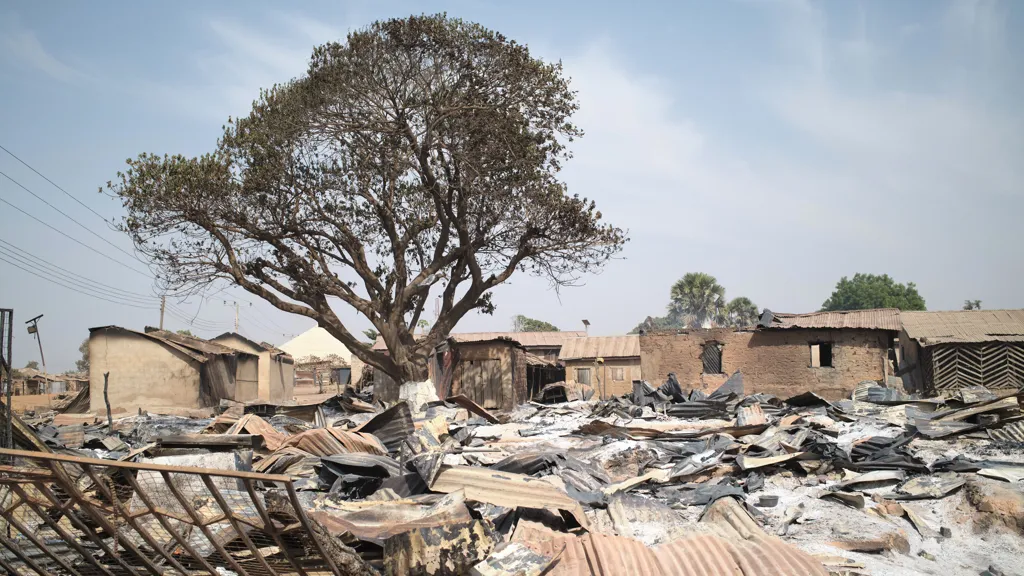
Mr. Salihu said he immediately informed Nigeria's equivalent of the F.B.I. But three weeks later, attackers brutally assaulted Woro and a neighboring village. They massacred as many as 200 people over about 10 hours. Nigerian security forces arrived only after the attackers had left, Mr. Salihu and other survivors said.
Nigeria has one of the continent's most feared and heavily funded militaries, known for peacekeeping and helping prevent coups in West Africa. Yet at home, experts say the military has repeatedly failed to stop the fatal attacks that happen almost daily in rural areas, leading to accusations of corruption and indifference.
Analysts cite myriad reasons for these failures, including embezzlement of the security budget and a force stretched too thin across Nigeria, Africa's most populous nation.
A few weeks ago, the governor of Zamfara State, one of the country's epicenters of violence, offered another explanation: "It is not their priority," Dauda Lawal told local journalists.
Now, hundreds of American troops are being sent to Nigeria to help identify potential terrorist targets for strikes, driven by President Trump's claims that the escalating violence amounts to a Christian genocide, though both Christians and Muslims are victims of the attacks.
Human rights groups and analysts say evidence from many attacks suggests Nigerian authorities had the intelligence to identify them in advance. But often, the authorities did not act, they said.
Responding to questions about the military's delayed responses, Maj. Gen. Samaila Uba, a military spokesman, said that, "troops are deployed across vast and often challenging terrains, sometimes with limited access routes." He said that when the military learned of threats in Woro, troops were dispatched to the area to patrol for two weeks.
When Mr. Salihu got the letter signed by Boko Haram in January, he said it followed months of terror in neighboring Muslim communities, with gunmen abducting and killing villagers and jihadists giving sermons in which they railed against Nigeria's Constitution and authorities.
He brought the letter to a representative of Nigeria's Department of State Services. Soon, military personnel began appearing in the neighborhood, but the patrols came only on Fridays.
Then, on Tuesday, Feb. 3, more than 100 militants stormed Woro on motorcycles, residents said. They rounded up young men and executed them. They burned down shops and houses. The slaughter began at 5 p.m. and lasted until around 3 a.m., survivors said.
"We put a call through to the military," said Mr. Salihu. But by the time the military came, the attackers had already fled, he said.
When it was over, he found his house had been attacked. Two of his sons, Khalid, 26, and Zachariya, 14, were dead. His second wife and three other sons had been taken hostage.
Gunmen attacked an army post in the village last November as well. But instead of sending more reinforcements, as residents had requested, the military removed the post completely, Mr. Salihu said.
"We even went to their superior officers," he added. "They said they were going to deploy other people."
It didn't happen, he said.
General Uba, the military spokesman, did not explain why the patrols in Woro were removed.
The attacks in Woro are an example of a grim pattern in which the Nigerian military has failed to stop violence, analysts and researchers said. And the militants who carry out the massacres and the military commanders under whose leadership they occur are rarely brought to justice, they say.
"Always, they fail. Always, they do the wrong things," said Isa Sanusi, the executive director of Amnesty International's Nigeria office.
While rural areas are often left defenseless because of an overstretched military, security analysts say that around 100,000 police officers in Nigeria are assigned to guard V.I.P.s, including politicians, businessmen and celebrities, a practice successive governments have pledged to abolish.
And sometimes, the military is fighting against its own guns. Late last year, Nuhu Ribadu, Nigeria's top security official, publicly admitted that corrupt police officers and soldiers had sold firearms to "bad people."
President Bola Tinubu of Nigeria took office in 2023 after promising to tackle the rampant insecurity that now blights the lives of millions of Nigerians. But residents say little progress has been made.
Local leaders in the central village of Yelwata, which is mostly Christian, described how, in the months before a June massacre, gunmen flooded into the area. Long before the deadly attack took place, residents repeatedly tried to sound the alarm, correspondence and court filings reviewed by The New York Times show.
In December 2024, six months before 200 residents of Yelwata were killed, the leader of a farmers' association, Gbongbon Dennies, sent a letter to the head of Nigeria's paramilitary agency.
He explicitly warned of a mass influx of "dangerous, notorious and deadly bandits." He listed the names of the people he said were directing the attacks, and pleaded for "urgent intervention."
The warnings reached the highest command, with two powerful state governors acknowledging that they had been alerted to the threat. Nothing was done to prevent the attack, Mr. Dennies said.
When gunshots rang out in Yelwata at 10 p.m. on June 14, Ukeyima David, 35, a local farmer, scrambled to gather his wife and three sons. They ran to a row of grocery stores where dozens of other terrified villagers were hiding. Soon, bullets began hitting the walls and roofs.
Then they heard an attacker instruct others to save bullets and torch the building, he said. They poured fuel onto the roof and set it on fire. They hacked and shot anyone who tried to flee, Mr. David said.
Mr. David was wounded, but managed to escape the burning building. Desperate, he ran to the local police station for help with his family trapped in the store, he said.
“They told me to find a place to hide because they had exhausted their bullets,” Mr. David said. “I cried and pleaded with them to save my family, but they told me to be patient.”
Yelwata has police and military outposts. The state capital, Makurdi, is less than an hour’s drive away. Yet the attackers massacred villagers for more than four hours, residents said, and left before backup arrived.
Mr.David found his wife, Judith, 27, lifeless, riddled with bullets. His two older sons, Samson, 7, and Michael, 6, had been hacked to death, he said. The charred remains of his youngest, Kingsley, 18 months old, were found in the ashes of the shop.
Yelwata, which is in Nigeria's Middle Belt region, became a touchstone for those pushing Mr. Trump to intervene in Nigeria on behalf of the nation's Christians.
"Impunity is baked into the political system in Nigeria," said James Barnett, a research fellow at the Hudson Institute specializing in African security and politics.
Nnamdi Obasi,a senior adviser at the International Crisis Group,p pointed to "a lack of political will,the lack of urgency about bringing these issues to an end."
No senior commanders in Nigeria have been held accountable for the attacks in Woro or Yelwata.