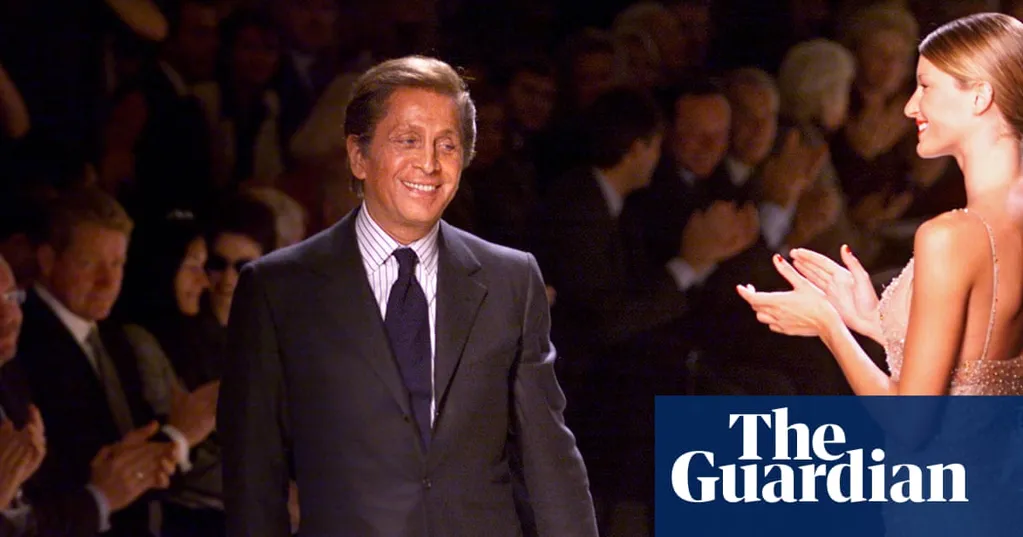
After Valentino Garavani retired in 2008 from a fashion world in which the meaning of luxury had changed, his half-century of couture creation was marked with exhibitions.
The one at Somerset House in London in 2012, Valentino: Master of Couture, displayed more than a hundred of his outfits within close peering range, each with a card bearing the name of the woman - royal, diva, star, social leader - for whom it had been created.
In another room were samplers of the superlative techniques of Valentino's ragazze, the ''girls'' in white coats in his couture ateliers who had sewn those gowns. The definitive Valentino dress was patchworked of handmade lace, so light it could have been posted in an A3 envelope.
Valentino, who has died aged 93, was a specialist in a high level of luxury without undue grandeur, dressing the world's most photographed women from the Dolce Vita period of Italian cinema in the 1960s to J-Lo at the Oscars in the 2000s. He never led, or wanted to lead, fashion in cut, line or mood, and, although he was proud to be the first Italian couturier fully, if reluctantly, accepted by Paris as one of their own by training and aspiration, he kept a direct connection with a more personal Italian tradition of skilled dressmakers: the needs of the wearer always came first.
Glamour was his metier - he had been enchanted into the business as a boy by the glittering, shimmering, robes of the showgirls processing down endless stairs in the 1941 Hollywood musical Ziegfeld Girl. Long before red carpets at film premieres and the steps of the New York Metropolitan Museum on gala night became major fashion venues, Valentino designed gowns that would have been show-stoppers on them.
He was far ahead of Paris when the actual red carpet business took off in the late 80s.
Valentino was born in Voghera, Lombardy. From his babyhood onwards, his parents, Mauro and Teresa (she named him after the silent film sensation Rudolph Valentino) indulged the boy's tastes, and later his aunt Rosa and another local dressmaker allowed him into their workrooms. From 1949, his parents funded his education at the Ecole des Beaux-Arts in Paris, and supported him through five years of apprenticeship in the house of the couturier Jean Dessès; then he did two more years with Guy Laroche.
Valentino's father and a fellow businessman backed his first couture studio, on the Via Condotti in Rome in 1959, and Valentino, determined to equal Parisian couture, spent without limit on fabrics, furs and French mannequins. It might have ended in bankruptcy, but in a cafe, one hot night in July 1960, he met the 19-year-old architecture student Giancarlo Giammetti. Giammetti, who had a natural aptitude for business, gave up his studies and joined Valentino to refound the company in a small apartment on the Via Gregoriana. Gradually, they took over the rest of the palazzo.
Their business was in the right place at the right time. Italian craftwork was relatively cheap compared with France for the making of fashion and California for the shooting of movies. Valentino made a dress for Elizabeth Taylor visiting the then Rome studios Cinecittà for a premiere and in 1962 Giammetti persuaded Valentino to show at the Italian collections in the Pitti Palace in Florence which attracted American department store buyers unwilling to pay ever higher Paris premiums for the rights to reproduce catwalk designs.
Valentino began to sell directly in New York in 1964; his most valued customer was widowed Jacqueline Kennedy who later commissioned him to make her delicate lace dress for her wedding to Aristotle Onassis. As John Fairchild of Women's Wear Daily said: "Valentino just wanted to dress very important beautiful women."
Jackie O was his perfect customer: moneyed yet devoid of vulgarity—as were most of his private clients. Through the 60s and into the 70s he was court dressmaker to beautiful people including empress Iran Farah Pahlavi Vogue editor Diana Vreeland; dressed them all featherweight majesty though Yves Saint Laurent’s business partner Pierre Bergé once sneered at him for dressing ''whores kept women''.
As Paris couture turned theatrical from mid-70s Valentino remained safest salon wealthy women Giammetti ensured he Valentino could live similar level clients through up 42 lucrative licensing deals. Their style high—parties travel retinue five fully-staffed antiques-stuffed homes around world; yacht jet Italy’s most turbulent years bullet-proof Ferrari Valentino’s signature shade red. "You feel cosy around them," Joan Juliet Buck former editor French Vogue said pair "wondering when they’ll bring out next quail egg."
All this was more extravagant than Parisian couturier manner. Even Hubert de Givenchy never assembled an art collection to compare with that of Valentino, who hung his beloved Bronzino portrait of Eleanora of Toledo behind his desk. In 1990, he opened an art gallery—the Accademia Valentino—in Rome, where he was, teased Giammetti, "a state power".
The history of the fashion house is best traced garment by garment, who wore it and when. His dressmaker's good manners in physically flattering his clients brought movie-star and later pop-star custom, including Taylor, Sophia Loren, Audrey Hepburn, and Cate Blanchett, who had not a measurement or a gesture in common - "you need to know the body," Valentino warned, "you need to know the mood of the lady, and you need a very good seamstress".
The couture ateliers lost a few million annually out of a billion-dollar turnover, but were an investment in prestige, research and development. In Valentino: The Last Emperor, Matt Tyrnauer's 2008 documentary film, the links between Valentino, his clients and the workhands who clad them are visibly close: many customers and seamstresses were with him all their adult lives, and his few key upper-level personnel stayed for decades too. The film was an unexpected pop phenomenon and made Valentino's retirement feel even more like the end of an era.
Giammetti had persuaded Valentino to go directly into high-end ready-to-wear, menswear and accessories, and in the 90s terminated all licences except for perfume, jeans and sunglasses. In 1998, when couture houses were being transformed into brand trophies, he and Valentino were paid $300m for the company by the Italian conglomerate HdP.
It was sold on in 2002 to the textile firm Marzotto Apparel: a private equity group bought it in 2007 and sold it to a Qatari consortium in 2012. Valentino showed his final collection in 2008 but in retirement still designed for a few favoured clients and the ballet. Otherwise, he sustained his perpetual deep tan between the yacht and the gardens of his houses with his tribe of pug dogs and important guests.
The end of his emotional relationship with Giammetti after 12 years never impaired their business partnership and friendship. From 1982 onwards Valentino lived with Bruce Hoeksema who was vice-president of the company until its sale. His sister Wanda who also worked in business died in 1997.
Of all his Italian American British and French awards he was most pleased at becoming chevalier Légion d'honneur 2006 with Médaille de la Ville de Paris 2008. He remembered when French did not believe there could ever serious Italian couture.