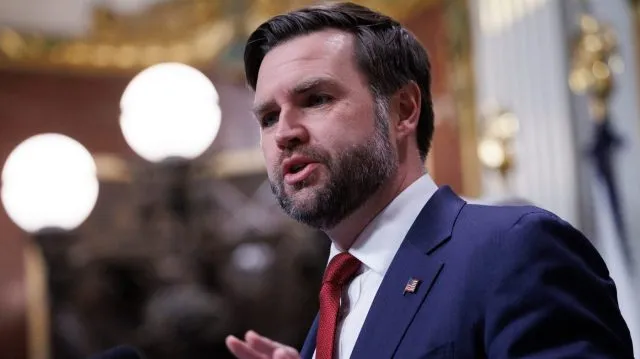
Vice President Vance began his new role leading the Trump administration's war on fraud with a bang this week by announcing a nearly $260 million moratorium on Medicaid funding for Minnesota.
Strategists on both sides of the political spectrum say the campaign carries risks for the administration as it seeks to move on from the deadly immigration campaign in the state earlier this year.
Maddie Twomey, communications director for the Democratic-aligned health advocacy group Protect Our Care, said attacking health care is rarely a politically sound move.
"Trump's own pollsters have said this again and again, and yet they continue to chip away at vital programs like Medicaid and in a midterm election year," Twomey said. "It's kind of shocking that this would be something that they're trying to continue to attack when people are so clear that they are concerned about health care."
President Trump and other Republicans have repeatedly said that they are focused on bringing down the costs of health care for Americans, even as they have slashed funding for Medicaid and ObamaCare over the past year.
The president only briefly mentioned his health care efforts during the State of the Union address this past week, touting TrumpRx, his discount prescription drug portal, and announcing that Vance would be leading the administration's war on fraud.
Republicans in Congress have been unable to unify around an alternative to the ObamaCare subsidies they let expire, which caused insurance costs to spike for millions, which some in the party worry will become a major liability in November.
Preya Samsundar, a Twin Cities-based GOP strategist, acknowledged that freezing Medicaid for more Americans could give Democrats more material to run on in the upcoming midterm elections but argued that Vance's efforts could ultimately give the administration a boost.
"It might hurt in the short term for some folks, but the reality is, is that if they are finding fraud, and they are saving taxpayer dollars to the tune of hundreds of millions, that's going to be a win that they are going to be able to tout in the months and years to come," Samsundar said.
While the administration's immigration surge in Minnesota turned off many voters, particularly after two residents were killed by federal immigration authorities, Samsundar said the initial focus on social services fraud within the Somali community hit a chord with many voters.
"Even when you look at polling whilst Operation Metro Surge was happening, there's a very specific dichotomy that voters are straddling," Samsundar noted."They do not like how the administration chose to handle Operation Metro Surge; they don't approve of the tactics, but they still support the core message."
Stretching back to the Biden administration, Minnesota has been embroiled in scandal surrounding its Medicaid program over allegations that fraudsters set up businesses that charged state agencies potentially billions of dollars for services that were never provided.
The damage was enough for Minnesota Gov. Tim Walz (D) to drop his reelection bid, providing Republicans with an avenue for attack. Vance's war on fraud appears to be an effort to reset after the Trump administration's aggressive response fueled a backlash, both on the ground and in the polls.
Amy Koch, a political strategist and former Republican majority leader for the Minnesota Senate, said the administration's actions in the North Star State are taking away from the conversation about fraud that could benefit the GOP. And she said the funding freeze was once again a missed opportunity.
"If you are trying to do good work like feed kids and work with autistic children and find stable housing for homeless folks, all of that money has been stolen from the people that need it the most," Koch said. "So, this freeze, like I get it. It seems like, why would we continue to send money to a state that hasn't demonstrated that they have this under control? And also, why not send in assistance and figure out what happened instead?"
Koch said Trump's response to the fraud in Minnesota has been "incomplete."
"Instead of sending 3,000 ICE agents, had Donald Trump sent 300 forensic auditors to figure out just exactly what's going on with allthe fraud in thestate, he would have been a hero," Koch added."The freezing ofthe funds,without additional assistanceormoves tofigure outwhat isgoingon here,is likehe'smissing apiece."
While the fraud allegations have been under investigation for years, leading to dozens of arrests during the Biden administration, it became a national issue this winter largely because of the Republican response to a video YouTuber Nick Shirley posted online making unsupported claims that Minnesota child care programs were not providing services.
Conservative alarm over the fraud claims were used as a justification to launch Operation Metro Surge, with rhetoric and raids largely targeting the large Somali American community in Minneapolis.
Vance announced the latest funding freeze -- which follows the Trump administration's plan to defer up to $2 billion in annual Medicaid funding to Minnesota -- alongside Centers for Medicare and Medicaid Services (CMS) Administrator Mehmet Oz.
"We have decided to ... temporarily halt certain amounts of Medicaid funding that are going to the state of Minnesota in order to ensure that the state of Minnesota takes its obligation seriously to be good stewards of the American people's tax money," he said.
Responding to the moratorium Thursday, Walz defended his state's record and decried the freeze as blatant political retribution.
"It is absolutely not serious. It's not meant to fight fraud," Walz said. "I don't know when at sometimes somebody says that enough is enough. This is a targeted retribution against a state that the president doesn't like."
According to health policy experts, an audit would have aligned with past efforts to address Medicaid fraud.
"Certainly, we know that this process that CMS is using is not typical or standard in terms of how CMS has historically dealt with issues of fraud and compliance," said Robin Rudowitz, senior vice president at KFF and director of the Program on Medicaid and the Uninsured.
"They're withholding or deferring these funds, which means that the state is not going to get -- they're not tied to a specific audit or finding thatthe state can dispute,"Rudowitzadded.
Overall, $260 million represents less than 2 percent of what Minnesota spends on Medicaid annually, but with 64 percent of that being federal dollars.
"It's not enormous, but it's not negligible,"said Sayeh Nikpay,associate professor at University of Minnesota's divisionof health policyand management.
"Ifyou'regetting paid2 percentless thanwhatyouwereexpecting,that'snotgreat,"Nikpayadded."Butalso,becauseMedicaidisalmosta thirdofbudgetforstateMinnesota,itmeansthatthere's--relativeto statewherethey'respendingwaylessonMedicaidashareofstatebudget--there'ssortoffewerresourcestoshiftintomakingupforthat2percentloss."