Your pet could be at risk from toxic cancer-causing 'forever' chemicals found in popular wet foods, according to a new study.
Per- and polyfluoroalkyl substances (PFAS) are a class of synthetic chemicals often used in plastics, cleaning products and non-stick coatings.
They can take over 1,000 years to break down and have been detected in nearly all environments including remote Arctic areas, deep oceans, drinking water and human blood.
Now, experts have found that pets could be exposed to these forever chemicals in the food they eat - with the largest intake from wet products.
For their study, the team analysed 100 popular commercial pet food products sold in Japan - including those from China, the USA, Australia and the EU.
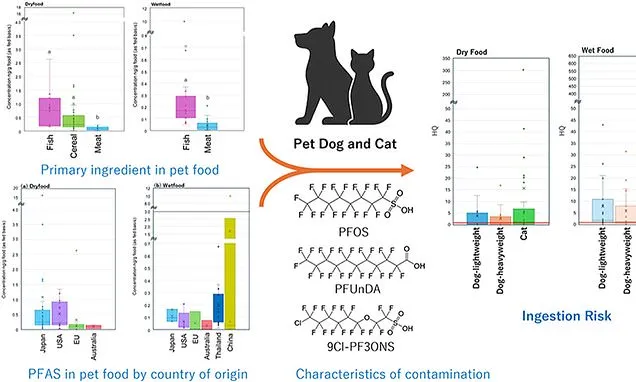
They detected PFAS across many of them, with higher concentrations in fish-based foods and dry products.
However, because wet foods have higher serving sizes, they resulted in the greatest exposure.
'The PFAS concentrations detected in pet food in this study are a significant source of daily exposure for companion animals,' the researchers warned.
The researchers found that the largest intake of PFAS was from wet food, with higher concentrations also found in fish-based products.
The main difference between wet and dry pet food is moisture content. With dry food, pets consume lots of calories in small quantities while with wet products, they must eat twice or three times as much.
The study, published in the journal Environmental Pollution, revealed that PFAS concentrations varied widely among the pet food products.
Dog dry foods measured up to 1.7 nanograms (ng) of PFAS per gram, while dry cat food contained up to 16ng per gram.
Wet dog food, however, measured up to 0.67ng of PFAS per gram while wet cat food contained up to 9.9ng per gram.
Despite the wet food showing lower concentrations, higher serving sizes mean the pets would have greater exposure to the chemicals from wet options, the researchers explained.
Fish-based products also carried significantly higher total PFAS amounts compared to meat-based products, while grain-based products also showed elevated levels.
'These findings underscore the urgent need for further investigation into the health effects of PFAS exposure in companion animals,' the scientists said.
Although there have only been a few studies looking at PFAS contamination and pets, it appears that dogs and cats can both be affected.
PFAS exposure has been found to affect the liver and kidneys of both animals, as well as the lungs and thyroid of cats.
In humans, studies have linked PFAS to infertility, behavioural problems, birth defects, high cholesterol levels and even various cancers, including kidney, testicular and ovarian.
As well as being ingested they can be inhaled through the lungs, and stay in our bodies for years.
In 2023, experts revealed these chemicals are now in the blood of animals on nearly every continent on Earth.
Scientists from the Environmental Working Group (EWG), who carried out the research, said types of PFAS have been found in horses, dogs, Siberian tigers, pandas, sea lions, wild boar, otters and even oysters.
'PFAS pollution is not just a problem for humans. It's a problem for species across the globe,' said David Andrews, a senior scientist who worked on the study.
Nathan Donley, environmental health science director at the Centre for Biological Diversity, added: 'It's quite ironic that many species on the brink of being lost forever are loaded with synthetic 'forever chemicals' designed to never break down.'
HOW PFAS CHEMICALS CONTAMINATE WATER AND FOOD SUPPLIES
PFAS are man-made chemicals used as oil and water repellents and coatings for common products including cookware, carpets, and textiles.
These endocrine-disrupting chemicals do not break down when they are released into the environment, and they continue to accumulate over time.
PFAS chemicals can contaminate drinking water supplies near facilities where the chemicals are used.
PFAS contamination has been detected in water near manufacturing facilities as well as military bases and firefighting training facilities where foam containing PFAS is used.
They also enter the food supply through food packaging materials and contaminated soil.