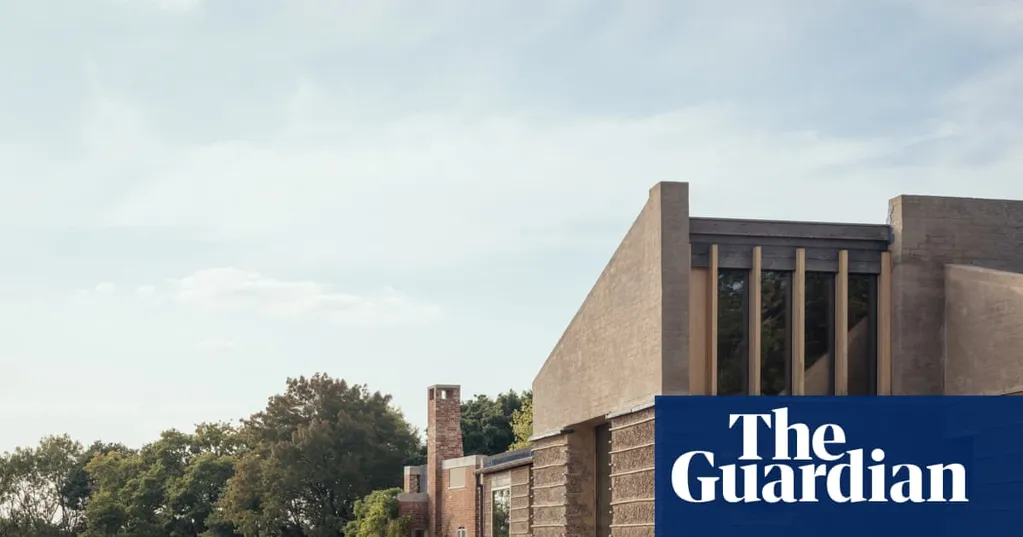
Rammed earth sourced from, or near, the grounds of a proposed building site is attracting attention as an eco-friendly construction material.
From afar, the low-rise homestead perched in the Wiltshire countryside may look like any other rural outpost, but step closer and the texture of the walls reveal something distinct from the usual facade of cement, brick and steel.
The Rammed Earth House in the Cranborne Chase is one of the few projects in the UK that has been made by unstabilised rammed earth - a building material that consists entirely of compacted earth, and which has been used as far back as the Neolithic period.
Today, as architects seek to improve the sustainability of a sector that is responsible for more than a third of global carbon emissions, the concept of using rammed earth sourced from, or near, the grounds of a proposed building site is attracting attention.
The argument for a component that has been used for construction in places as meteorologically distinct as Spain and Japan is that traditional building techniques can be deployed to create a circular construction process and address contemporary problems.
"Climate change makes it even more important that rammed earth is framed as a mainstream material," says Emaad Damda, a lead architect at Tuckey Design Studio, which worked on the Rammed Earth House.
"The fact that our temperatures [in northern Europe and other temperate climates] are rising means that rammed earth, as a material, offers thermal mass, temperature regulation and moisture control."
Last year, the OECD published a report on the outlook of urbanisation in Africa projecting that the continent's urban population would double to 1.4 billion by 2050. Meanwhile, pressures on housing are already a common feature of city life worldwide. With the construction industry estimated to be the single largest emitter of greenhouse gases globally, the sector's architects and engineers have turned to bio-based materials, such as bamboo and earth, to rethink ways of addressing growing demand for infrastructure without aggravating the climate crisis.
Supporters of rammed earth point to the convenience of in-situ construction - built on the site of a former brickworks, the Rammed Earth House in Wiltshire benefited from the recycled use of demolished outbuildings and the ground's clay-rich soil.
Clay, along with demolition waste, is often a major component of rammed earth. Jonathan Tuckey, founder of Tuckey Design Studio, says: "If you find a geological map of the world where seams of clay run underneath the surface, [earth is] - by no coincidence - used as a building material."
Tuckey adds, "The decision you need to make early on when you're using earth ... is whether you're going to be making it on-site from the ground that is underneath or around your property, or whether you're going to prefabricate it like bricks and then drive it to site."
Since the nature of rammed earth mixtures are dependent on the composition of soil, which varies in different geographies, the material's lack of consistency can cause problems with building regulation and home insurance.
Antonio Moll, a tutor of environmental and technical studies at the Architectural Association, said: "The enemy of rammed earth is water and low temperatures."
As long as rain and cold temperatures remain a common feature of British weather, the risk is that the finer particles of rammed earth erode over time and leave gaps in exposed exterior walls. "Stabilised" rammed earth - where other components such as lime or cement are added to the mixture - is one way around these structural challenges, but the use of this "dirty concrete" threatens to defeat the low-carbon point of using earth in the first place.
One of the projects that Moll's studio is working on is a residential building block in Dartford called Orchard House. In this case, Moll opted for prefabricated blocks that had been pressed in a Spanish factory and then delivered to the site. Although there is the carbon cost of importing rammed earth blocks, the benefits were still greater than relying on regular bricks, says Moll.
"The reality is that not many construction materials are produced in the UK," he says.
This, along with financial limits, prevented him from developing the rammed earth mixture with local soil. The process itself is also labour-intensive, which can make developers hesitant.
Roger Boltshauser, a Swiss-based architect who has encouraged the use of rammed earth construction in Europe, is optimistic about the prospects of localised factories producing prefab blocks and then delivering them to building sites "within a 300km radius" in an effort to minimise carbon emissions.
His practice has used former cement and brick factories as locations to produce blocks, and Boltshauser believes the standardisation of prefabricated blocks is a way of circumventing the need for unique approval for each project.
The ingenuity of unstabilised rammed earth is that buildings become part of a circular construction process, says Boltshauser. Materials are gathered from a local area and used to create something new, but can be returned to the ground in the case of demolition.
Boltshauser cited medieval structures in Morocco as a source of inspiration. He said: "It's important for us to study different building cultures ... we can learn from the old. The quality of [rammed earth] is clear."
Far from being confined to rural environments, Boltshauser's studio has been involved in bringing rammed earth to the urban landscape. Matthias Peterseim, an architect at the studio, said: "It all started in rural areas because they're a way to experiment a little bit ... [but] our first rammed earth buildings were actually in Zurich."
Materials such as glass and timber have been used to blend these structures in with their city surroundings while avoiding cement. "The more pure the material, the more sustainable it is,[otherwise] it is harder to recycle," says Peterseim.
And then there is the aesthetic appeal. "The atmosphere within the Rammed Earth House is so different to that of a conventional building, acoustically in terms of the softness of sound and light,the filtering of air," said Tuckey.
"It has so many benefits. It more than just does a good thing for the environment in terms of its responsibility. It produces incredibly beautiful spaces to live in,to work in,and to be in."