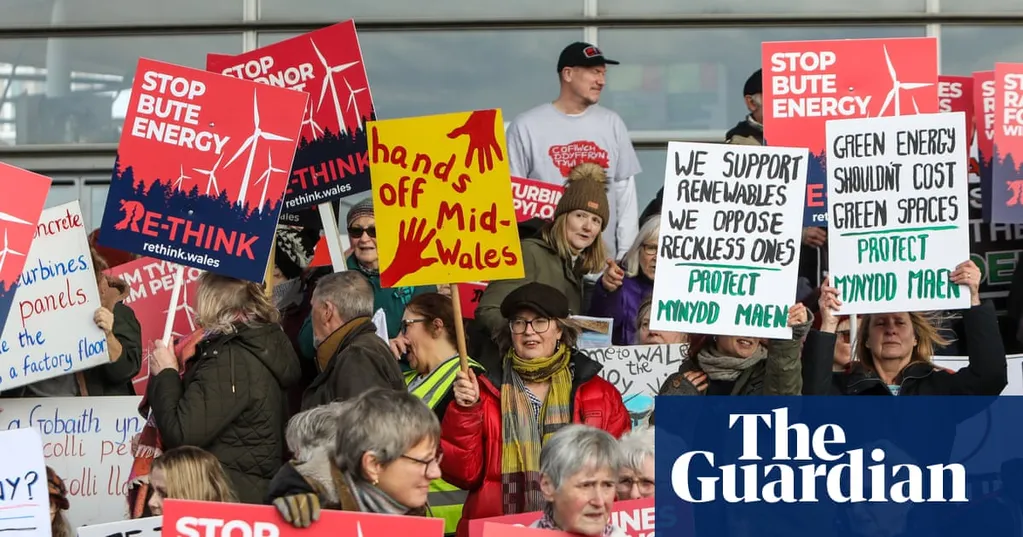
A group of 500 Welsh farmers have brought a landmark legal claim to the high court over the alleged conduct of a green energy developer planning to build electricity pylon routes across their land.
The court will hear allegations that Green Gen Cymru "unlawfully sought entry to private land, intimidated landowners, and showed disregard for biosecurity and basic rights", as well as examine laws that force landowners to sell property to utility companies, in a hearing on Tuesday and Wednesday.
The claimants say the case could fundamentally shift the relationship between rural communities and energy companies.
Green Gen Cymru, part of the Bute Energy group, is planning to build three new electricity pylon routes across Carmarthenshire, Ceredigion and Powys, connecting offshore windfarms to the Welsh mainland and Shropshire.
Wales's electricity grid is widely considered not fit for purpose and unable to support the country's target of 100% renewable electricity by 2035.
The farming collective Justice for Wales and the Welsh Countryside Charity (CPRW), which brought the joint claim, say they do not oppose renewable energy projects but how the work is being carried out.
They allege Green Gen Cymru representatives have acted aggressively in entering privately owned land without consent or forewarning, and with dirty tyres and boots, which risk the spread of livestock diseases such as bovine TB and sheep scab.
The lead claimant, Natalie Barstow, from Builth Wells, in Powys, also alleges agents acting on the company's behalf were caught on wildlife cameras walking through a protected stream that is home to otters.
"For months we have been left feeling unsafe in our own homes and stripped of our power as farmers and landowners. This is not a protest against renewable energy; this is about standing up for what is right: our right to dignity and to have a voice, and for the future of our land, wildlife, and livelihoods," Barstow said.
Jonty Colchester, CPRW chair, said: "This hearing is a major moment for rural Wales. It has taken months of determined work by Justice for Wales and CPRW to bring these concerns before the court.
"This is ultimately about accountability, whether powers affecting people's land, livelihoods and communities are being exercised lawfully and transparently. Reaching this point has not been easy, but there is real determination in seeing these issues finally tested in court.
"We are proud to stand together behind this challenge and to make clear that communities in Wales must not be sidelined when decisions of this scale are being made."
Green Gen Cymru declined to comment on the case, citing the proceedings, but a spokesperson said: "We remain committed to working respectfully with landowners and engaging openly with local communities. Our approach is to seek agreement wherever possible and to carry out all activities with due consideration for people and the environment.
"The development of this infrastructure remains an important part of delivering a secure, resilient energy network for Wales and forms part of critical infrastructure aligned with government policy."
The farmers are also worried they could lose their land and homes to the 125 mile pylon scheme. Part of the legal case challenges whether section 172 notices, which allow access to land prior to any compulsory purchase order, are lawful. CPOs allow public authorities and utility companies to acquire land for infrastructure projects deemed to be in the public interest without the owner's consent.
Using Welsh land and resources to supply England has a fractious and emotive history in Wales, epitomised by the village of Tryweryn, in Gwynedd, which was flooded in 1965 to supply drinking water to Liverpool.
Approximately 90% of Welsh land is used for farming and agriculture, and rural communities play a vital role in the survival of Welsh culture and language: 45% of agricultural workers speak Cymraeg as their first language, more than any other industry, according to Welsh government figures.