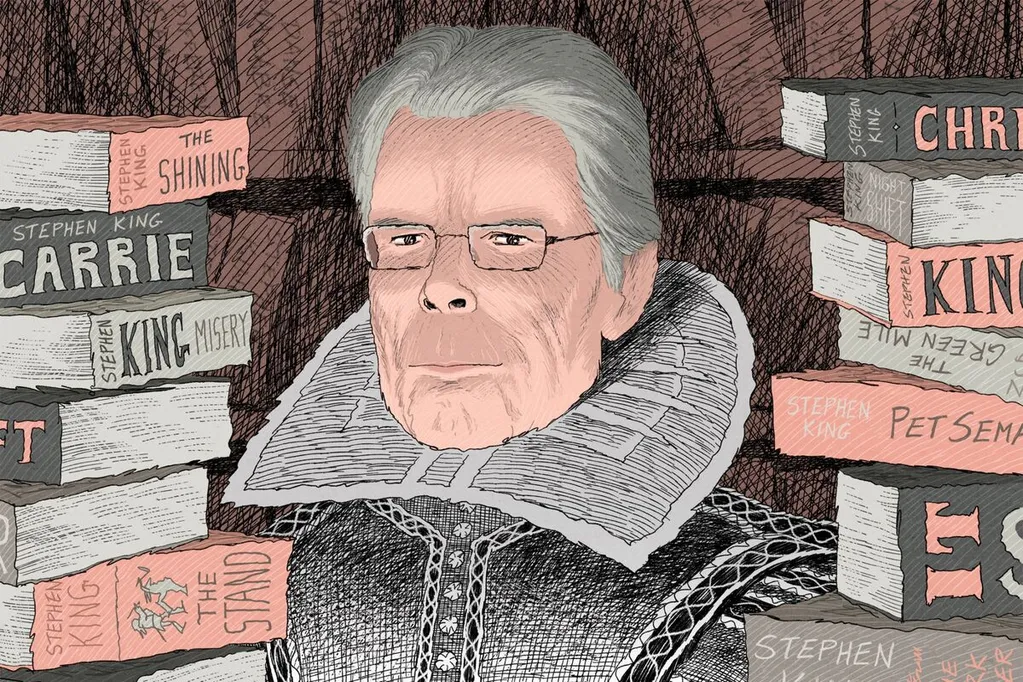
If you ask the average Stephen King fan how old they were when they first encountered the master of horror, I'd be willing to put money on the answer being somewhere between 12 and 17. Those middle- and high-school years are when the surface-level sell of King's work -- thrills, chills, and plenty of sex -- is most potent. Even if they haven't kept up with King into adulthood, chances are various Kingisms will haunt them forever: "REDRUM" from The Shining, the refrigerator in It, the Boogeyman in "The Boogeyman."
The latter made a particular impression on Caroline Bicks, a Shakespeare scholar and author of Cognition and Girlhood in Shakespeare's World and Midwiving Subjects in Shakespeare's England. "'The Boogeyman' did to me what a great horror story (as King writes) does best: "Dance its way to the center of your life and find the secret door to the room you believed no one but you knew of,'" she writes in her new book Monsters in the Archives: My Year of Fear with Stephen King (April 21, Hogarth).
How did a Shakespeare scholar go from writing books about midwifery and girlhood in the time of the Bard to exploring King's early work for a broader audience? The explanation almost seems like the story of one of King's own protagonists, often writers who land in a new place and discover some obscure project that will come to consume them. In 2017, Bicks accepted the inaugural Stephen E. King Chair in Literature at the University of Maine, King's alma mater. She was hired as a Renaissance specialist, but after meeting King, she dove into his personal archives to investigate a topic she'd been wondering about for decades: how he had crafted the horror stories that had so disturbed her as a young girl.
The book examines the writing and rewriting process of five of his early works, Pet Sematary, The Shining, Night Shift, Salem's Lot, and Carrie, drawing on never-before-public early drafts of the texts, conversations between King and his editors, and King's own notes, all of which are part of his archive. With each book, Bicks zeroes in on one central literary element that King developed over his drafts and that makes them so terrifying and effective for her and millions of others; she highlights, for example, the exploration of childhood's distinctive psychology in Salem's Lot, and how he processes his own growth into adulthood through the stories in Night Shift.
Bicks also consistently draws parallels between King and Shakespeare. She references King's masterful use of the sound of words to create emotional impact in Pet Sematary -- particularly the repetition of "gritty" and "grating" -- suggesting that his deployment of rhythm is "not unlike a five-foot line of Shakespearean verse." She explores the influence of Hamlet on The Shining, comparing Jack Torrance to Hamlet and Wendy to Ophelia. She identifies King's own use of Shakespearean tragedy as a motif for framing the book, which in earlier drafts had been broken up into five acts.
Bicks particularly relishes the commonalities between Macbeth and Carrie, focusing on a concept she wrote about in her first book -- "I was exploring beliefs from [Shakespeare's] time about cognition, and finding lots of evidence to suggest that people back then thought something special happened to girls' brains when they hit puberty: Their imaginations, memories, and intellects expanded and sharpened in ways that set them apart from boys, men, and women."
It isn't surprising that Bicks found elements of Shakespeare in King, considering her professional specialization. But by the end of Monsters in the Archives, which mentions the Bard on 29 different pages, I couldn't shake the sense that she was raising a larger idea, one she never explicitly states but that runs throughout the book: Shakespeare and King have something fundamental in common, a quality they share that few other writers do. The question is: what?
King has been an enormously popular writer since he first published Carrie in 1974, selling over 400 million copies of his books worldwide. Critical acceptance came later, solidified with a Medal for Distinguished Contribution to American Letters from the National Book Foundation in 2003. The year before, the winner had been Philip Roth, more or less the platonic ideal of a critically lauded writer in the second half of the 20th century. Ever since, King has been considered not just one of America's most popular writers,but one of its best.
Not by everyone, though. The 2003 honor was divisive, and the critic Harold Bloom -- a champion of Shakespeare -- wrote in the Los Angeles Times that the award was "extraordinary, another low in the shocking process of dumbing down our cultural life. I've described King in the past as a writer of penny dreadfuls, but perhaps even that is too kind. He shares nothing with Edgar Allan Poe. What he is is an immensely inadequate writer, on a sentence-by-sentence, paragraph-by-paragraph, book-by-book basis."
A steady trickle of critiques have followed in the two decades since, most of them echoing Bloom's central criticism: Sure, this guy can sell books, but is he actually a good writer? And not just a genre writer, but a writer of literary fiction? Can you seriously mention him in the same breath as Shakespeare?
There's an implicit suggestion in Bloom that, at best, you should grow out of King, into more serious literature. Bloom offers Thomas Pynchon, Don DeLillo, and Cormac McCarthy as counterexamples, suggesting that any one of them would have been a more deserving recipient of the award bestowed on King. He spends the rest of his piece -- which reads, in retrospect, like a vanguard action in the culture war to follow -- exclusively criticizing female writers.
Contrary to the experience of Bicks and many others, I didn't read my first King novel until I was 33, well after I'd made my way through a healthy chunk of Bloom's beloved Western canon. Up to then, I had dismissed King for the same reasons that Bloom did: because I thought he wasn't a serious writer. But when I actually read him, I discovered someone remarkably different than what I'd been expecting.
It should be said, King's most dedicated fans -- even King himself -- will admit that there are large swaths of his prose, including entire books, that are just not that good. This would be a hard dynamic to avoid when you've published as widely as King; the guy's written nearly 70 novels and over 200 short stories translated into 52 languages, with over a hundred adaptations for film and TV. But anyone who can get out of their own way should be able to recognize the superb quality of much of his writing, particularly in his best novels.
Where King excels is "his almost instinctual understanding of the fears that form the psyche of America's working class," according to crime novelist Walter Mosley. "He knows fear, and not the fear of demonic forces alone but also of loneliness and poverty, of hunger and the unknown."
This is King's genius, and it's what brings him into conversation with Shakespeare. Despite working largely in genre, his best characters and settings are grounded to an astonishing degree: convincing emotionally, practically and intuitively. At times, It reads more like nonfiction than fiction, so thorough and exhaustive is King's realization of the town of Derry and its history -- notable for a novel chronicling the exploits of a demonic clown. This level of discipline tracks with King's inherent experience of storytelling; he told The New Yorker that "stories are found things, like fossils in the ground." He elaborates further in On Writing -- his own ode to the craft -- that "the writer's job is to use the tools in his or her toolbox to get as much of each one out of the ground intact as possible."
The evidence Bicks uncovers bears out this metaphor. King frequently strips away the most overt, gory, and over-the-top horror elements during his revision process, bringing his characters closer and closer to the real world as he reworks them. That's true of Gage, the resurrected monster-toddler from Pet Sematary who King gradually shifts from a caricaturish killer to more of an ambiguous force, as well as of Carrie, who goes from a Satanic creature with an engorged brain and a God complex in the first draft to a normal-looking girl who just happens to have some strange powers in the final one. In doing so, he ends up making them both scarier -- because reality is always going to be more disturbing than obvious fictions.
By addressing consequential themes in the form of work that is fundamentally accessible and relatable to a wide audience—from the problem of evil to the nature of childhood to the character of place—King operates on the most sensitive and vulnerable aspects of the human psyche while still causing his readers to lean in rather than away. And he doesn't just do this in horror. While Bicks focused on his early horror novels, King has since established himself as a master of just about every genre under the sun, including crime, science fiction, and—especially—fantasy.
Shakespeare did much the same. While we don't know much about how he wrote or why, we do know that he wrote quickly and fluidly. He produced a shocking number of great works in both major genres of his time: tragedy and comedy. As Bloom writes in Shakespeare: The Invention of the Human, Shakespeare's great gift was his ability to write psychologically complex and nuanced characters who could still play to everyone—including the "groundlings" who would pay a penny to stand before the stage. In his life, Shakespeare was a popular writer; only later would he become a sainted one.
"The representation of human character and personality remains always the supreme literary value, whether in drama, lyric or narrative," Bloom writes. By Bloom's own standard then—King is exceptional. Is comparing him to Shakespeare inherently flawed? Of course—it's like comparing Bob Dylan to Mozart. The context is so different that it creates inescapable difficulties. But in a world in which I can just as easily pull up The Epic of Gilgamesh on my phone as I can an email I received ten seconds ago; it's worth understanding how these writers talk to us across time. And it's hard to think of another contemporary author who has written as much; as well; as entertainingly; and dramatically; for as wide an audience as King.
whether a writer can be as absurdly popular as king and still good -- in the literary artistic sense that bloom prizes so highly -- will always be a matter of taste personal judgment. i would argue though that they can be; and proof such writer exists shakespeare himself: endlessly adapted; universally read; surprisingly accessible; exhaustively delightful. bicks herself serves kind case point: deep thinker; anxious child; voracious reader dove deep both shakespeare stephen king found herself just comfortable both.