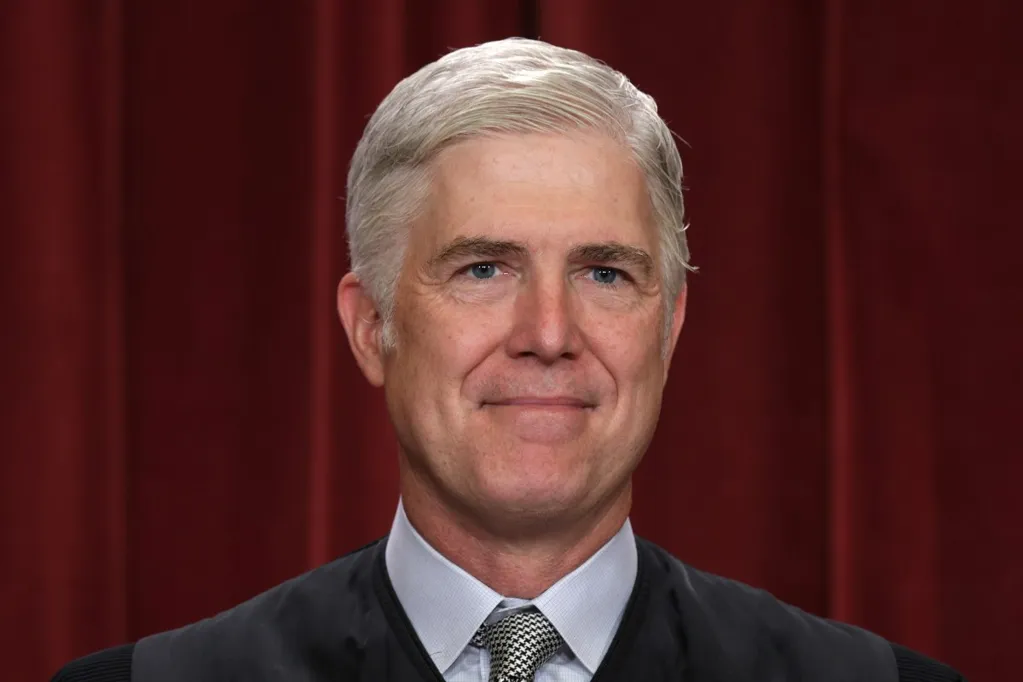
Supreme Court Justices Samuel Alito and Neil Gorsuch both referenced the Insurrection Act in their dissents of a decision blocking President Donald Trump's administration from deploying National Guard troops in Illinois to support its immigration agenda.
Newsweek reached out to the Supreme Court for comment via email.
Trump's efforts to deploy National Guard troops to the Chicago area faced another legal roadblock on Tuesday following the latest order from the Supreme Court. Trump has sought to federalize the National Guard of Democratic states without consent from governors throughout his second term in office. He has also floated the potential use of the Insurrection Act.
The court sided against the administration in the latest case but did not go as far as to make a general ruling about whether he could use the Insurrection Act. However, several justices mentioned the provision in their written opinions. The ruling is the latest legal test of presidential authority of the second Trump term.
The Insurrection Act gives presidents authority to deploy military forces domestically if a state is unable to suppress an insurrection or is defying federal law.
A majority of justices ruled against Trump on Tuesday. Conservative Justices John Roberts, Brett Kavanaugh and Amy Coney Barrett joined the liberal-leaning justices in the majority opinion. Justices Samuel Alito, Clarence Thomas and Neil Gorsuch dissented from the majority.
The order dealt with 10 U.S.C. §12406(3), a statute that states the president may call into federal service members and units of the National Guard in cases when the U.S. is being invaded, there is a rebellion against the authority of the U.S. government or the president is unable to execute the law "with the regular forces."
The Insurrection Act, on the other hand, lays out when presidents can use the military to deal with insurrections against the U.S. authority. It was most recently used during a series of riots in Los Angeles in 1992 after four Los Angeles police officers were acquitted for beating Black motorist Rodney King.
In his dissent, Alito wrote about the Insurrection Act in connection to the phrase "to execute the laws." The court's interpretation of the phrase would be "inconsistent with the way the phrase is used elsewhere," he wrote.
"Nor do we read the Insurrection Act, which authorizes the use of militia and armed forces to 'enforce the laws,' as preventing the President from ordering troops to serve protective functions," he wrote.
Gorsuch, meanwhile, asked in his dissent whether §12406(3) provides "standalone authority permitting the President to deploy the Guard" and how it interacts with "other statutes in the field, such as the Posse Comitatus Act, 18 U.S.C. §1385, and the Insurrection Act, 10 U.S.C. §§251 -- 255?"
"What, if any, inherent Article II power does the President have to deploy the Guard to protect federal personnel or property, and how might that inform the interpretation of §12406(3)?"
Justice Brett Kavanaugh wrote in his concurring opinion: "As I read it, the Court's opinion does not address the President's authority under the Insurrection Act. See 10 U.S.C. §§252, 253. Moreover, the Court's opinion does not address or purport to disturb the President's long-asserted Article II authority to use the U. S. military (as distinct from the National Guard) to protect federal personnel and property and thereby ensure the execution of federal law."
President Donald Trump told reporters in October: "Well, it's been invoked before, as you know. If you look at Chicago, Chicago is a great city where there's a lot of crime, and if the governor can't do the job, we'll do the job. It's all very simple."
Illinois Governor JB Pritzker, a Democrat, wrote to X that the order was a "big win for Illinois and American democracy": "American cities, suburbs, and communities should not have to face masked federal agents asking for their papers, judging them for how they look or sound, and living in fear that President can deploy the military to their streets. The brave men and women of our National Guard should never be used for political theater and deserve to be with their families and communities, especially during the holidays, and ready to serve overseas or at home when called upon during times of immense need."
The Supreme Court's order is not a final ruling. It is yet to be seen whether Trump will invoke the Insurrection Act.