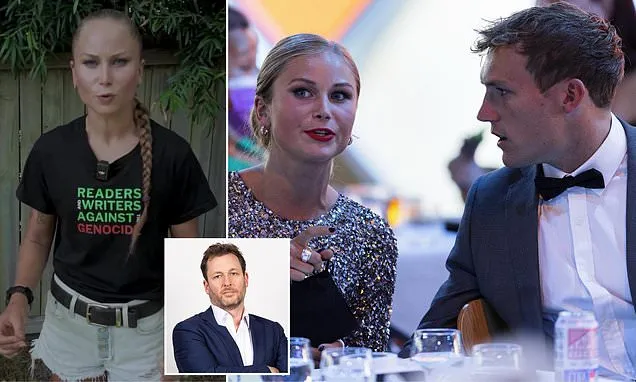
There was a time when Grace Tame could do no wrong in polite Australian company.
Not because she was infallible, but because the media decided she was untouchable.
Any criticism, however measured, was treated as proof of a critic's moral deficiency. She was cast as the unimpeachable victim-advocate whose motives were assumed to always be pure and her judgement on any other matter wasn't to be questioned.
That period is over, and it's over largely because she ended it herself.
A classic example was when Tame so rudely posed for a photograph with former PM Scott Morrison when visiting his official residence for a function. Rather than just not go, or politely decline to be photographed in the first place, Tame looked like she was in a hostage video while the Morrisons smiled for the camera.
I had the temerity to call out the rude, juvenile display unbecoming of our Australian of the Year, only to be shouted at by Tame's conga line of sycophants on the left who hated Morrison and idolised her.
And I was an ardent Morrison critic myself!
But look at all of Tame's antics since that time - including showing up at one of Prime Minister Anthony Albanese's events wearing a T-shirt with the words 'Fk Murdoch' plastered across it. Charming.
Tame was untouchable when she became Australian of the Year in 2021. Since going from laudable, single-focus activism to being a general leftist agitator, she has lost the mainstream.
Her classy display didn't end there. She later took to social media to exclaim that she didn't mean it literally when referring to the 94-year-old mogul.
But her antics have morphed from juvenile to reckless since then.
Tame's decision to lead a crowd chant to 'globalise the intifada' at a Sydney rally wasn't a minor slip or a misunderstood flourish. It was deliberate wording and timing.
It landed during a febrile, grieving period in Sydney, with heightened anxiety in the Jewish community and acute political sensitivity around protest rhetoric.
While Albanese didn't have the courage to condemn Tame, his Labor colleague and NSW Premier Chris Minns did. And good on him for not falling into the weak orbit of Albo.
You don't get to pretend words are weightless simply because you insist you meant them nicely. Tame's defence has been to argue that intifada essentially means 'shaking off' and that her message is non-violent and anti-racist.
That line is clever in the way a lawyer's footnote can be clever. It's also evasive in the way a lawyer's footnote can be evasive.
In contemporary political usage, 'globalise the intifada' isn't a neutral appeal for human rights. It is a slogan with a freighted history, tied in public memory to uprisings that included suicide bombings and attacks on civilians, and it is heard by many Jews not as abstract solidarity, but as a menace exported to their streets.
Tame's decision to lead a crowd chant to 'globalise the intifada' at a Sydney rally wasn't a minor slip or a misunderstood flourish. It was deliberate wording and timing.
Imagine the consequences if a hate preacher screamed what Grace Tame did. Why is she so special? PVO
Even where supporters argue it can mean uprising in a broader sense, the contested meaning is precisely why responsible public figures avoid it, unless they actively want the provocation. But not Tame. And that is exactly the point of what she has become.
'Globalise the intifada' is politics by dog-whistle, except it's shouted through a megaphone. People pretending this is just a linguistic misunderstanding are kidding themselves. The slogan is useful precisely because it's incendiary, and because it tests how far a movement can go before mainstream institutions blink.
Predictably, the radical left quickly defended Tame, but the likes of Albo - who was once in thrall to her - did not.
That split is the entire point of her pivot in recent years: the mainstream is something to be baited, not persuaded. The centre is something to be scorned, not won. No PM can continue to support someone who does that.
Tame was elevated to Australian of the Year - not unreasonably - because she channelled legitimate anger into a cause that commanded broad moral agreement: confronting institutional failures around sexual abuse.
She had credibility because the cause did not require Australians to join a tribe; it required them to face reality. But, bit by bit, she has chipped away at that reservoir of goodwill, substituting seriousness with performative combativeness and replacing persuasion with contempt.
The result is predictable. She has lost mainstream Australia in a big way, narrowing her audience, and finding her only reliable applause line in the most radical activist left.
However, anyone calling for her to be stripped of her Australian of the Year title should understand what they are really proposing.
The National Australia Day Council has a formal 'Withdrawal of Award Policy' that explicitly allows review and revocation, including where, in the board's opinion, the recipient has behaved in a manner that has brought the awards into disrepute.
So yes, there is a pathway. That's how Alan Bond was stripped of his award after being convicted of fraud.
But the smarter question is whether doing it to Tame would achieve anything other than making her the story she so desperately wants to be. She would love becoming a martyr. She would dine out on it for decades. She would use the revocation as proof positive that Australia punishes her for speaking the truth, and her supporters would weaponise it as evidence that the establishment silences dissent.
We've already seen the playbook in action with her defiant response to the backlash so far - reframing criticism as propaganda and positioning herself as a righteous target. A formal stripping of the title would hand her the trophy she craves, and it would do so in a way that drags the awards themselves deeper into the culture wars.
There is a better way to deal with someone who keeps trying to turn civic recognition into political theatre: stop treating them like porcelain.
The kid-gloves era did more damage than people admit, because it taught Tame that celebrity activism comes without consequences. It also taught a generation of journalists to confuse compassion with credulity.
The shift now is not cancellation or a right-wing pile-on. It is simply the end of the media's old reflex to protect Tame from scrutiny. And scrutiny is exactly what she earned by stepping into a volatile global conflict she knows little about and choosing a slogan that maximises heat while minimising accountability.
If brands won't touch her - remember that Nike ended its association with Tame last year - that isn't some grand conspiracy. It's simple risk management. Corporations don't sponsor moral purity - they sponsor reputational stability. When a public figure starts flirting with language widely experienced as threatening by a minority community, the commercial world does what the commercial world always does - it walks away.
The tragedy for Tame - if she's still capable of self-reflection - is that she once had the kind of standing that could have built bridges across causes and communities.
Instead she's busy burning them, then complaining about the smoke.
And let's be clear about the moral arithmetic here. None of this requires taking a position on Gaza, Israel or the ethics of protesting right now. Plenty of Australians sympathise deeply with Palestinian civilians and still understand that 'globalise the intifada' is rhetorical napalm.
This adds to the tragedy of what Tame has become: her antics actively harm her causes, making her a counterproductive agent for the things she is passionate about.
That's assuming the causes still matter more to Tame than tribal signalling. If not, we're witnessing narcissism dressed up as activism.