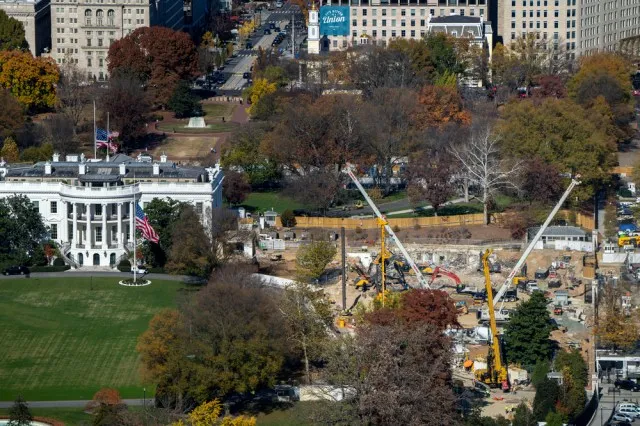
A federal court fight over President Trump's plan to build a massive ballroom on the site of the former East Wing of the White House has recently pulled a long-quiet project into public view: the overhaul of a military bunker buried deep underground.
"The military is building a big complex under the ballroom, which has come out recently because of a stupid lawsuit that was filed," Trump told reporters on a Sunday in late March aboard Air Force One.
Crews are carving out a new Presidential Emergency Operations Center (PEOC) beneath the surface of Trump's proposed 90,000-square-foot ballroom, details of which are slowly coming to light in court filings and the president's own comments about the usually secretive project.
His decision last October to demolish the existing East Wing was met with swift pushback from Democratic lawmakers, historians and preservation groups.
The National Trust for Historic Preservation sued the White House in December, seeking to halt construction of the $400 million ballroom because the public had not had an opportunity to weigh in on the plans.
While the expansive aboveground complex has drawn most of the attention, Trump revealed during a recent Cabinet meeting that there was another motivation for the construction.
He told Cabinet members there was a national security component to the project that was "supposed to be secret" and the military "wanted it more than anybody."
"It was supposed to be secret, but it became unsecret because of people that are really unpatriotic saying things," he said.
Shuffling through renderings of the project, Trump described the underground facility as having bulletproof glass and "drone-proof" roofs and ceilings.
The bunker dates back to World War II, when a shelter was built beneath the newly constructed East Wing to protect former President Franklin D. Roosevelt in the event of an air raid, according to the White House Historical Association.
The organization described the original secretive space as having "thick concrete walls and steel-sheathed ceilings with a small presidential bedroom and bath inside," as well as nearby rooms with ventilation masks, food storage and communications equipment.
The facility, which later became known as the PEOC, has been modernized over the years and can serve as a command center for the president if needed. It was used by President George W. Bush and his team following the Sept. 11, 2001, terrorist attacks.
Former First Lady Laura Bush recalled in her 2010 memoir being "hustled inside and downstairs through a pair of big steel doors that closed behind me with a loud hiss, forming an airtight seal" as she was escorted by Secret Service agents through the underground hallways.
Questions about the PEOC reemerged after CNN reported earlier this year that the ballroom could feature a "top-secret project," including the rebuild of a "secret bunker under the West Wing."
Trump has often pointed to the ballroom as a needed addition so that future administrations can hold large state events indoors, rather than continuing to use outdoor tents as is done now. But the administration has also argued that delaying construction would imperil national security and expose the White House to potential damage.
The Secret Service has taken a central role in the dispute. In a sworn declaration in December, Deputy Director Matthew Quinn warned that stopping the unfinished project would interfere with the agency's protective mission.
"While the contractor has completed most of these temporary security measures, improvements to the site are still needed before the Secret Service's safety and security requirements can be met," Quinn wrote.
"Accordingly, any pause in construction, even temporarily, would leave the contractor's obligation unfulfilled in this regard and consequently hamper the Secret Service's ability to meet its statutory obligations and protective mission."
U.S. District Judge Richard Leon halted construction on the White House grounds this week, finding that Trump did not have the constitutional authority to move forward without congressional approval.
He excluded "construction necessary to ensure the safety and security of the White House," however.
Trump announced plans to appeal in the Oval Office later that day, running through a list of security upgrades that coincided with the ballroom project.
"We have bio-defense all over. We have secure telecommunications and communications all over. We have bomb shelters that we're building. We have a hospital and very major medical facilities that we're building," he said.
"So on that, we're okay," Trump added, referring to the aforementioned section of Leon's order.
Despite legal uncertainty, the National Capital Planning Commission (NCPC) voted 8-1 to approve the ballroom's design, which includes planned seating for up to 1,000 guests.