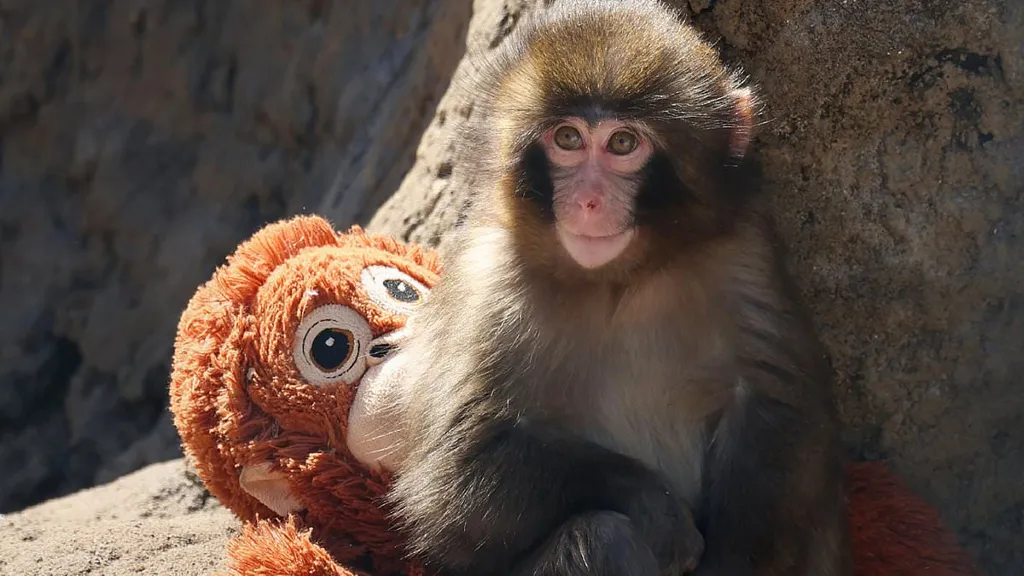
Scientists have revealed the likely fate of Punch the monkey - the viral macaque who has stolen the hearts of millions across social media.
The seven-month-old Japanese macaque was born at Ichikawa Zoo last year, where he was rejected by his mother.
Zookeepers gave him a stuffed orangutan toy, who he quickly formed a bond with - with viral footage showing him clinging to the plushie.
Fans were briefly relieved when footage emerged of another macaque grooming and comforting Punch.
However, just days later, Punch was rejected a second time - and this time it was in an even more aggressive fashion.
Now, Dr Emily Bethell, Associate Professor in Primate Cognition and Welfare at Liverpool John Moores University, has revealed what's next for the lonely macaque.
'I expect Punch will be under careful observation by the keepers, and it sounds like they are trying various approaches to find a way to keep Punch in the group, which is best practice,' Dr Bethell told the Daily Mail.
'If it looks like he is at risk of physical harm he would be removed from the group. As macaques are highly social intelligent primates this would be the last resort, only if he were deemed to be at risk of physical harm.'
According to Dr Bethell, the biggest risk to Punch is not another physical attack.
Instead, she says it's the long-term psychological effect of social isolation.
'Having been abandoned by his mother and the social group more broadly he has missed key developmental opportunities to learn appropriate social behaviours that would help him to navigate the hierarchical social world of macaques,' Dr Bethell explained.
'At 6 months old a wild macaque would still be somewhat reliant on the mother for comfort, nutrition and opportunities to learn about social behaviour.'
However, the fact that Punch is a male will work in his favour.
'Japanese macaques are female-bonded and males typically migrate out of the social group at sexual maturity,' Dr Bethell said.
'There is evidence that mothers may invest more in raising daughters since they will stay in the natal group.
'He may therefore be moved to a new social group when he gets older and have an opportunity to forge new social relationships.'
Zookeepers gave him a stuffed orangutan toy, who he quickly formed a bond with - with viral footage showing him clinging to the plushie
Dr Bethell says that an intervention by the zookeepers could actually cause more damage for punch in the long-run
Why aren't keepers removing Punch?
An intervention by the zookeepers could actually cause more damage for Punch in the long-run.
At this stage, it's crucial he has the opportunity to interact with other monkeys to develop species-typical social skills.
If he is raised mostly by keepers, and his interactions are mostly with humans, he may never learn the necessary skills to integrate into a social group fully.
Across social media, many fans have called for the monkey to be removed from the enclosure.
Taking to TikTok, one fan asked: 'Why is that baby being left in that enclosure if he is being abused!?!?'
Another added: 'Why are the zoo workers not protecting him!'
And one wrote: 'Why arent the zoo keepers doing anything i'm so maaaaad.'
However, Dr Bethell says that an intervention by the zookeepers could actually cause more damage for Punch in the long-run.
'What is key at this stage is that he has the opportunity to interact with conspecifics to develop species-typical social skills,' she explained.
'If he is raised mostly by keepers, and his interactions are mostly with humans, he may never learn the necessary skills to integrate into a social group fully.'
Dr Bethell added that while many people have become enamoured with Punch, he is a wild animal at the end of the day.
'All primates are wild animals and should never be kept as pets,' she said.
'I am concerned at the images appearing online around this story showing primates apparently being kept as pets. While they look cute, these wild animals will be suffering psychologically, and cute juveniles in nappies will grow up to become poorly socialised and aggressive adults that may pose a threat to their owners.'
The predictions come shortly after scientists revealed why Punch's mother abandoned him in the first place.
Maternal abandonment is unusual in macaques, but tends to happen when the mother is young and inexperienced.
'Punch was his mother's first baby, in which case she might not have had a great deal of experience,' explained Professor Jo Setchell, a primatologist at Durham University.
'I have seen inexperienced primate mothers hold their baby upside down, for example, and appear to be very stressed when the baby wriggles.'
'It's a big change to go from being pregnant to having a baby clinging to your tummy all the time, for the first time!'
Conditions were also particularly hot when Punch was born, which might have contributed to his abandonment.
'If the mother is in poor condition herself, she might prioritise her own survival and her future offspring over caring for a baby that is unlikely to survive the current conditions,' Professor Setchell added.
While little is known about Punch's mother's upbringing, this may also have played a role, according to Dr Bethell.
She said: 'Abandonment is more likely to happen if the mother herself had abnormal rearing - for example, if she was separated from her own mother too young, or experienced other forms of early life stress, possibly associated with captivity.'