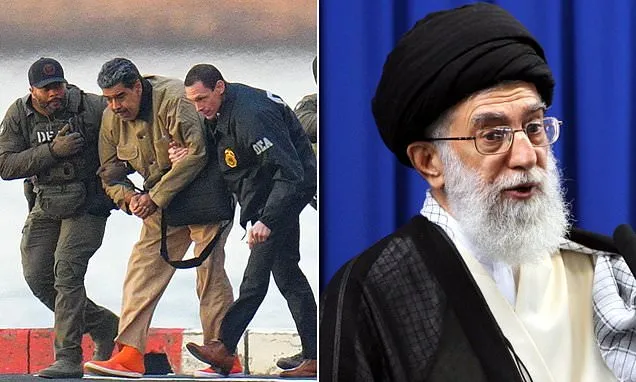
Predictably enough, the US-led raids that killed Iranian supreme leader Ayatollah Ali Khamenei and snatched Venezuelan President Nicolas Maduro were hatched amid intense secrecy.
So how then were mystery gamblers able to earn huge sums after successfully wagering that the events would happen - just hours before they took place?
In January, less than five hours before US planes went in to pound the defences of Caracas before special-forces troops kidnapped Maduro, someone on Polymarket, a hugely popular betting platform that allows people to make wagers on virtually anything, made the last of a string of suspiciously 'prescient' bets that the dictator would be out of power by the end of the month.
The trader was able to remain anonymous because Polymarket bets can be made only in cryptocurrency such as Bitcoin, whose holders are virtually untraceable.
Whoever it was had only created a Polymarket account just weeks earlier and, apart from a few bets about Maduro's fate in the days leading up to the raid, hadn't wagered on anything else. For a total stake of $34,000 in bets placed in a week, they earned a staggering profit of $400,000 (£300,000).
At the end of February, the same thing happened - repeatedly. At least six suspected insiders made $1.2million gambling on a US strike on Iran, mostly placing bets in the final 24 hours before bombing began. The biggest winner walked away with nearly $500,000 on a $61,000 stake.
As with the Maduro wager, they hadn't made any other bets on the site.
Suspicions that a select few were getting inside information from the heart of the Trump administration only grew when it was revealed that yet another bettor, hiding under the possibly revealing name of 'magamyman', made more than $553,000 with bets on whether Iran's Ayatollah Ali Khamenei would be out of power by the end of March.
Venezuela's president Nicolas Maduro were arrested by federal agents in January, hours after someone on Polymarket made a suspiciously prescient bet
Maduro's fate was the only thing this mystery gamblert placed bets on
Their biggest stake, for $20,000, was placed just a few hours before Khamenei was killed in the Israeli strike.
In fact, just on Polymarket (the most popular place for this sort of geopolitical gambling), half a billion dollars were traded over when exactly U.S. forces would drop bombs on Iran. And on February 27, more than 150 Polymarket accounts each bet at least $1,000 that a strike on Iran would take place by the next day - which, of course, it did.
Democrats in Congress rapidly drew their own conclusions - that this was no case of uncanny coincidences but something altogether more disturbing.
'It's insane this is legal,' said Democrat Senator Chris Murphy. 'People around Trump are profiting off war and death.'
Although the White House insisted that nobody connected to the President had placed bets, many are sceptical. Some believe that the sheer number of bets reveals that this macabre gambling goes way beyond Trump's immediate circle and is highly likely to involve military personnel involved in the operations.
Polymarket is particularly opaque because, despite the company being based in New York, its main platform is hosted on servers operating offshore. That ensures it is not covered by a law insisting American financial companies know the true identities of their clients.
Prediction markets - of which Polymarket and Kalshi are the main players - are booming in the US, where gamblers staked nearly $44billion (£33billion) on them last year.
Meanwhile, British politicians may be about to face their own challenges surrounding prediction markets with Matchbook, a popular sports betting group, planning to introduce Britain's first prediction market over the coming weeks, even as the industry in the US is increasingly dogged by ethical and legal questions. And anyone using a virtual private network (VPN) may already be accessing US prediction markets, even though they do not have a UK gambling licence.
The compound of Iran's Ayatollah was blizted in the early hours of February 28 and, again, suspicious bets were placed hours before it
At least six suspected insiders made $1.2million gambling on the strikes against the regime, mostly placed in the 24 hours before they commenced
There has been no let up in the strikes on Tehran, with sights such as this a common occurence
But given the row it's caused across the Atlantic, is it worth taking a punt on prediction markets succeeding in the UK?
Some industry experts say Matchbook and competitors already offer a betting exchange in the UK that is fairly similar to a prediction market, only presented differently, so it may not signal the betting frenzy that happened stateside. However, the markets are spooked and have already knocked nearly £19billion off the share price of the big international gambling companies.
Even if companies such as Polymarket manage to slip under the regulatory radar, say critics, prediction markets are always going to be difficult to police - especially in America, where the sitting President and his family are shamelessly enriching themselves off this lucrative trend.
Trump's media and technology company has even unveiled its own prediction exchange, Truth Predict, while his son, Donald Jr, actually sits on Polymarket's advisory board as well as being a 'strategic adviser' to its main rival, Kalshi.
The Trump administration has been dismantling the regulations set in place by the Biden government to govern almost everything to do with scandal-plagued cryptocurrencies, even though their near guarantee of anonymity has attracted criminals since the day they were invented.
Experts say prediction markets are particularly popular with inexperienced gamblers because, unlike sports betting, little specialist knowledge is needed. Their websites are more straightforward, too, generally requiring customers to just press a 'yes' or 'no' button to the eventuality that is the subject of the wager.
Unlike conventional betting platforms which set their own odds, prediction markets leave gamblers to bet against each other, while the site takes a small commission for each bet.
Gamblers can propose whatever 'markets' they like and the odds are worked out as a prediction percentage based on what the customers believe will happen.
Currently, Polymarket offers the chance to bet on anything from which football teams will be relegated from the Premier League this season,whether Trump will say 'Jesus' this week,through to the price of crude oil by the end of this month and the date when US troops will enter Iran.
You can even wager on whether the US will confirm aliens exist by 2027 which, at a 19 per cent chance of happening, is considered rather more likely than the Second Coming of Christ by the same deadline, which sits at a paltry 4 per cent.
There are some limits. Bets on the prospect of nuclear Armageddon were apparently taken down after the company was inundated with complaints.
It appeared gamblers had found another way to game the system when an Israeli journalist this week reported receiving death threats after writing an article about an Iranian missile strike on March 10 on Beit Shemesh, a city outside Jerusalem.
Fury over mystery betting account which made $600K on Iran strikes
After being warned to address 'inaccuracies' in his article, he traced the threats back to a Polymarket prediction that had more than $14million wagered on whether Iran would strike Israel on March 10.
Polymarket was launched in New York in 2020 by university dropout Shayne Coplan, now 28, who later became a billionaire in the cryptocurrency industry.
Kalshi, also New York-based, was co-founded with former fellow student Tarek Mansour in 2019 by a 29-year-old former ballerina, Luana Lopes Lara, who in 2025 unseated Taylor Swift to become the world's youngest self-made billionaire.
Prediction markets first attracted widespread attention when they paid out hundreds of millions of dollars to people who'd bet on Trump's 2024 election victory. The markets' success in predicting the outcome far more accurately than traditional polls has encouraged some economists to welcome them as a highly reliable predictor of future events.
This 'democratisation of information' is a good thing, they claim. These optimists attribute the accuracy of prediction markets to so-called 'crowd wisdom' and the fact that people with inside knowledge have an incentive to reveal what they know.
Some Wall Street companies now use them to help clients make share-trading decisions.
Others, however, counter that Polymarket and its ilk are a growing menace, encouraging illegal insider trading,the leaking of privileged information and - even worse - fuelling the possibility that anyone from the US President downwards might try to make specific events happen, including violent events,purely to profit from it.
At least one government has already cracked down on this: last month Israel charged an army reservist and a civilian with using classified information about military operations to place bets on Polymarket. Meanwhile, the controversies involving very suspicious Polymarket betting are only continuing.
In December a user was dubbed the 'Google insider' after they made $1.2million by betting on Google's most searched people in 2025. The same user also made a six-figure windfall betting on the release of Google's latest Artificial Intelligence system.
Another scandal concerned claims that gamblers hacked a think-tank's website to edit a map showing the changing war in Ukraine and win a bet about if the Russians would capture a certain city by mid-November.
In a third fuss, the Nobel Institute says it too may have been the victim of 'espionage' after Polymarket gamblers seemed to know that Venezuelan politician Maria Corina Machado was about win the 2025 Nobel Peace Prize.
Of course, if these markets get too much of a reputation for insider betting, they'll dry up.
That might be just as well.
Sceptics fear that the real threat to any country that allows prediction markets to flourish is that they will create a new type of national security threat.
Just imagine, they say,that Iran and Venezuela saw the intense betting on Polymarket that they were about to be attacked,and decided to retaliate in advance.