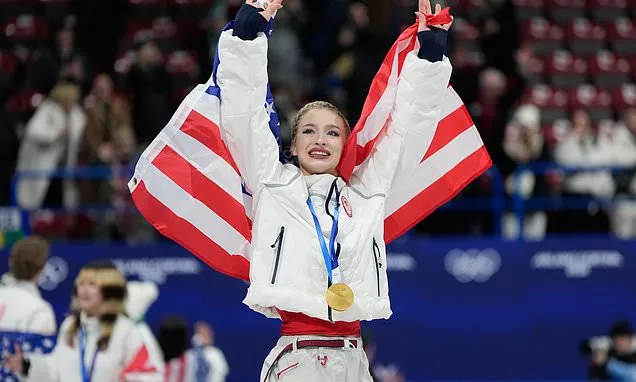
MILAN (AP) - One of the recurring issues during the opening week of the figure skating program at the Milan Cortina Olympics has been copyright problems, which have forced some athletes to scramble for approval and others to ditch their planned programs entirely.
Spanish skater Tomas-Llorenc Guarino Sabate made headlines last week while working feverishly to obtain approval to use music from the animated film "Minions." He eventually got it on Friday, allowing him to perform his short program Tuesday night.
Russian skater Petr Gumennik wasn't so fortunate. He had to alter his short program two days before the event after failing to secure permission for music from the film "Perfume: The Story of a Murderer." He pivoted to "Waltz 1805" by Edgar Hakobyan.
Then there's U.S. skater Amber Glenn, who had been using music from Seb McKinnon the past two years. The Canadian artist was surprised to learn that his song "The Return" was part of her free skate after Glenn had helped the Americans defend their team gold medal last weekend. Glenn and McKinnon wound up talking and were able to resolve the issue.
"Even now, we don't really understand what we can and can't use, but we're all working through that," Canadian ice dancer Piper Gilles told The Associated Press. "Everybody is trying to get on the same page, but it does make it harder."
The International Skating Union long forbade the use of lyrics in any discipline besides ice dance, forcing athletes to perform to older pieces of music - often classical tunes, such as piano concertos. Those pieces were considered part of the public domain, which meant that they could be used or modified freely and without permission.
That changed in 2014 when the ISU lifted its ban on lyrics in the hope of appealing to younger audiences. Suddenly, skaters had the choice of just about any musical genre, from pop to hip-hop to hard rock and even heavy metal.
The problem is that modern music is not part of the public domain, which means athletes must obtain permission to use it. During the 2018 Pyeongchang Games, the first Olympics in which lyrics were allowed, American skaters Alexa Knierim and Brandon Frazier used a cover of "House of the Rising Sun," and the indie rock band ultimately sued them for using it without its permission.
Figure skaters have found that obtaining permission is hardly as straightforward as simply asking the artist to use a song.
Sure, the performer themselves usually has a piece of the copyright to their music. But that copyright also might be held by someone who originally wrote the song, their recording label or publisher, and even a movie studio if the tune was used in a film.
Depending on the music, different licenses might also be needed for the music to be played in the venue, broadcast on television and used online. Still more hoops must be jumped through if the broadcast is recorded, and international copyright laws add another layer of complexity, especially given the global reach of the Winter Olympics.
Throw in the fact that most skaters use cuts from multiple songs in a single performance and the process can be overwhelming.
"My experience has been chaos," Glenn told AP. "First we get, like a website or some sort of application to track things. And then once we´re like, 'OK, yeah, it´s cleared. It´s good,´ suddenly it´s not a reliable source anymore. OK, then what do we do?"
The ISU has been working with a third-party company called ClicknClear, which serves as a clearinghouse for a vast number of artists and songs, and has created an online system that helps figure skaters to more easily obtain copyright permissions.
National governing bodies also have tried to help their skaters through the process. In the case of U.S. Figure Skating, it has worked with ASCAP, the American Society of Composers, Authors and Publishers, along with BMI, or Broadcast Music Inc., to help ensure the music used by American figure skaters is not flagged at the last minute for any copyright infringements.
Yet the process remains so hazy and complex that problems are still arising.
"Things change rapidly every day, and we're just trying to understand what this landscape looks like," said Justin Dillon, who heads the high-performance program for U.S. Figure Skating. "There's still so much to learn in this space."