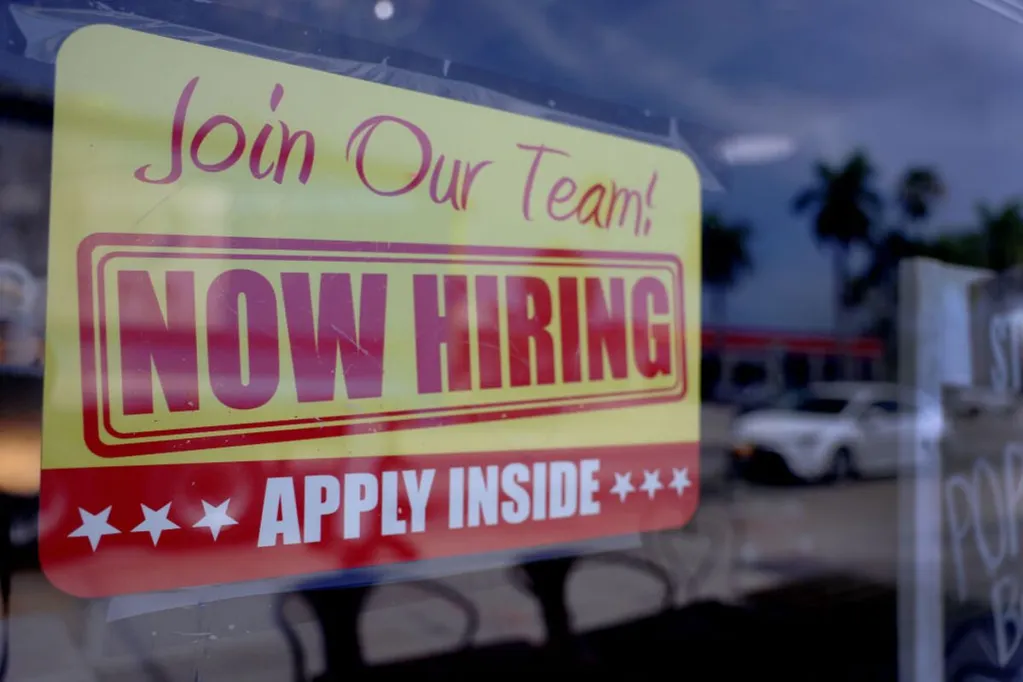
America is not, according to the official definition, in a recession. And yet the American labor market is so weak that it raises an obvious question: What's the difference? More precisely, how is today's labor market different from the labor market during a recession?
Maybe it's not so obvious. In the 18 years since the US economy last made the transition from expansion to contraction (as opposed to the abrupt shock of the pandemic), the labor market -- and the understanding of it -- have changed. The pain that was generally thought to be limited to recessions is much more pervasive than commonly realized because recessions aren't the only cause of constrained mobility in the labor market. There's now a different source: employer concentration.
What makes recessions so harmful to workers is the freezing of movement. The gears of the labor market -- gears that are constantly shuffling workers from job to job to unemployment to job again -- slow to a crawl. As headcounts shrink, workers with a job find it harder or riskier to switch; workers without a job, more numerous during recessions, find it takes longer to find one. Wage growth sputters.
This lack of movement is what is making today's labor market so damaging. A measure of slack in hires and quits, known as the Labor Market Tightness Index, shows a decline in conditions that is just as dramatic -- if not more so -- than a recession. Wage growth sees a parallel fall in the index.
I return to my non-obvious question: How come the labor market looks like we're in a recession if we're not?
Technological advances are a popular explanation. AI will certainly make some workers and jobs obsolete, and maybe the numbers show that process starting in real time. And the historically tight labor market of 2022 may have left many employers layoff-averse, given the time and expense it takes to hire. They can lean on AI to save money and manage headcounts. The historic plateau in the number of US jobs would seem to support this story.
There's only one catch: The change in the labor market has been happening for decades, while the AI economy is a three-year story. In addition, AI's ability to replace workers so quickly would be concentrated in a few firms in select industries.
The longer, broader story, the one that makes more sense, is employer concentration. The labor market has been heading toward a situation like this -- with recession-like conditions of slow gears even when the market should be tight -- for a while.
One way to see it is in the long-term unemployment numbers, which track the share of the unemployed who have been searching for at least 26 weeks. It typically spikes just after a recession and then falls until the next downturn. Since 1970, however, in both bad and good economies, it has been trending upward. Even during the tight labor market of 2022, one in five workers was long-term unemployed. Today it's one in four.
A group of economists recently studied why wage growth has stalled for the last four decades. They identify employer concentration and non-compete agreements, both of which limit the movement of workers, as the key explanations for weak wage growth.
Their findings fit well in a constellation of research about the labor market. Over the last decade, economists have found that a central source of wage growth is moving to a higher-paying firm, while a central source of wage decline is moving to a lower-paying firm. They have shown that anti-competitive employer concentration is pervasive in the US. There is a growing consensus that employers have monopsonistic power to set wages, as opposed to having wages determined via a competitive market.
It's intuitive: If you lost your job, would you want there to be one employer in your city, or one thousand? The more firms that can hire you, the better off you are. Employer concentration means most US labor markets are moving away from 1,000 employers and toward one. Even if that one employer is a high-growth, high-paying, high-productivity firm, it's still better for workers to have more firms to choose from.
In other words, the slow gears of recession labor-market churn have become something of a permanent feature.
The upshot is that anxiety about the possibility of a recession could be more productively channeled toward greater concern about employer concentration and its trilogy of discontents: reduced worker mobility, reduced worker power and reduced worker wages. There's no need to wait for a recession to be declared -- and in fact, improving the labor market now could make one less painful when it comes.