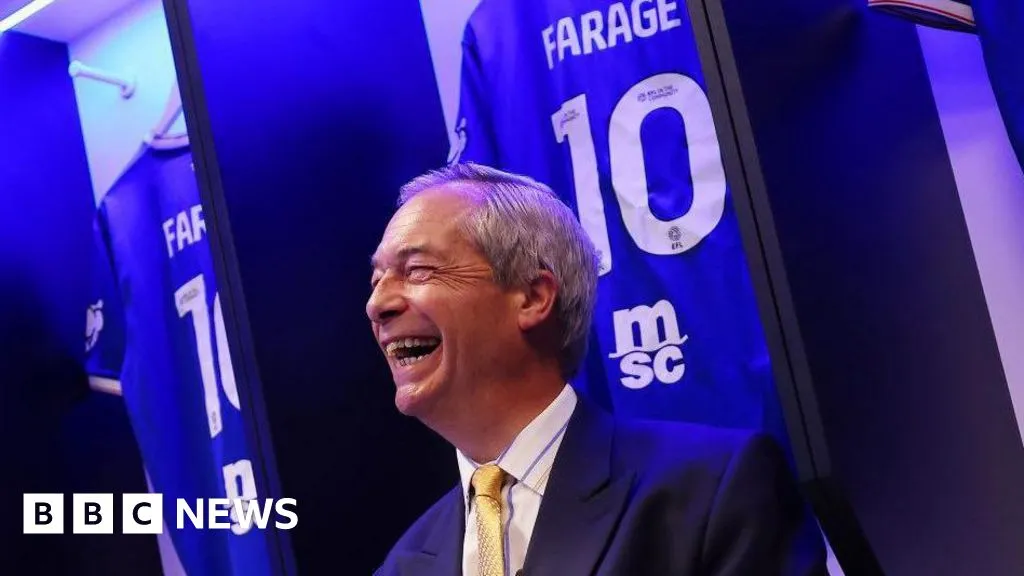
Reform UK leader Nigel Farage caused upset last month when he visited Ipswich Town's Portman Road stadium and posed with personalised shirts.
The club's chairman and chief executive, Mark Ashton, later apologised for the handling of the visit and the "harm and distress" caused to the fanbase.
Farage's visit sparked fierce debates, but politics and football have been closely linked for decades.
So why do politicians get involved with clubs and align themselves with the sport and could we see future generations of fans less willing to engage with politicians in this way?
Football is undoubtedly one of the biggest sports in the world with the power to unite people.
With that, politics has certainly played a part and the game sometimes used as a tool for campaigns and drawing attention to issues.
In other cases, politicians have simply come out claiming support for particular clubs.
Chris Lee, a football historian, author and podcaster based in London, says politicians publicly supporting clubs is happening more and more, especially since the rise of the Premier League.
But he says compared with parts of Europe, English football is "comparatively apolitical".
Lee brings up examples of the former Conservative prime minister David Cameron famously claiming to be an Aston Villa fan in 2015 before he accidentally slipped and said he was a West Ham supporter.
His remark came during a speech on his plan to increase opportunities for ethnic minorities.
"Where you can be Welsh and Hindu and British, Northern Irish and Jewish and British, where you can wear a kilt and a turban, where you can wear a hijab covered in poppies," Cameron stated.
"Where you can support Man United, the Windies and Team GB all at the same time. Of course, I'd rather you supported West Ham."
It came just weeks before the 2015 general election, but Cameron blamed "brain fade" and said "these things sometimes happen when you are on the stump".
It did not stop the unforgiving wrath of Twitter coming after him, however.
In 1995, Tony Blair, in possibly an attempt to show New Labour as cool, trendy and youthful, was captured doing headers with then Newcastle United boss Kevin Keegan during a party conference.
Blair would go on to lead a Labour landslide victory in the 1997 general election and the former prime minister would be seen having many kickabouts with those in the sport over the following years.
In more recent years, Conservative Rishi Sunak also came under scrutiny of football fans.
In 2022, prior to becoming prime minister, Sunak stated his club Southampton could improve their fortunes by beating Manchester United in their next upcoming weekend fixture.
The team were in fact playing Leicester City that weekend, but were playing United the following one.
Closer to home here in the East of England, there have been several examples of politicians visiting clubs.
Farage, now the MP for Clacton, Essex, appeared at Colchester's JobServe Community Stadium in September 2019, when he kicked off the Brexit Party national tour rally calling for a rapid exit from the European Union.
Harold Macmillan, a former Conservative prime minister who was in power between 1957 and 1963, also famously said,"most of our people have never had it so good",highlighting post-war prosperity during a rally at Bedford FC.
Labour's Sir Keir Starmer, prior to becoming our current prime minister, visited Northampton Town in 2024 to discuss the future of football governance.
When asked why he thinks politicians make use of football clubs during campaigns and events, Lee explains clubs are an "integral part" of communities.
"In Ipswich Town's case, as the only league club from Suffolk, it attracts support from the entire county, so its appeal is broader than solely one neighbourhood or city."
Lee says people feel "a sense of ownership and connection" with their club and, combined with their own political views, can create a mix of feelings when someone seeks to use the club for political gain.
"Politics and football mix, whether we like it or not," he continues.
"It always has, from sectarian violence around football in 1890s Belfast, to Mussolini's propaganda victory in the 1934 World Cup, or the Argentine Junta's World Cup in 1978 right to the present day; football and politics often overlap.
"Football is the world's most popular sport, so it generates headlines and serves as a platform for politicians."
Luke Smout, from near Ipswich, is a PR and communications specialist.
He says for both sides, they are trading control for exposure with various positives and negatives.
He explains politicians aligning with a club can help them reach hard-to-engage audiences, but the risk can outweigh their message.
For clubs it can offer a profile boost, but they similarly risk hurting fans' trust and it could be a distraction.
"They both want publicity; they think it's a good thing to do and obviously have in mind it could be negative but there's no such thing as bad publicity," he adds.
Culture and identity play a large part in football and more generally sports teams.
Eloise Skinner, who grew up in Hertfordshire and is now based in London, is a psychotherapist and author with a specialism in existential therapy including cultural change,generational values and identity.
She explains that stadiums represent "something larger than itself" as well as a "place in the community" where people come together,celebrate or rally together,and ultimately are therefore attractive to politicians and other public figures.
"Stadiums in particular have been associated since ancient Greek times or ancient Roman times with community spaces where there's a lot of top down power and people coming together to be subject to that in a sense."
Skinner says things might be changing when it comes to how young people view politicians and those who align themselves with sports teams as younger generations are increasingly "value orientated" with strong personal opinions.
"They really want to stand up for what they believe to be right,rather than just going with what they've been told; whereas with previous generations we might have had a bit more of a sense of allegiance to authority," she says.