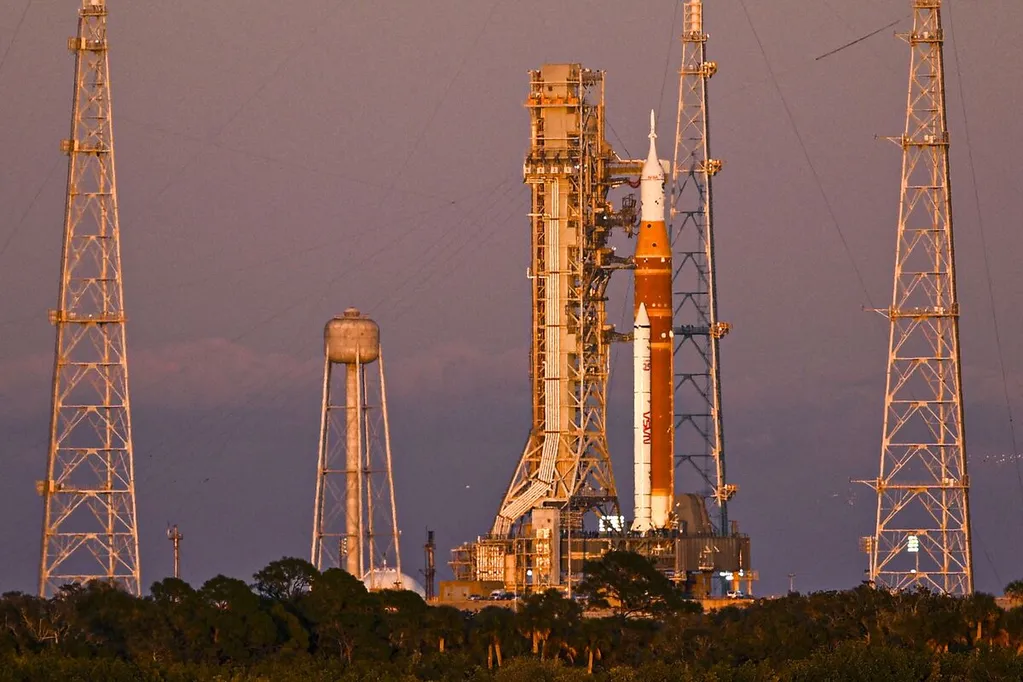
NASA sees the moon as a stepping stone for deeper space exploration, with the Artemis program aimed at gathering scientific data, building a lunar base, and creating a "lunar economy" that could eventually support further exploration, including a potential mission to Mars.
NASA pulled off the moon landing in 1969 with a clear goal from the outset: to be the first nation to put boots on the lunar surface.
The US was locked in a space race with the Soviet Union, and the Apollo 11 landing helped cement America's lead in the competition to be the reigning geopolitical superpower in the depths of the Cold War.
Now, NASA is heading back with its Artemis program. As early as April 1, the agency will send a crew of four around the moon as a precursor for a landing this decade.
But why spend nearly $100 billion to repeat a journey NASA has already made? The goal of Artemis is less obvious than that of Apollo -- so much so that the justification for NASA's lunar return largely depends on who is answering the question.
It could be about outracing its current rival, China. It might be sustainability -- setting up a lunar base to make further exploration easier. Or it could be much simpler: NASA is returning to the moon because it wants destinations for its astronauts, and the lunar surface is the next logical place to showcase its technological prowess.
"Human spaceflight is at the core of the institution of NASA going back to Apollo, and the self-identity of a large swath of the agency," said Casey Dreier, chief of space policy at the Planetary Society, a space advocacy group.
The Apollo program set a precedent that NASA should strive to have a flagship human spaceflight initiative that drives US space exploration forward. After Apollo, NASA's crewed efforts rallied around the Space Shuttle and then the International Space Station—both in low-Earth orbit rather than farther out in space.
With the Shuttle retired and the ISS set to end this decade, NASA sees a future where humans can travel deeper into the solar system.
"Now that, in a sense, NASA has done low-Earth orbit and done the reusable Shuttle, it's now the moon," Dreier said.
There has been tension for decades, however, about where the next cosmic destination should be: back to the moon or onward to Mars. Programs to do one or the other often struggled to stay funded because of limited resources and revolving political ambitions.
But in 2017, President Donald Trump signed an executive order to return humans to the moon, and thanks to a combination of hardware already in development and sustained political momentum, the Artemis program has endured. The moon is also in astronauts' reach with current technology, unlike Mars.
"We went to the moon and we have wanted to go back ever since," said Lori Garver, former deputy administrator of NASA under President Barack Obama. "And the combination of hardware and technology have allowed us to finally be in a position where that's in sight."
Mars, however, remains in NASA's sights. The agency hopes to use Artemis as a learning opportunity for what it would take to live off-world. Artemis missions will be focused on gathering scientific data about the moon and its resources, and eventually astronauts will build a base there, the design of which NASA unveiled on Tuesday. The lunar outpost will offer astronauts a deep-space environment in which to live, work and conduct experiments that could be applied to Mars living.
NASA has also said it wants to use Artemis to create a "lunar economy." The agency hopes resources on the moon, such as ice lurking in frigid craters and lunar minerals, could help sustain bases and perhaps create business opportunities for companies. Any industry will most likely be geared toward sustaining lunar exploration.
"When we think of the space economy, it will not be so centered around Earth," said Clayton Swope, deputy director of the Aerospace Security Project at the Center for Strategic and International Studies. "In the long run, though, we'll probably come to a point where we derive value from something in space that has value in space. So when I think of things like water on the moon, that will probably have value when there's activity happening beyond Earth."
Though Artemis began in Trump's first term, some of the primary vehicles for the program have been in development for decades. During that time, the geopolitical landscape has changed: China has made significant strides with its space program and plans to put humans on the moon by the end of the decade.
For lawmakers and defense hawks, that has added urgency for returning. Some, including former NASA administrator and former Senator Bill Nelson, have even said China could lay claim to resources that would prevent the US from exploring the moon. China could also militarize the moon, some analysts warn, putting US space assets at risk.
It's a situation not unlike the space race in the Cold War. But NASA is meant to focus on peaceful exploration. And though the rhetoric for international cooperation has dimmed under the current administration, the Artemis program has mostly revolved around showing that the US and allied nations can still achieve great things together.
Apollo was "anchored around national security, economic security, science, and then what I would call prestige," Swope said. "I think those are really the same reasons that we continue to want to go to the moon today."