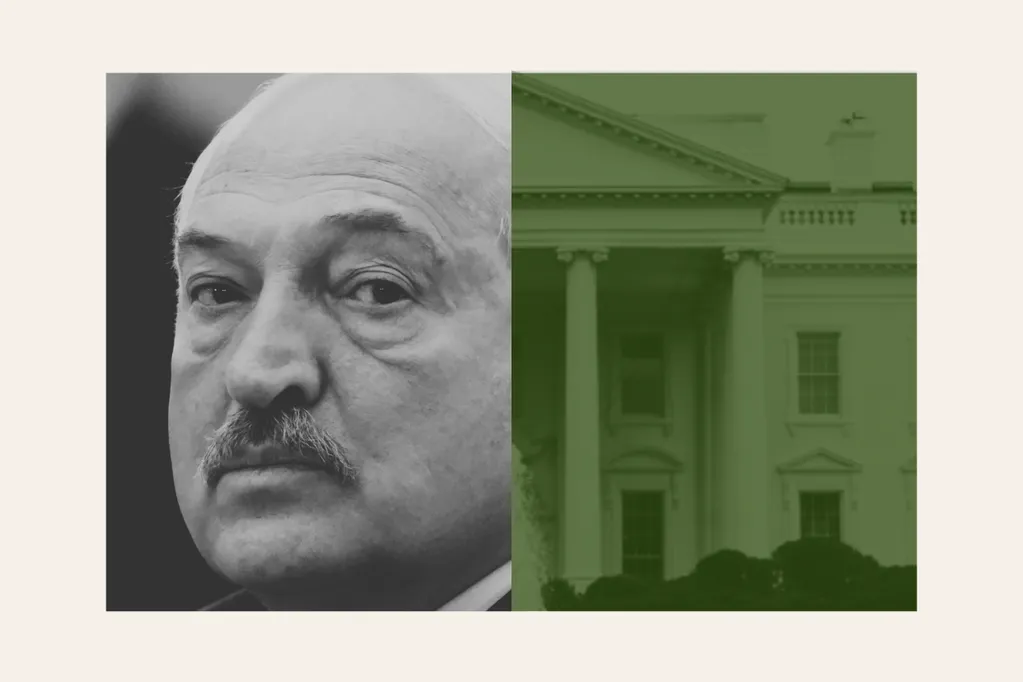
U.S. policy rested on isolation: Sanctions, a diplomatic freeze, and support for the Belarusian opposition.
That consensus is now shifting. In recent weeks, the Trump administration has signaled a thaw, sending a special envoy to Minsk, easing select sanctions, and raising the prospect of a meeting between President Donald Trump and Lukashenko on U.S. soil.
At the same time, Lukashenko has been keen to present himself as newly relevant, telling visiting Americans he wants to discuss not only Ukraine but wider conflicts, and suggesting he has ideas related to Iran.
This is not a moral reappraisal of Lukashenko. It is a strategic gamble. The Trump administration is testing whether Russia's closest ally can be turned into leverage at a time when conventional diplomatic tools have delivered little.
The immediate catalyst is transactional.
Trump's envoy for Belarus, John Coale, has made several visits to Minsk focused on securing the release of political prisoners, one of the few concessions Lukashenko can offer quickly without weakening his grip on power.
Following Coale's March 19 meeting with Lukashenko, Belarus released 250 prisoners as part of an arrangement tied to sanctions relief.
For Washington, the logic is straightforward. Prisoner releases provide a humanitarian justification for engagement with a long-isolated regime.
More importantly, they reopen a line of communication largely closed since 2022, with the potential to restore fuller diplomatic operations at a time when direct channels with Moscow are limited.
The prisoner issue is an entry point. Washington stands to gain greater access if its play pays off.
Moscow's response to the Minsk-Washington thaw is telling.
Russia's Foreign Intelligence Service (SVR) had warned in February about alleged Western efforts to weaken Belarus's alliance with Russia, an implicit acknowledgment that Minsk is no longer being treated as a fixed asset.
At the same time, the Kremlin has avoided directly attacking Trump's outreach, a restraint that avoids escalating tensions with Washington right as Moscow has the U.S. president's ear on Ukraine.
Belarus is central to Russia's strategic position. It borders NATO states and Ukraine and played a direct role in the early stages of the invasion.
While Belarusian troops have not formally entered front-line combat, the country remains deeply integrated into Russia's war effort, from logistics to infrastructure.
Ukrainian officials say that role is expanding.
President Volodymyr Zelensky has accused Russia of using Belarusian territory to enhance drone operations against northern Ukraine, one reason Kyiv has sanctioned Lukashenko and hardened its stance toward Minsk.
Even a limited U.S. opening could carry weight.
A Lukashenko who believes he has options has more room to maneuver within Russia's orbit, introducing uncertainty into a relationship the Kremlin prefers to keep tightly controlled and another pressure point to end its war in Ukraine.
Lukashenko has long tried to position himself as an intermediary between Russia and the West. He has hosted talks in the past and periodically offered to broker negotiations involving Moscow, Kyiv, and Washington.
His pitch hasn't changed. But Washington's willingness to engage with it has.
Coale's meetings in Minsk went beyond bilateral issues to include discussion of Ukraine and broader geopolitical questions.
For Trump, the attraction of a meeting with Lukashenko is clear. Lukashenko is one of the few leaders with direct access to Vladimir Putin and an incentive to demonstrate his usefulness.
In a diplomatic landscape where direct U.S.-Russia channels are strained, especially due to Trump's actions in Iran, Cuba, and Venezuela, Belarus offers a potential workaround.
Minsk could help to break the deadlock on finding peace in Ukraine, a top priority of the White House since Trump re-entered in January 2025.
But the risks are equally clear. Lukashenko's priority is not resolving the war in Ukraine but maximizing his own autonomy, legitimacy, and economic relief.
Engagement with Washington can serve those goals without altering Belarus's alignment with Moscow. He has long balanced between Russia and the West to extract concessions from both.
Minsk also appears to be positioning itself as a broader diplomatic player. During Coale's visit, Lukashenko raised not only Ukraine but wider issues, including Iran.
Belarusian state media later reported he had proposed his own scenario for ending that conflict, without offering details. An offer to mediate between Washington and Tehran competes with Moscow’s own desire to be a broker of peace in Iran.
By inserting himself into multiple conflicts, Lukashenko is signaling that Belarus should be seen as more than a single-use back-channel and a useful diplomatic player for Washington.
But that also deepens the risk for the U.S.
A Belarusian channel may simply transmit messages aligned with Kremlin interests while allowing Lukashenko to secure sanctions relief and a measure of legitimacy in return for limited concessions such as prisoner releases.
The softening U.S. approach is also at odds with Ukraine's evolving policy toward Belarus.
Kyiv has taken a harder line, sanctioning Lukashenko and warning of "special consequences" in response to Belarus's role in supporting Russia's war effort.
At the same time, Ukraine has deepened engagement with the Belarusian opposition in exile, including meetings between Zelensky and opposition leader Sviatlana Tsikhanouskaya.
This reflects a broader shift: Ukraine increasingly treats Belarus as a willing co-enabler of Russian aggression.
It's a divergence that complicates Washington's strategy. While the Trump administration is testing a narrow opening, Kyiv is moving to further isolate Lukashenko's regime.
European allies sit between these positions, themselves divided on how to engage with Belarus.
Sanctions risk pushing Belarus deeper into Russia's orbit and limited engagement could reduce that dependence. But normalization could strengthen an authoritarian regime without changing its strategic alignment to the Kremlin.
The result is a fragmented Western approach, with Washington experimenting, Kyiv resisting, and Europe divided.
At the center of this shift is a simple question: Does engaging Lukashenko create leverage over Russia or just give him more room to maneuver?
The answer depends on whether engagement produces measurable changes, such as reduced military integration with Russia or greater diplomatic independence. Without that, the policy risks becoming largely symbolic.
If so, Lukashenko could regain international legitimacy and economic breathing room while continuing to support Russia's war effort.
Washington, in turn, would have paid for access without gaining meaningful influence that yields long-sought results with Russia and in Ukraine.
Trump's outreach reflects a willingness to test unconventional options. Rather than treating Belarus as irreversibly tied to Russia, the administration is probing whether even a close ally can be partially leveraged.
It is a pragmatic approach, but one that runs up against recent history.
Lukashenko has repeatedly shown he can extract concessions without making lasting strategic shifts. Putin, meanwhile, has tightened Russia's hold over Belarus, especially since the 2020 protests that left Lukashenko more dependent on Kremlin support.
That limits how far Minsk can move, regardless of Washington's overtures.
The result is a test. The administration is trying to find leverage in a constrained environment, using engagement as a tool rather than an endorsement. Whether that produces real influence or simply reshapes the optics remains unclear.
What is clear is that all sides see an opportunity. Washington wants access. Lukashenko wants legitimacy and relief.
Moscow is watching closely to see whether either comes at its expense.