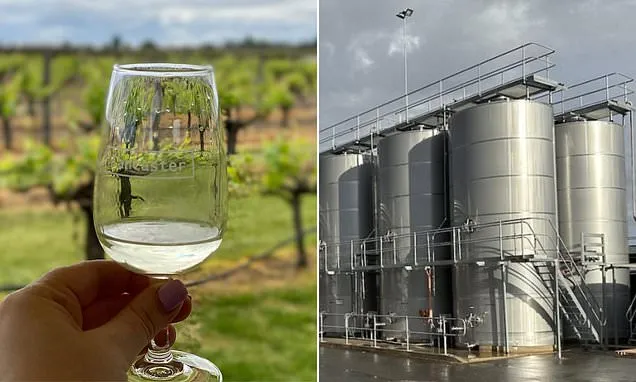
One of Australia's largest wineries has entered voluntary administration after failing to recover from the stifling impacts of the Covid-19 pandemic.
Winemasters SA, a Riverland maker established in the 1970s, appointed administrators on Tuesday, ASIC records show.
The specialist contract winery, formerly known as Riverland Vintners, offers processing services to customers, including pioneering selling bulk wine in China.
However, company director David Harris said the business never recovered from President Xi Jinping's harsh trade restrictions during the pandemic.
'In November 2020, President Xi said he had enough of us all and it all stopped. We lost 85 per cent of the business,' he told the Daily Mail on Friday.
'We never fully recovered. We had a good business before then. The Chinese came back but not the same as it was before.
'It's mathematically impossible to put grapes into a winery and sell them as bulk wine and make a profit. The more you do it, the more you lose at the moment.
'There's a lot of fruit being bought for nothing that is flooding the market.'
Winemasters SA, a Riverland maker established in the 1970s, entered voluntary administration.
Company director David Harris said the winery never recovered after harsh trade restrictions were introduced by China's President Xi Jinping during the Covid-19 pandemic.
Additionally, drinking patterns have changed, with Mr Harris saying younger people are drinking less than other previous generations.
'These kids are all goody two shoes now - they don't drink as much as we do,' he said. 'When things are profitable, you need to get big.
'When things are not, you need to stay small.'
Winemasters SA's facility near Monash crushes grapes from all major South Australian wine regions, about 1,000 tonnes a day.
It was put on the market last September but never sold, Adelaide Now reports.
Business turnaround adviser Eddie Griffith said he is working closely with the director and investors to develop a DOCA (Deed of Company Arrangement) for Winemasters SA.
The creditor pool includes Bendigo and Adelaide Bank, owed approximately $3.2 million; the Australian Taxation Office, owed around $300,000; and significant related party loans. There are no employee liabilities and no outstanding trade creditors.
The collapse of Winemasters SA is not a blip but a symptom of a wider issue.
This was highlighted by Ashley Ratcliff, who runs Ricca Terra - a winery made up of ten individual vineyards located in Barmera and Berri, South Australia.
'Nothing is really a shock at the moment,' he told the Daily Mail, adding the caveat that only staff are privy to a business's internal financial position.
'You always wish them the best. You know, this isn't good for anyone. This impacts owners, shareholders and staff. You need to be really compassionate.
'A lot of wineries or growers or distributors on a global scale, they're all finding times challenging currently.
'The guys that have got really smart business models or good brands or good grapes, good wines, they'll see this through. The businesses that may be a little bit on the weaker side, they will have amplified challenges that might pose bigger problems.'
Mr Ratcliff said there were well‑known issues across the sector, echoing concerns raised by Winemasters' director David Harris.
'There's been an oversupply of grapes and wine,' Mr Ratcliff said.
'You've got changing demographics in respect to what people are drinking and this is having a compounded impact.
'But it will change because what will happen is, you'll have companies going out of business, and supply will change and that will marry up with demand, and then you find ourselves back in a balanced position.'
The region has seen other businesses struggle over the last year, including McLaren Vale's Aramis Vineyards, Fox Creek Wines and Simon Hackett Wines.
Despite the state of the industry in Australia, Mr Ratcliff said he remains optimistic.
'I think that this is a correction that needs to happen,' he said, noting this may be a low point in the industry's cycle.
'There are certain people that shouldn't be in the wine industry, and there are people that need to stay in the wine industry, because they're the DNA of it.'
'It's interesting. We're going into a period of potential drought, very low vintage. But we could be sitting here in 12 months' time saying we don’t have enough wine.'