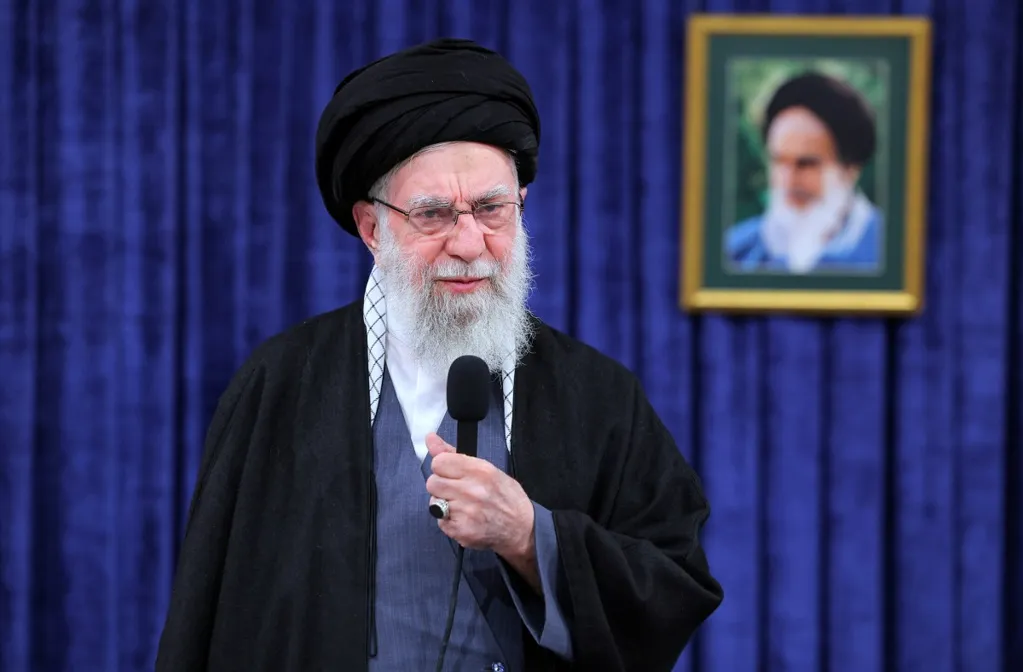
Iran's Supreme Leader Ayatollah Ali Khamenei's reported death by coordinated U.S. and Israeli strikes has prompted a cautious response from many leaders, including celebration from some and alarm from others, amid growing concerns over the strikes' legality, precedent, and the risk of wider regional escalation.
President Donald Trump said the strikes were intended to cripple Iran's nuclear and missile capabilities and urged Iranians to overthrow their leaders once the operation ends, telling them to "take over your government."
Khamenei was Iran's second and longest-serving supreme leader, taking office in June 1989 after the death of Ayatollah Ruhollah Khomeini, who led the 1979 revolution that established the Islamic Republic and ruled for about a decade. Khamenei has held the post for more than 36 years, serving as the country's ultimate authority and wielding sweeping power over Iran's foreign and domestic policy.
Since the 1979 Islamic Revolution, Iran has remained fairly isolated from many countries, with limited diplomatic relations with the United States and often tense ties with European powers and several regional rivals. Tehran has instead cultivated closer partnerships with countries such as Russia while backing allied armed groups across the region, including Hezbollah in Lebanon and the Houthis in Yemen. Iran has been repeatedly accused by rights groups of widespread human rights abuses, including torture, imprisonment of dissidents and deadly crackdowns on protests.
Amid ongoing speculation about Khamenei's whereabouts, Trump wrote in a Truth Social post on Saturday "Khamenei, one of the most evil people in History, is dead."
The announcement came hours after Israel and the U.S. launched a massive attack on the country and reports of Khamenei being found in the rubble circulated.
World leaders were much quicker to condemn the U.S. and Israeli strikes initially on Saturday morning, raising concerns about international law violations, than to respond to Khamenei's death. Iran has not confirmed his death.
Israeli Prime Minister Benjamin Netanyahu was one of the first to acknowledge the reported death and celebrate it, saying, "For 47 years, the Ayatollah regime has chanted 'Death to Israel' and 'Death to America.' It has spilled our blood, murdered many Americans, and slaughtered its own people."
In another post, he added, "There are many signs that the tyrant himself is no more. This morning, we neutralized senior officials in the regime of the Ayatollahs, commanders of the Revolutionary Guards, and top figures in the nuclear program."
Israel Defense Forces (IDF) shared an X post on Saturday identifying seven individuals affiliated with various leadership roles in Iran who have been killed in the strikes. Two particularly prominent individuals were listed, IRGC commander General Mohammed Pakpour and Defense Minister Aziz Nasirzadeh, among others. More senior Iranian officials have been reportedly killed.
The official X account of Ukraine celebrated Khamenei's death, writing in an X post: "Nothing beats the death of a dictator."
Prior to the reports of Khamenei's death, British Prime Minister Keir Starmer, French President Emmanuel Macron and German Chancellor Friedrich Merz said in a joint statement, "We condemn Iranian attacks on countries in the region in the strongest terms. Iran must refrain from indiscriminate military strikes. Ultimately, the Iranian people must be allowed to determine their future."
Canadian Prime Minister Mark Carney backed the U.S.'s strikes, saying, "The Islamic Republic of Iran is the principal source of instability and terror throughout the Middle East, has one of the world's worst human rights records, and must never be allowed to obtain or develop nuclear weapons."
Representative Yassamin Ansari, the first Iranian American Democrat elected to Congress, said in an X post: "Khamenei was the epitome of evil. For decades, he oversaw the torture, imprisonment, and murder of countless Iranians who dared to demand freedom. American blood is on his hands as well. No one should mourn him and his death is a relief. But removing one man does not dismantle a brutal regime. Military force alone will not secure a democratic future for the Iranian people, and it risks putting U.S. troops in further danger if there is no serious plan for what comes next. An action of this magnitude demands strategy, clarity, and a credible path forward. I want nothing more than a free Iran and safety and security for innocent Iranians. That requires more than force. It requires seriousness, accountability, and a real plan to support the Iranian people in determining their own future."
Nader Hashemi, a Georgetown University professor and co-editor of The People Reloaded: The Green Movement and the Struggle for Iran's Future, told Newsweek in an email statement Saturday: "If true, it's a major development. He was the most powerful person in the regime. I strongly suspect his death was anticipated and a successor has already been selected. Khamenei wanted to die this way, a martyr at the hands of his arch enemies."
Secretary General of the United Nations Antonio Guterres said on Saturday: "Everything must be done to prevent a further escalation in the Middle East. I call on all sides to strictly uphold their obligations under international law, including the @UN Charter, protect civilians & ensure nuclear safety. Let's act responsibly & together to pull the region & our world back from the brink."
In a Truth Social post on Saturday afternoon, Trump wrote that "the heavy and pinpoint bombing" in Iran "will continue, uninterrupted throughout the week or, as long as necessary to achieve our objective" of peace throughout the Mideast and world.