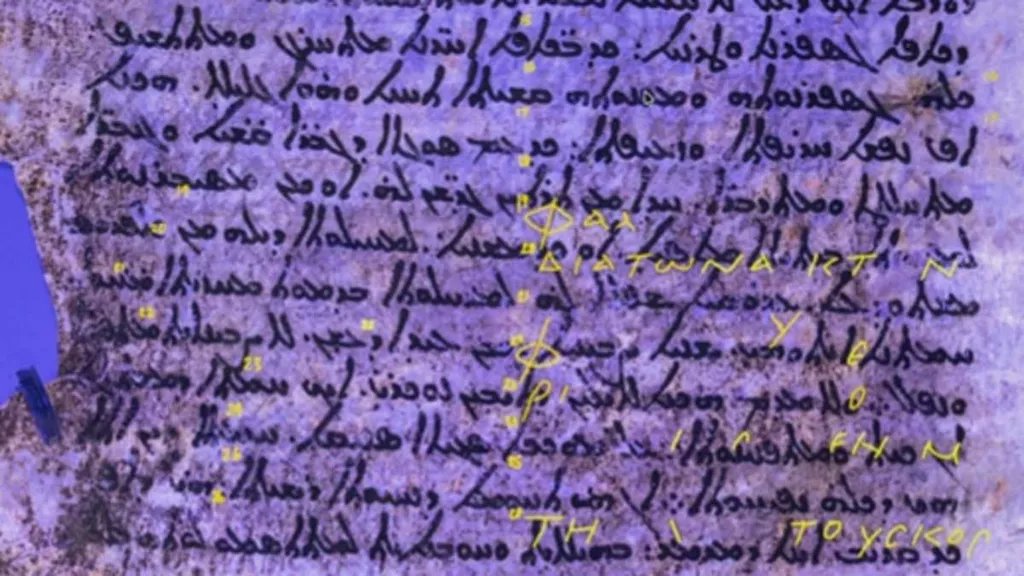
Scientists are reconstructing the oldest known map of the night sky - long thought lost to time - by using X-rays to reveal its secrets.
The map, which was created around 2,000 years ago, has spent centuries hidden under a medieval manuscript.
It is thought to be the work of famous Greek astronomer Hipparchus, who lived from around 190 to 120BC - long before the invention of the telescope.
Four years ago, in 2022, analysis of a 6th century monastery text revealed it could contain the ancient star map underneath.
Now, experts at the SLAC National Accelerator Laboratory in California are using X-rays to bring the ancient cosmos back to life.
'The goal is to recover as many of these coordinates as possible,' Victor Gysembergh, the lead scholar on the experiment, told KQED.
'And this will help us answer some of the biggest questions on the birth of science. Why did they start doing science 2,000 and more years ago? How did they get so good at it so fast?
'The coordinates we are finding are incredibly accurate for something that is done with the naked eye.'
The map, which was created nearly 2,000 years ago, has spent centuries hidden under a medieval manuscript.
While the original text contained ink with hints of calcium, the overwritten version used ink rich in iron - allowing the team to visually separate the two.
The medieval manuscript, called the Codex Climaci Rescriptus, is thought to have been originally recovered from St Catherine's Monastery in Egypt.
Since parchment was expensive in the Middle Ages, material was often scraped clean of ink and reused - which scientists expect may have happened here.
In order to closely analyse the parchment, the researchers used an X-ray that can distinguish between different chemicals in a material without damaging it.
While the original text contained ink with hints of calcium, the overwritten version used ink rich in iron - allowing the team to visually separate the two.
The team have already identified the word for 'Aquarius' and descriptions of 'bright' stars within that constellation.
'This new scan that we started...line after line of text showed up in ancient Greek from the astronomical manuscript,' Dr Gysembergh said.
The team said they can now use the information to try and answer questions about how ancient astronomers achieved such accurate results without the use of magnifying instruments.
A total of 11 pages are currently being scanned at the SLAC lab. The entire manuscript runs to around 200 pages in total - but the rest of the pages are scattered around the world.
The team said they can use the information to try and answer questions about how ancient astronomers achieved such accurate results without the use of magnifying instruments.
Who was Hipparchus?
Hipparchus (c. 190-120 BCE) was an ancient Greek astronomer and mathematician.
He is often called one of the greatest astronomers of antiquity and sometimes the father of scientific astronomy.
Hipparchus is famous for creating one of the first star catalogues, recording the positions of hundreds of stars in the sky.
He also discovered the 'wobble' of the Earth and created one of the first trigonometric tables.
In a video uploaded to the SLAC YouTube channel, the researchers present the manuscript and say: 'This is the Codex Climaci Rescriptus, a set of ancient pages that hide a secret.
'But X-rays can reveal the truth.
'A long-erased star map lies beneath the text and hasn't been seen for hundreds of years...until now.'
Dr Gysembergh added: 'Row by row, the ancient Greek text of the astronomical manuscript is gradually emerging.'
'The opportunity to reconstruct the first map of the night sky is an extraordinary achievement for science.'
In order to ensure maximum protection the manuscript pages have been put in custom-made frames, placed in humidity-controlled cases, and carried by hand.
Light in the scanning room is also deliberately controlled to prevent further ink fading.
Hipparchus wrote much about the cosmos, pulling inspiration from Pre-Socratic philosophers, Aristarchus of Samos, Eratosthenes, and Archimedes of Syracuse, as well as from Babylonian and Egyptian sources.
Not much is known about the private life of the astronomer except that he was born in Nicea, a city in the region of Bithynia in Asia Minor (modern-day Turkey), and is said to have died in Rhodes.
All his writings, except for one, have been lost and only noted in second-hand reports.
The researchers think that Hipparchus's coordinates may have included observations of nearly every visible star in the sky.
Since telescopes were not yet in existence, experts have proposed the ancient Greek astronomer likely used a sighting tube that would have taken 'countless hours of work.'