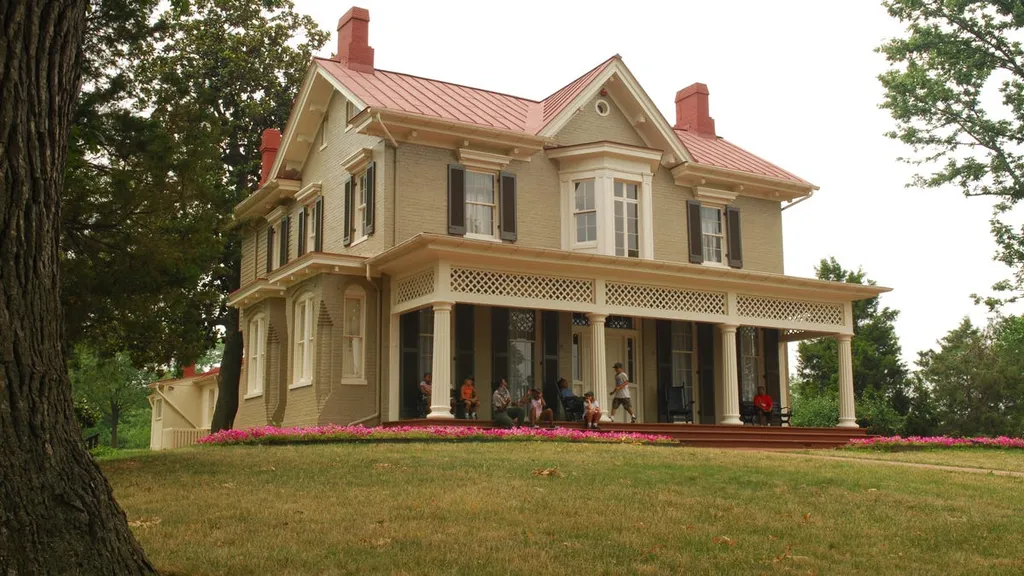
USA TODAY's Michelle Del Rey explores the nation's capital to visit some of its hidden gems.
Just off a busy boulevard in one of Washington, DC's historic black neighborhoods sits the home of abolitionist and orator Frederick Douglass.
Douglass lived in the estate called Cedar Hill, now part of the Frederick Douglass National Historic Site, for the last 17 years of his life. He moved into the home in 1878 and died in the foyer in 1895 after suffering a heart attack. A year after his death, his wife, Helen Pitts Douglass, a white suffragist, created an association to encourage people to make pilgrimages to the estate.
It became part of the National Park Service in 1962 when President John F. Kennedy signed Public Law 87-633, making it permanently protected by federal law.
Why it matters
Born a slave in Talbot County, Maryland, in 1818, Douglass, whose birth name was Frederick Augustus Washington Bailey, is considered one of the most influential figures in the early U.S. Civil Rights Movement. Douglass became such a prominent figure during his lifetime that, according to some historians, he is the most photographed American of the 19th century.
By disguising himself as a free Black sailor, he escaped slavery in 1838. He rose to fame after publishing his 1845 autobiography titled "Narrative of the Life of Frederick Douglass, an American Slave." Though Douglass was not allowed to read as a slave, he taught himself how to read and write as a child.
Douglass moved to the Cedar Hill residence the year he was appointed US Marshal for the District of Columbia. He lived there with both his wives, Anna Murray Douglass and Pitts Douglass.
When he moved into the home, the neighborhood, now known as Historic Anacostia, was called Uniontown. While nearly 92% of Anacostia's current population is Black, Douglass was one of the only Black residents in the neighborhood, which was predominantly white upper class.
Location
The Frederick Douglass National Historic Site is located at 1411 W St SE, Washington, DC, 20020.
The sprawling 8-acre estate sits atop a 50-foot hill overlooking Washington and offers sweeping views of the Potomac River and U.S. Capitol.
What to see today
The historic home boasts a rare collection of original artifacts, including a bust of Frederick Douglass made by sculptor Johnson Mundy, the family's china collection, original dining table chairs and the abolitionist's sitting bed.
Today, visitors can take a peek into the abolitionist's life by taking a National Park Service tour. Because the home is operated by the agency, it's free to visit year-round. Tours typically last 1.5 hours, as the guides walk visitors through the home and explain the residence's significance.
Plan your visit
As tour groups are small, it's encouraged to make reservations prior to visiting. Visitors can book tickets on the National Park Service's website.
The home can be reached via car and public transit from Downtown Washington. Free parking is available on site. If taking the Metro, visitors should use the Green Line and get off at Anacostia Station. The site is approximately 3/4 miles from the station.
After arriving at the historic site, visitors should begin their experience at the visitor center. There, guests can pick up brochures, guided tour tickets, watch an introductory film and experience exhibits featuring a life-sized statue of Frederick Douglass and quotes from his writings.
The home provides a fascinating glimpse into the life of one of the most famous Black men of the 19th century.
Michelle Del Rey is a trending news reporter. Reach her at mdelrey@usatoday.com.