In the Bible, humanity attempts to build a tower to reach the heavens -- until God scuppers everyone's plan by making them speak different languages and dispersing them across the world. "It's permanently the most controversial building because it can never be completed," says the American architect Daniel Libeskind, 79. He considers the Tower of Babel an ancestor to other incomplete projects that illustrate humanity's hubris like the Line in northwest Saudi Arabia, an ongoing, albeit increasingly scaled-back, development that would include a carless 106-mile horizontal "skyscraper" stretched across the desert, and Palmanova, a turn-of-the-17th-century Italian fortress that was to encase an ideal city -- if only they could get anyone to live there.
A former office of Italy's National Fascist Party, Casa del Fascio embodies "the tension between great architecture and the circumstances in which it was built," says the Japanese architect Toshiko Mori. While Fascist architecture was intended to overwhelm "the human scale, this building is very human, lightweight and luminous. In its own way, it subverts the idea of fascism. The architect's political affiliation broke under [the weight of] his talent." Today, Terragni's geometric structure houses the Italian financial police, the Guardia di Finanza, and is considered a jewel of postwar Italian architecture.
What began as an effort to build a capital city for Punjab after India attained independence in 1947 became, according to Libeskind, "a relic of a colonial imagination." India's first prime minister, Jawaharlal Nehru, invited the Swiss French architect Le Corbusier to design civic buildings for a new, forward-looking urban hub. But the results were "so odd and unrelated to the life of the people of Chandigarh," he adds, that it proved the limitations of importing an architect from an unrelated context. "Even a great architect like Le Corbusier couldn't foresee his own failure."
Who's allowed to make a building? And when does a work of art become a work of architecture? These questions play out in the story of the Watts Towers, a series of 17 aerodynamic structures made from wire mesh and thin-shell concrete reinforced with steel and patched with tiles and pieces of colored glass -- which the New York-based architecture and design critic Alexandra Lange, 53, refers to as an "architecturally scaled outsider-art project." Having survived a proposed demolition in 1959 and the uprising in the Watts neighborhood in 1965, the towers became a National Historic Monument in 1990.
What should be done with once-beloved buildings that have fallen out of favor with those in power? Tange's gymnasium, which Mori describes as "a masterpiece" of Japanese postwar design, offers a case study. "It never achieved historic status because it's not old enough to qualify," she notes. The government sought to demolish the building, which has been closed since 2014, after it was declared unsafe. Although a privately funded committee proposed refurbishing it last year and a lawsuit was recently filed to block its destruction, its fate remains uncertain.
One of America's most famous examples of Brutalism, Boston City Hall "is often cited as the country's ugliest building," Lange says. Imposing and blocky, it was one of a wave of Brutalist municipal buildings erected in the United States in the 1960s that "made people feel like, 'Does the government hate me?'" Over time, some came around to its monolithic grandeur, and it became a city landmark in 2025. But, Lange admits, "there are those who are never going to like Brutalism."
In the late 1970s, Gehry renovated his house -- and rankled his neighbors in the process. With a budget of $50,000, he wrapped a classic-looking bungalow with chain-link fencing, plywood and cinder blocks, using "all these cheap construction materials in a totally different way, blowing it out and blowing it up," says Lange. The home, according to Lange, became an icon of the architectural style known as Deconstructivism, which focused on breaking conventional forms. "At the time, it was seen as aggressive."
The swooping concert halls built on top of an existing brick warehouse reflect "how controversy ages over time," Mori says. The project was the subject of fierce debate during its protracted construction. First scheduled for completion in 2010, with a budget of just over $300 million, it ended up costing nearly $1 billion by the time it finally opened in 2017. Once it was finished, "the public perception completely changed. Everyone loves it. You can't get tickets."
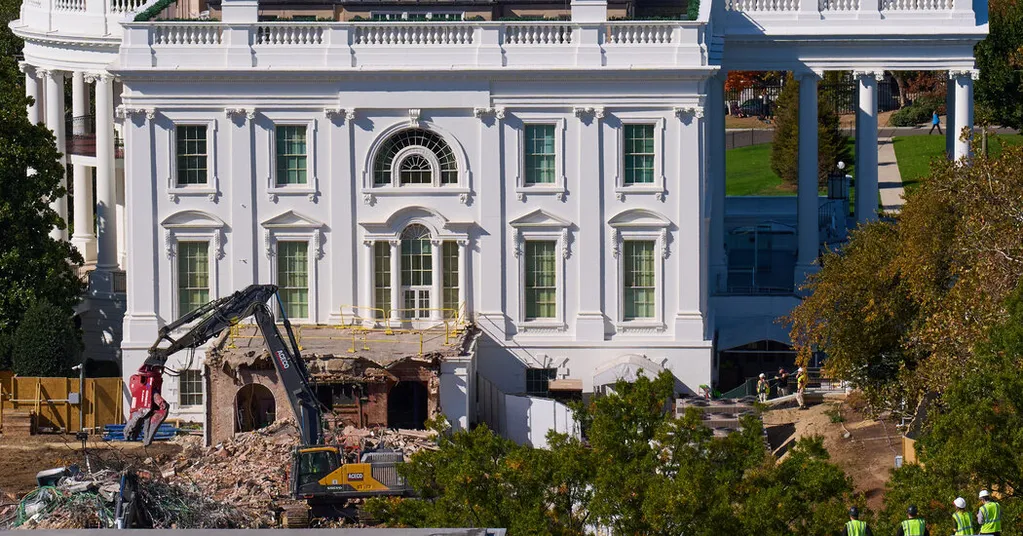
Well before its scheduled completion in 2028, the White House Ballroom has become a flashpoint in debates over U.S. presidential authority, historic preservation and the conservative push to return to Greek and Roman design principles. The Trump administration demolished the East Wing to make room for the new building, which Libeskind says will "dwarf" the rest of the White House. (In response to such speculation, President Trump, who wrote on social media that the ballroom would be "The Greatest of its kind ever built!," has said that the new structure won't be taller than the Executive Mansion of the White House.) "It will be controversial for a long time because it'll change the appearance of the White House as the house of the people," Libeskind says.