PHOENIX -- A Phoenix Republican lawmaker is trying to jump-start construction of a controversial stretch of the proposed Interstate 11.
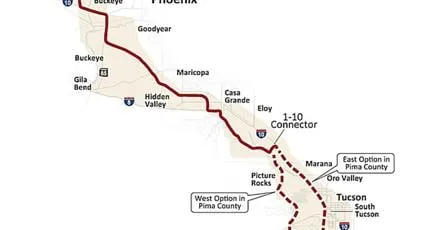
The proposal by Rep. Matt Gress would direct the Arizona Department of Transportation to ask the Federal Highway Administration to consider a stretch between Casa Grande and Wickenburg separately. He said that would expedite the necessary studies that have been halted because of litigation over whether state and federal highway officials ignored environmental concerns when they mapped out a route for the segment around Tucson, which stretches between Nogales and Casa Grande.
But Gress is running into opposition from those who question not just the tactic but the larger issue of whether I-11 should be built.
"This is a very expensive proposition,'' said Sen. Mitzi Epstein, with estimates of the pricetag for building the road from Nogales to Wickenburg running anywhere from $3.1 billion to $7.3 billion.
And it's not just capital costs, said the Tempe Republican about a project. Even if the feds pick up 90% of construction -- what has been the practice in the past -- it is the state that is left with maintaining the road.
"We don't take care of the freeways and the roadways we have now,'' she said.
Sen. Brian Fernandez of Yuma agreed. He pointed out that lawmakers have not raised the state's 18-cent-a-gallon gasoline tax -- the primary source of dollars into the Highway User Revenue Fund that pays for road repairs -- since 1990.
And he said that the roads outside Maricopa County, where voters have approved a local sales tax for transportation projects, "they vary in degrees from decent to really, really terrible.''
But it's not just Democrats raising questions.
"We can't keep up our own roads,'' said Tucson Republican Sen. Vince Leach.
Beyond construction and even maintenance costs, he said the state remains on the financial hook to build the connections between the freeway and existing roads.
But Leach agreed this past week to vote to get the proposal by Gress out of the Senate Committee on Appropriations, Transportation and Technology on a 6-4 party-line vote.
Still, the future of the plan remains in doubt. Even Sen. David Farnsworth, who chairs the committee and voted for the bill, said he is unsure whether he will support it when it reaches the full Senate.
"We have a lot of other needs,'' said the Mesa Republican.
What's driving what Gress is trying to do is a 2022 lawsuit by the Center for Biological Diversity.
The Tucson-based group, along with the Coalition for Sonoran Desert Protection, the Friends of Ironwood Forest and the Tucson Bird Alliance, contend that state and federal officials, in planning an alignment of the road, did not do the proper and legally required environmental studies.
Much of the focus is on where to build the road through -- or around -- Tucson.
One option being considered is to co-locate I-11 along existing stretches of I-19 and I-10, at least through the area of Picacho Peak. That likely would mean widening I-10 through Tucson.
From Picaco Peak, an entirely new highway would be built to the north and west.
But there also is the option -- actually labeled at one point as the preferred one -- to have I-11 divide off from I-19 north of Green Valley. Then the road would head west around the San Xavier Reservation and then cutting north near Tucson Mountain Park and Saguaro National Park, both points of contention.
"Every Arizonan should be deeply concerned about the thinking of Federal Highway and ADOT here, that they would run a major interstate between a national park and a national monument and right smack through really culturally rich, archaeologically rich valley that's important to tribes,'' said Russell McSpadden, the Southwest conservation advocate for the Center for Biological Diversity, when And there's something else. That route also runs directly through what's known as the Tucson Mitigation Corridor.
That corridor is not new. It actually goes as far back as the 1980s as part of the development of the Tucson leg of the Central Arizona Project.
Part of the reason for its creation was to minimize disruption to wildlife during aqueduct construction. But it also prohibits future development in the 4.25 square mile area to "preserve this fragile desert habitat from urbanization and maintain an open wildlife movement corridor.''
Foes last year won a temporary reprieve when the Federal Highway Administration agreed in a court filing to re-evaluate its environmental impact statement, which concluded there was no problem with where it proposed to locate I-11. That now requires the agency to decide whether its original decision remains valid "or a supplemental or new analysis and new decision is needed.''
As part of the agreement with highway foes, the federal agency also will allow a 60-day public comment period after it has reached a decision.
More to the point, it agreed to take no further action to advance planning work on the highway.
The most recent status report, filed on March 16 with the court, said the Federal Highway Administration anticipates it will complete its reevaluation sometime this fall. But agency lawyers told the judge they cannot provide a date for a final report.
It is that uncertainty -- with no firm date of completion -- that is behind the bid by Gress to push ahead by asking the feds to divide the project into two segments.
One would be the more controversial one between Casa Grande and Nogales. That, he said, would remain undisturbed by the legislation.
Gress contends, however, that segmentation would free up progress on the stretch between Casa Grande and Wickenburg.
But Sandy Bahr, president of the Grand Canyon Chapter of the Sierra Club, said what Gress is pushing is based on a flaw in his reading of the lawsuit.
She said the litigation is not limited to what is occurring around Tucson.
It also questions that northern segment -- the part Gress wants to separate because he thinks it can be expedited -- because the proposed route runs adjacent to the Sonoran Desert National Monument. There are claims it would cut off access for some animals to the area.
Bahr told lawmakers there's also a larger question of whether a new freeway between Nogales and Wickenburg makes sense and is needed. Issues of additional air pollution aside, she said it would promote more urban sprawl -- and do so at the benefit of those who own land near the proposed freeway.
"It would destroy pristine Sonoran desert, harm threatened desert tortoises, harm wildlife,'' she said.
And Bahr said that the pending lawsuit also alleges that state and federal transportation officials, who have advanced the freeway as necessary for commerce, did not consider alternatives like rail.
Gress, however, said there is bipartisan support, not only for the project but for his proposal to break it into segments to allow some work to start. He cited a letter that was signed by seven of the state's U.S. representatives, as well as Sen. Mark Kelly, all asking the governor for segmentation.
"All this is saying is: ADOT, apply to the Federal Highway Administration for segmentation,'' Gress said.
Still, even he acknowledged that the move, if approved by the feds, wouldn't necessarily clear the way for construction of the road. Gress said none of that keeps foes from mounting additional challenges to the Casa Grande to Wickenburg segment.
If the bill is approved, it would have to be signed by Gov. Katie Hobbs.
And, until now, the governor has sought to stay out of the legal fray.
She told Capitol Media Services in 2024, even after the lawsuit was filed, that she would not use her power to direct ADOT to scrap a proposal that could route Interstate 11 west of Tucson next to Tucson Mountain Park.
The governor also has shown she is loath to get in the middle of a fight between business interests that want a new freeway -- including some landowners in the area whose property would become more valuable -- and the potential damage to the area.
"Every project is battling environmental groups,'' Hobbs said at the time. "We have to balance progress and sustainability.''
The governor's office said this week she has nothing more to add.
There actually already is work being done on Interstate 11, billed as a piece of what will connect Mexico through Nogales to Canada.
Nevada already has built a stretch between Las Vegas and the Colorado River. And in Arizona, there is work going on to improve U.S. 93, which runs between Wickenburg and the Nevada state line, to widen it and eventually make it part of the highway.