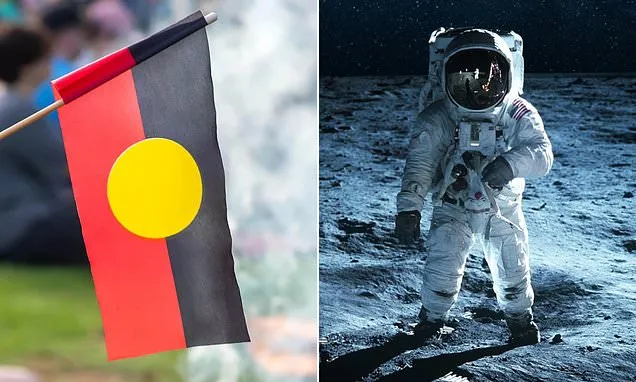
The Albanese government has awarded a university more than $500,000 to weave Aboriginal and Torres Strait Islander knowledge into Australian space policy.
The Australian Research Council (ARC) has revealed the latest recipients of its $103million Discovery funding for early-career researchers.
Among the projects now flush with government cash is one run by University of Newcastle's research fellow Dr Lara Daley, who was awarded $528,491.
Her study aims to 'broaden Australia's understanding of space by recognising long-held Indigenous knowledge systems and their relevance to sustainable human activity beyond Earth', the university said on Wednesday.
'Guided by Yolngu and Gumbaynggirr Custodians, Dr Lara Daley's project will help shape culturally respectful and environmentally responsible space exploration,' it said.
'Learning from songlines, creation stories and deep cultural connections between people and sky Country, the research will develop intercultural guidelines to help inform space policy, public education and industry practice.'
But the study has been questioned by some Aussies online, with critics calling the funding 'unbelievable' and questioning its real-world value for Aboriginal and Torres Strait Islander people.
'How does this improve the lives of Indigenous communities?' one person asked.
A University of Newcastle project to introduce Aboriginal and Torres Strait Islander knowledge into Australian space policy has been awarded $528,491 in government funds.
The study, run by Dr Lara Daley, aims to 'broaden Australia's understanding of space by recognising long-held Indigenous knowledge systems'.
'I'm sure the Indigenous community could have put this to a better project or use if they were aware of it,' another person wrote.
Daily Mail has contacted the University of Newcastle and ARC for comment.
According to the National Museum of Australia, the dark spaces between stars are as important for Indigenous people as the stars themselves.
'It shows when seasons and tides change and when certain foods are available. Although there have been many advances in technology and our knowledge of the solar system has expanded, people still look up at the stars for answers,' it said.
'They remain important in understanding our place in the universe.'
Among the 200 government-funded projects, some take an unexpected approach.
A University of Melbourne study received $530,079 for an investigation into whether AI and robots can perform believable comedy.
Dr Robert Walton aims to address a significant gap in Australia's understanding of machine capabilities and human-robot interaction by producing the first major study on robot comedy performance.
Pictured is a University of Newcastle building
Monash University's Dr Emily van der Nage was awarded $525,650 to explore social, ethical and regulatory challenges in Australia's emerging social media pornography industry.
'It will generate new insights into social media porn work, using qualitative methods that centre the experiences of porn creators and audiences,' the project description said.
Another Monash University project, run by Dr Blair Williams, will explore the role of Australian women's magazines in shaping political discourse, backed by $528,288 in funding.
Some projects hope to look at improving Australian infrastructure, including the Australian National University's $507,308 project to understand how plants sense drought using specialised protein sensors.
'This offers a promising route for engineering climate-smart crops with enhanced drought resilience, leading to better water use, increased yields and strengthened food security,' it said.
RMIT University researcher Mohammad Saberian Boroujeni will use $514,678 to investigate how using food waste can create next-generation roads.