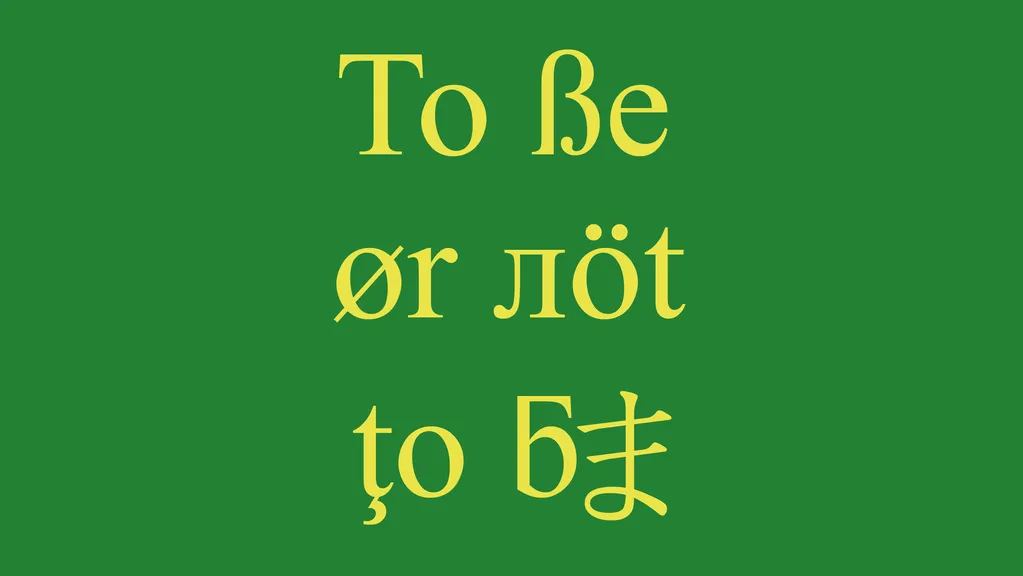
A Japanese person once told me that Shakespeare productions are sellouts in Japan. To say that Japanese and English are different languages is an understatement, and given that Shakespearean English and Modern English are at least different dialects, I wondered just how translators rendered the likes of "King Lear" into Japanese. Or any other language, really. What makes the Bard's language sublime would seem impossible to render effectively in any language but the one he wrote in.
The translator Daniel Hahn teaches us that this isn't true. Shakespeare's plays have long been translated worldwide, and Hahn has consulted countless translations both old and new. He has also interviewed what he calls his "flock" of over a dozen translators of Shakespeare's work. His goal is to show us how diligent translation can give an audience what Shakespeare did (or at least almost) in any language. Or, as he puts it, Shakespeare "can be appreciated for all his qualities even if we don't hear a single one of his words."
The upshot is often, in its way, a little sad. This translating achievement means that audiences hearing Shakespeare in other languages can understand the text more easily than Anglophones usually can. Shakespearean English is further from ours than we often know. The words are familiar, but the reason the text can sound in real time like a radio station poorly tuned in is that the meanings of so many of the words have so often changed so much. In Shakespeare's time, "wherefore" meant "why" -- Juliet wasn't asking "where" Romeo was when he was standing right in front of her. "Wit" meant knowledge, not arch humor. "Generous" meant "noble." "Light" could mean "sexually licentious."
People at a Shakespeare play in other countries don't have to deal with these false friends because the translations are into the modern language rather than the language as it was centuries ago. As Hahn notes, "Meanings that would have been clear to a Globe audience four centuries ago, and that have faded into obscurity (because our English is no longer Shakespeare's), are now clear again in Ukrainian or Korean." An American linguist friend of mine once admitted to me that the first time he really understood a Shakespeare play was when he watched it in French, and in other countries Shakespeare translations have often been updated over the years as the language changes.
Alas. But Hahn devotes each of 38 of his chapters to one of the problems a translator of Shakespeare faces in lending audiences this comprehension of such subtle and complex texts. Topics include rendering wordplay, punctuation, word order, levels of formality, and how characters who speak different dialects or even different languages will talk. In a "Julius Caesar" in Latin -- although frankly I'm not sure what the purpose of that translation is! -- Caesar's dying "Et tu, Brute" is in Greek, which is actually what some observers of the actual event recalled.
Hahn delights in how translators have conveyed the intricacies and nuances -- and hopefully even jokes -- through languages with different sounds, rhythms and word order. Even the "same" word between languages is, upon examination, different in each. English's "love" conveys a rather wide splotch of meanings, which many languages submit to a division of labor between two or more words -- i.e., in Russian, if you say you "loved" a book using the "love" word, it sounds as if you had feelings for it. In Romance languages like French and Italian, words are generally longer than English ones, making it harder to convey terser passages. Some languages’ rhythms would make iambic pentameter hopelessly limit a translator’s possibilities, requiring a decision as to what alternate poetic template to use, if any.
For all that Hahn wants us to think the translators are rendering Shakespeare as different but the same, sometimes I sense that some translations of Shakespeare are more like poeticizations. At a "Macbeth" production I once attended, a Russian family behind me were enthusiastically talking about the play so familiarly that it resembled the way Americans might discuss "Gilmore Girls." I turned and asked them who had written the translation they were talking about and the paterfamilias answered that it was by the poet Boris Pasternak. Hahn compares Pasternak’s “Romeo and Juliet” with that of his contemporary Anna Radlova, and shows that while Radlova conveyed Shakespeare’s prose line by line faithfully — although artfully — often Pasternak substituted his own poetic sensibility for Shakespeare’s, departing considerably from the original vocabulary, rhythm and sometimes even meaning. I’m not sure the people behind me “knew” the “Macbeth” they were discussing as well as they might have if it had come from Radlova.
But only in Hahn’s book could I have compared those two translations to understand this, which is symptomatic of the very fullness of the book. Hahn leaves no stone unturned, informing us that the languages quoted in the book include “Arabic, Azeri, Bulgarian, Cape Verdean Creole, Danish, French, Hebrew, Hungarian, isiXhosa, Italian, Japanese, Kurdish, Latin, te reo Māori, Portuguese,Russian, Swahili, Thai, Turkish and Yiddish.” “Hold me back!” say I, who harbors things like an LP from the 1960s of “Kiss Me,Kate” sung in German and an Estonian translation of the novel “Ragtime.” I admire Hahn’s intent.
But there can be no one-size-fits-all guide to translating Shakespeare, as each language presents its own challenges to the endeavor. This means that the book is essentially a tourist’s guide to the array of choices translators happen to have made here, there and everywhere. On your left is how they did this passage in Turkish; up straight ahead is how this came out in Mandarin.
The impossibility of a real through line ultimately means that the book is a little too, well, generous. It could lose a good 100 pages of its 400 and remain the fine thing that it is. Also, I am always in favor of nonfiction writers engaging in a chatty tone, but for some readers, Hahn will seem to overdo it in spots. To him, “Richard III” is one of the “uncliest” of the plays, and the final words of the book, on the difficulties he encountered in finding translated Shakespeare passages as his chapter titles, are “But it is annoying. ...”
But in the end, the book is about how Shakespeare comes off not only to English speakers but to the whole world. The book is a kind of master class in translation; a chronicle of the author’s healthy obsession; and a great way to catch up with Shakespeare’s work. We should know how people experience Shakespeare worldwide if , as Harold Bloom taught us , his work was “the invention of the human.” Hahn’s tour makes a lovely case for that.
IF THIS BE MAGIC: The Unlikely Art of Shakespeare in Translation | By Daniel Hahn | Knopf | 406 pp. | $35