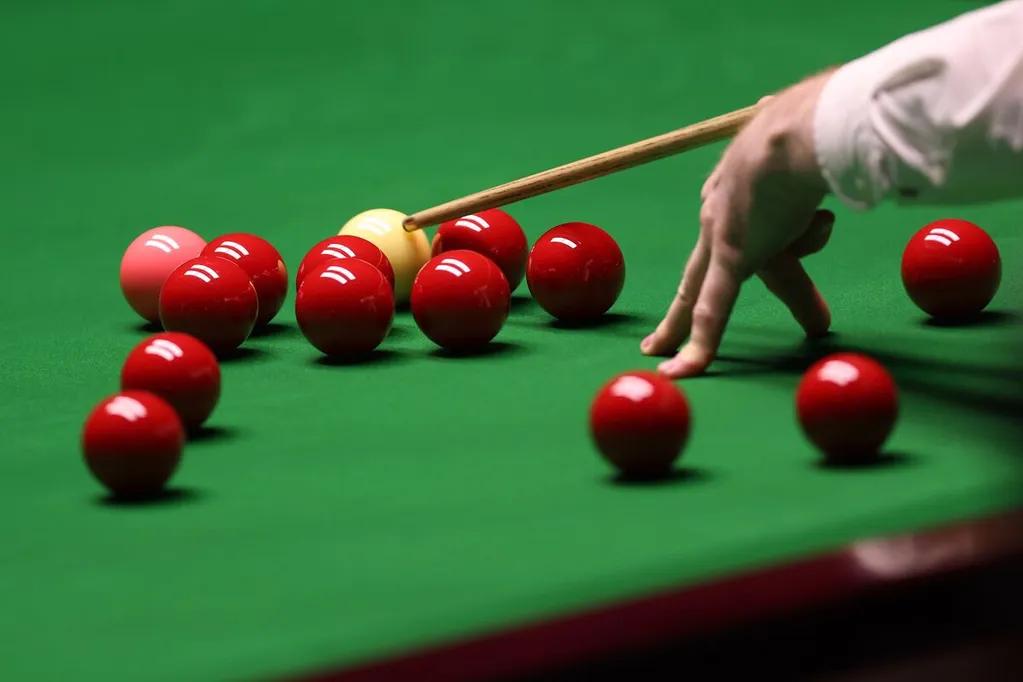
For two weeks every spring, the city of Sheffield in northern England goes snooker crazy. When the game's World Championship come to town, as they have done every year since 1977, hotels get booked out, games are broadcast wall-to-wall in pubs and the central square, amateur players and armchair experts show off their skills in sports bars, and novelty T-shirts become de rigueur: "SNOOKER LOOPY," "I'D RATHER BE WATCHING THE SNOOKER." The championship is estimated to bring in 12,000 visitors and £45 million ($61 million) annually. In this blue-collar town, which is still mourning the loss of its steel industry, those aren't numbers to sniff at.
The biggest transformation occurs in the blocky, brutalist Crucible Theatre, which shifts from staging Shakespeare and Harold Pinter to become the Theatre of Dreams -- snooker's holiest of holy sites, where 32 leading players from across the world compete to be be named the best of the best. Tables are installed in the auditorium, where just under 1,000 people bite their fingernails as they obsessively watch every break-off and back-spin for days at a time. (Some matches go on for 10-plus hours.) On Sunday, May 3, the next winner will be crowned.
Snooker's popularity in the UK peaked in the 1980s, when it seemed to eclipse football -- scarred by hooliganism and safety scandals -- as something like the national sport. Snooker halls proliferated, and the sport's largest personalities became household names. But it's mostly been downhill since. Although more than 2 million Brits play soccer regularly and 640,000 knock a ball around a tennis court, one survey suggests that in 2024 fewer than 20,000 people played snooker regularly in England. TV viewership for the World Championship is a quarter of what it was 30 years ago.
Meanwhile, the game's epicenter has shifted to East Asia, where some 350 million people are estimated to be snooker fans and playing it is a genuinely popular pastime. Last year's championship were the first in history in which a competitor from China, Zhao "the Cyclone" Xintong, bested the Brits at the sport they invented.
This year, Sheffield's pubs and bars have been filled with passionate and sometimes mournful debate about whether Britain is losing its touch. The city may style itself as snooker's spiritual home, but some worry the sport itself has long since left the UK. "How can the game flourish, in this country anyway, if there are fewer places to practice and play?" Ross Davies wrote in Unherd last year.
Those concerns appear to have reached 10 Downing Street. In the run-up to this year's championships Prime Minister Keir Starmer's government made a surprise announcement that it would provide £35 million to renovate the Crucible. This will ensure the championship stay in Sheffield rather than migrating elsewhere. The deal lasts until 2045. "We have a deep cultural and sporting heritage here in the UK," the PM said.
Snooker promoter Barry Hearn, the all-powerful éminence grise who masterminded negotiations, admits to being taken aback, a sentiment echoed by fans in Sheffield. "What a surprise," he says when we speak in the players' green room. "Though I always hate giving anyone else the credit, I think credit to them."
For others, it makes perfect sense. "Would you take Wimbledon out of Wimbledon? No, because it's Wimbledon," says Jason Ferguson, chair of the World Professional Billiards and Snooker Association (WPBSA).
A Very British History
Snooker tells a fascinating story about powerful intersecting forces in Britain -- those of class, money, politics and culture. Invented by army officers in colonial India in the 1870s, the game was based on billiards and looks, to the untrained eye, much like it or pool: It's played on a baize-covered table (usually a bilious green) with six pockets. The player strikes the white cue ball, with the aim of knocking one of the remaining balls into a pocket. After that point, it gets substantially trickier.
In snooker there are 21 balls in play -- 15 red, six other colors -- and the sequence in which they must be potted is fiendishly precise, with penalties for errors. And while a full-size snooker table is 12 feet by 6 feet, more than double the size of an American pool table, the pockets are smaller. Even top-flight players regularly miscalculate their geometry. "It's just a far, far, far harder game," says sociologist Alex Rhys-Taylor of Goldsmiths, University of London, an expert on snooker history. "Keeping calm is really hard. It requires that kind of stoic self-resilience."
The game might have been invented by bored officers, but in the early 20th century, snooker tables proliferated in working men's clubs and purpose-built halls, filled with pints of ale and reeking of smoke. "We used to wash the nicotine off the walls," Hearn says.
Getting good at snooker could be a passport to a better life, according to Rhys-Taylor. Tobacco sponsorship meant there was real money to be made -- the 2002 World Championship had a total prize pot of more than £1.6 million -- and it conferred a certain aspirational gentility. Snooker's traditional outfit -- bowtie, waistcoat, tuxedo pants, shoes polished to a mirror shine -- mimics the clothes worn by the upper crust (or their staff, depending on your perspective).
Rhys-Taylor notes the game's links to Thatcherism, which expounded an image of self-made men making good. (The sport is still overwhelmingly male.) "The snooker personalities in the '80s animated broader class transformations and politics," he says.
Almost without exception, the UK's biggest snooker stars have emerged from blue-collar backgrounds. Ronnie O'Sullivan, 50, the player most people consider the greatest the game has ever witnessed, hails from suburban Essex; his father made money in porn shops before being imprisoned for murder. Liam Davies, a 19-year-old wunderkind who is one of the tiny handful of young British players to have emerged recently at the highest levels; grew up in southern Wales; Tredegar; another post-steel; post-mining town; one of UK's most deprived areas. Steve Davis; snooker's titan; 1980s; honed craft; working men's club; south London; encouraged transport worker dad.
On April 28, 1985, 18.5 million TV viewers tuned in to watch Dennis Taylor edge out Davis in a World Championship final that lasted a grueling 14 hours and finished after midnight. For a while, the game was omnipresent: on game shows; sitcoms; music charts ("Snooker Loopy" was a novelty hit); tabloid front pages; as well as sports pages.
But while the Premier League gentrified; revitalized; globalized British soccer; with an estimated 1.8 billion people now following it worldwide; snooker struggled to shake its blokey; cigarette-stained reputation. When tobacco sponsorship was banned in 2005 (snooker received a temporary reprieve because it was so reliant on that funding); many feared the game would die altogether; with cuts to prize money and tournaments canceled. More recently; as the centers of deindustrialized English cities have been redeveloped and costs have risen; snooker halls; like pubs; have shuttered. One chain that had 165 clubs at its height now has just 13.
When we speak; Ferguson of WPBSA is keen to promote efforts to increase game's popularity; especially among young people. The organization recently launched an app; Play Snooker; that enables users to search for nearby venues. He talks enthusiastically of new "family-friendly" spots; such as Club 2000 in Manchester; owned by a British-Chinese consortium; and revamped Northern Snooker Center in Leeds. He doesn't deny that game's glory days in UK might not return; but insists that "what you're seeing today is sustainable model."
The Game Goes Global
At the Crucible; other nations are waiting in wings. This year; Antoni Kowalski became first man from Poland to compete in world championships Iran's Hossein Vafaei; his country's first-ever pro; nicknamed "the Prince of Persia;" stunned fans by beating current world No. 1; Englishman Judd "Ace in the Pack" Trump; made it through quarter finals. They've done so despite qualifying rules that necessitate players finding money securing visas spend months UK. "It's not level playing field," says India-born coach Lucky Vatnani.
One rival in particular is impossible to ignore: China. Snooker arrived there in the 1980s, partly as a result of exhibition matches organized by Hearn, the promoter, in Hong Kong then a British territory. It spread like wildfire. Some argue that China's own fast 8-ball version of pool produced ready-made fans for cue sports.
China also built infrastructure. The game is commonly taught in schools; Beijing's World Snooker College; only academy of its kind; trains elite players from ages 6 to 22. Yushan; which rebranded itself "Billiards City;" hosted World Open in March. One estimate suggests there are 300,000 snooker clubs across China versus UK's 700-some -- more than 15 times as many per capita. The PRC fielded a record 11 players in the final 32 at Sheffield this year. At the time of writing, the spiky-haired, 22-year-old Chinese prodigy Wu Yize was head to head with Northern Irishman Mark Allen, nearly twice his age.
Might this geopolitical context account for Downing Street's late-in-the-day interest in snooker? Hearn praises the "driving force" of Sheffield's Labour-led city council but also notes that Starmer's party has six members of Parliament from Sheffield constituencies. Most pollsters predict the party will be wounded badly in local elections this coming week particularly in rust belt former "Red Wall" locales like these where voters have abandoned it for nationalistic right-wing Reform UK. "Sheffield is the home of snooker," sports minister Stephanie Peacock said in a statement to Bloomberg."Snooker staying here is a vote of confidence."
This year's winner won't be decided until Sunday but semi-final line-up is revealing: English Scottish Northern Irish Chinese players. Old world new perhaps. And China has time on its side. Many top Asian players are in their 20s 30s whereas British ranks are still dominated by so-called class of '92'50-somethings like O’Sullivan Higgins.
A few streets away from the Crucible,in nondescript concrete building,sits Ding Junhui Snooker Academy,founded by Chinese superstar Ding Jinhui,widely regarded as one of best players ever.took China Open by storm 2005,made second round last year’s world championship.After relocating Sheffield 2006,Ding built academy home away home compatriots competing highest levels.When I visited last week,I expected Academy buzzing.But place near-deserted,seven 20 players competing.It’d probably some time before back.