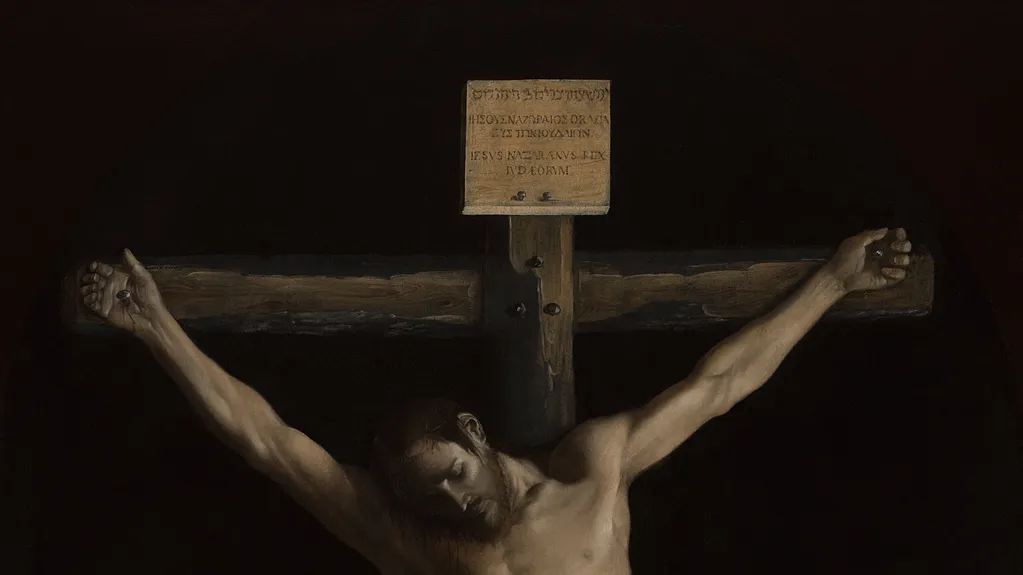
An exhibition of works by Francisco de Zurbarán at London's National Gallery highlights the painter's ability to draw in the viewer with detail and drama.
No one does high drama -- the agony and the ecstasy, the deepest blacks and brightest whites, the crispest lines and most lucent objects -- like the Spanish Catholic Baroque painters.
There is a painting of Christ on the cross so exquisitely rendered, so realistically modeled in light and shade, it was said by an 18th-century writer, that everyone who saw it believed it to be a sculpture. This work, "The Crucifixion" (1627), by the painter Francisco de Zurbarán, who spent most of his life in the southern Spanish Andalusian capital, Seville, opens the exquisite and tightly curated survey of the visionary artist's work that is on through Aug. 23 at London's National Gallery.
Zurbarán, who was born in 1598, initially trained as a sculptor. This, perhaps, accounts for his innate understanding of the human body in the round, and of the power of corporeal presence -- particularly in paintings whose purpose was to inspire devotion.
"The Crucifixion," his earliest signed work, was hung in the sacristy of San Pablo el Real, a 13th-century Dominican convent (and onetime seat of the Inquisition in Seville) that had hired the artist to produce 21 paintings over the course of just eight months. Many more such commissions would follow: The city's religious orders, increasingly prosperous thanks to trade across the territories of the Spanish Empire, competed with one another to create the most stunning buildings and decorations.
In the low lighting of the room in which priests and attendants keep their vestments and dress for services, the painting -- executed in an almost monochrome palette, with heightened chiaroscuro -- must have been striking, not only for its realism: Christ, arms outstretched and head nodding limply, wears an elaborately draped loincloth whose various folds and swags seem to glow incandescent and bright; whites that are echoed in a crumpled piece of paper, nailed to the wooden post below, which faintly bears the artist's signature.
- Rocky, Reconsidered: The sculpture is at the center of a show by the Philadelphia Museum of Art that explores the meaning of monuments.
- Route 66 Turns 100: Exhibitions recall the history of the neon corridor that helped define the American road trip.
- A New Museum Comes With a D.J.: The space in Indianapolis, housed in a former dairy barn, aims to upend expectations of what an art museum can be.
- The Fisher Collection in a New Light: A Bay Area family made a deal with SFMOMA that called for exhibitions of the collection's works every 10 years.
- More on Museums: Artists and institutions are adapting to changing times.
Sumptuous textiles -- even when plain, a loincloth or a monastic robe -- are a mainstay in Zurbarán's work through his lifetime. The verisimilitude, the sense that one is regarding something holy, confected with just paint and canvas, but almost real enough to reach out and touch, was central to his work's sacred vitality. As if you could walk right into the narratives depicted -- for instance, "The Adoration of the Magi" (1638-9) or "The Circumcision" (1639), which both show scenes from the early life of Christ.
Or, as in "Saint Francis of Assisi" (1636) and "The Vision of Saint Alonso Rodriguez" (1630), you might feel that you yourself were having a holy vision, as devoted and transcendent as the saint pictured.
In "The Vision of Saint Alonso Rodriguez," that 16th-century Majorcan Jesuit who devoted his life to venerating the hearts of Christ and the Virgin Mary is shown in spiritual rapture. In the lower half of the painting, he appears in a sober setting, eyes raised to the heavens above, where the Mary and the Son of God, surrounded by cherubim and a choir of angels, look down on him. Each holds out a pink heart shooting out beams of light that radiate from heaven to Earth and alight on the breast of Rodriguez, where two black hearts flame.
Saint Francis, conversely, is shown in his traditional brown robes and knotted rope belt, starkly lit from the left, eyes aloft and mouth open. We cannot see what he sees, but the texture of the plain cloth worn by the man who renounced material goods, his solidity as a figure, and the expression on his face, of absolute holiness, is transporting.
Rooms in the exhibition are devoted to the beauty and precision of Zurbarán's painting of fine garments, often used to depict saints like Apollonia, Casilda and Catherine of Alexandria, who are shown in garb that would have been familiar to Spaniards of the time and demonstrate the artist's knowledge of materials like silk and brocade.
In the show's final spaces, the artist's technical facility, as well as his variety and creative innovation, is dazzling. A handful of still lifes of lemons and oranges, roses and teacups, ceramic cups and pitchers show objects painted with astonishing clarity against backgrounds of profoundest blacks so that they seem ripe with offering.
These are displayed alongside a series of works by Zurbarán's son, Juan, that are similarly accomplished and detailed -- particularly given that he died at age 29 in a plague that killed almost half of Seville's population.
Zurbarán's attention to objects of the material world is just as divine as that of his overtly sacred paintings; though some of these still lifes were likely studies for details that would appear in larger works -- as with "A Cup of Water and a Rose" (1630) and the moving "Agnus Dei" (1635-40), in which a lamb, legs trussed and eyes barely open, lies slumped forward in a narrow visual plane, waiting for slaughter.
In "The Crucified Christ With a Painter" (1650), a late work that seems peculiarly modern and meta, the death of Jesus is witnessed by a sole artist -- Saint Luke, the patron saint of painters -- who stands spotlit in a dark landscape looking up in awe and grief. Is this a portrait of Zurbarán himself? A brief image of the painter whose work shows that in the natural world which includes the artist's studio resides the miraculous? To paint is divine. What better way to spend a life of devotion than making this visible to others.
Zurbarán
Through Aug. 23 at the National Gallery in London; nationalgallery.org.uk.