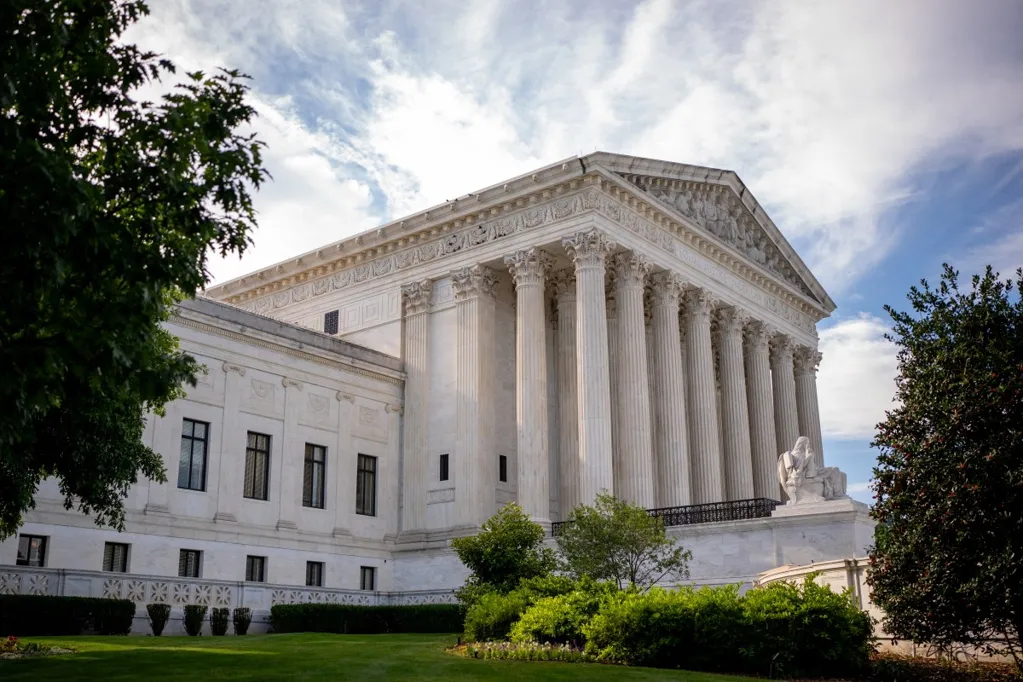
The Supreme Court will review challenges to the Trump administration's attempt to end deportation protections for migrants from Haiti and Syria—but for now, existing safeguards remain in place.
In a brief order, the justices agreed to hear two emergency petitions seeking to terminate Temporary Protected Status (TPS) for these groups, while declining the administration's request to immediately lift lower court injunctions blocking the policy.
The decision represents a setback for the Trump administration, which had asked the court to intervene quickly and allow it to move forward with ending the protections.
TPS is a humanitarian programme that allows people from countries affected by armed conflict, natural disasters, or other crises to live and work legally in the United States temporarily. It has been applied to Haitians following the 2010 earthquake and to Syrians during the country's civil war.
The Trump administration submitted emergency appeals after lower courts blocked efforts to immediately end TPS for about 350,000 Haitian nationals and roughly 6,000 Syrians.
They will continue to retain their legal status and work authorisation while the case proceeds. They are also expected to remain protected from deportation during this period.
The court consolidated the Syria case with a parallel challenge involving Haitian nationals and scheduled oral arguments for late April, bringing forward consideration of the legal questions surrounding the administration's authority to end TPS designations.
The Justice Department has argued that the Department of Homeland Security has the authority to end TPS, which was originally intended to be temporary, while immigration attorneys contend that conditions in both Haiti and Syria remain unsafe for return.
Federal courts in New York and Washington, D.C., have blocked the terminations pending legal review, with one court noting that the decision to end protections for Haitian nationals may have been influenced by improper considerations.
Under the Trump administration, Secretary of Homeland Security Kristi Noem moved to end TPS for several countries, including Yemen, Haiti, Somalia, and Venezuela, though some terminations have been delayed or stayed by federal courts amid ongoing litigation.
The Supreme Court previously permitted the administration to end deportation protections for over 300,000 Venezuelan nationals in the U.S. while related legal challenges were ongoing. The Trump administration has maintained that courts do not have the authority to review the secretary's decisions on TPS.
In December, the U.S. government added Syria to an expanded travel ban and paused decisions on pending immigration applications for Syrian nationals, limiting their ability to pursue other forms of immigration status or benefits.
Haiti was first granted TPS in 2010 after a devastating earthquake and has received extensions due to ongoing crises, including the 2021 assassination of President Jovenel Moïse and 2024 economic and security issues.
After Donald Trump returned to the White House, the administration moved to end TPS for Haiti effective February 3, citing progress in the country, though some risks remain. The State Department continues to advise U.S. citizens against travel to Haiti due to crime, civil unrest, and limited health care.
"While we are relieved that our plaintiffs and thousands of other Syrians will maintain their TPS status for now, it is disappointing that the Supreme Court took the extraordinary measure of taking on our case before the lower courts have weighed in," Lupe Aguirre, Deputy Director of U.S. Litigation at the International Refugee Assistance Project, said in a statement shared with Newsweek.
"We hope the Supreme Court will see the government's attempt to strip away the lawful status of thousands of Syrian TPS holders who have been living and working in the U.S. for years for what it is—unlawful and wrong."
Nargis Aslami, Legal Fellow at Muslim Advocates, said in a statement: "The Supreme Court's decision to take this case at such an early juncture is unusual: the factual record has not been fully developed, and the lower courts have not reached the legal issues on their merits. But we hope the Court sees through the Administration's lawless and discriminatory agenda to end TPS for Syria, and we urge the public to call their elected representatives to defend TPS against the Administration's attacks."
The Department of Homeland Security wrote in a press release: "USCIS is advancing the administration's and Secretary Noem's goal of ending the abuse and exploitation in certain immigration programs. This includes stopping broad abuse of humanitarian parole authority and terminating the family reunification and the Cuban, Haitian, Nicaraguan, and Venezuelan (CHNV) parole programs and Temporary Protected Status (TPS)."