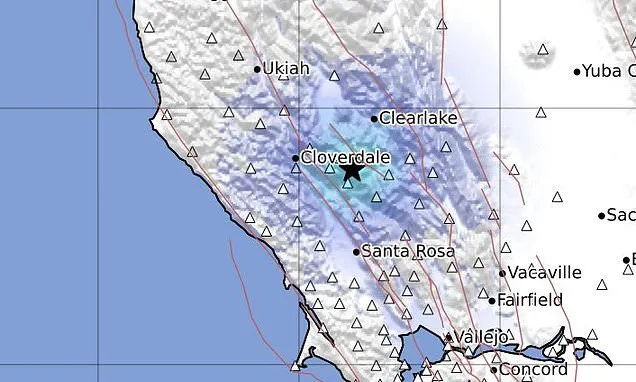
Californians were shaken by multiple earthquakes on Thanksgiving morning, raising concerns in the seismically active region.
At least 13 tremors, starting around 4:30am PT (7:30am ET) and ranging from magnitude 1.0 to 3.7, were reported near The Geysers geothermal field in Northern California.
The last earthquake, a small 1.1 magnitude, was detected at 5:47am PT (8:47am ET).
Residents as far south as San Francisco felt shaking, including from the first quake, a 3.6 magnitude tremor.
The Geysers is a large geothermal field in the Mayacamas Mountains, spanning Sonoma, Lake and Mendocino counties, which harnesses underground steam to generate electricity.
Although it is called The Geysers, the area does not have actual geysers but rather steam vents called fumaroles, a name given by early settlers who misunderstood the natural phenomenon.
This region in northern California lies atop a network of faults, including the Bartlett Springs Fault Zone and the Healdsburg-Maacama Fault system.
Smaller faults beneath the geothermal site have made the area prone to frequent earthquakes, and experts say some tremors may be triggered by the region's geothermal energy operations, raising concerns about the potential for stronger shaking.
The Geysers Geothermal Field, sprawling across roughly 45 square miles, sits about 72 miles north of San Francisco.
Home to 18 geothermal power plants, the region is no stranger to tremors, as frequent minor earthquakes rattle the area as a direct result of the operations used to harness steam for electricity, according to the USGS.
Workers and nearby residents can often feel the quakes beneath their feet.
Seismologists have said that these earthquakes are triggered by a combination of factors.
As steam and heat are extracted from underground reservoirs, the surrounding rock contracts, creating stresses that can set off tremors.
Adding to the seismic activity, reclaimed water is pumped back into the steam chambers.
The stark temperature difference between the cold water and the superheated rock can further destabilize the underground environment, producing even more quakes.
'It is possible that a magnitude 5 could occur, but larger earthquakes are thought to be unlikely. For a larger earthquake to occur, a large fault must exist,' the USGS said, and 'at the Geysers, no such continuous fault is known to exist.'
California is the third-most seismically active US state after Hawaii and Alaska.
Data shows that so far this year, California has experienced more than 14,000 tremors, compared to Alaska, which is nearing 60,000.
However, California experiences more earthquakes that cause damage due to its higher population and extensive infrastructure.
Thursday's seismic activity follows multiple earthquakes that hit near Silicon Valley on Wednesday.
A magnitude 4.0 tremor struck just 23 miles south of San Jose at 9:16am ET on Wednesday morning.
It was quickly followed by a smaller one, of magnitude 2.7, two minutes later, and then a more significant magnitude 3.6 quake at 9:20am.
The quakes struck just miles from the headquarters of firms including Google, Apple, Nvidia, Meta, Netflix and countless startups.
Over 1,200 people near the quake's epicenter, east of Gilroy, reported feeling the seismic event to the US Geological Survey (USGS).
Readings from the area have revealed that shaking from the initial 4.0 quake reached San Francisco, over 60 miles away.
Quakes between 2.5 and 5.4 in magnitude are often felt for several miles in all directions but typically cause only minor damage, such as knocking objects off shelves.