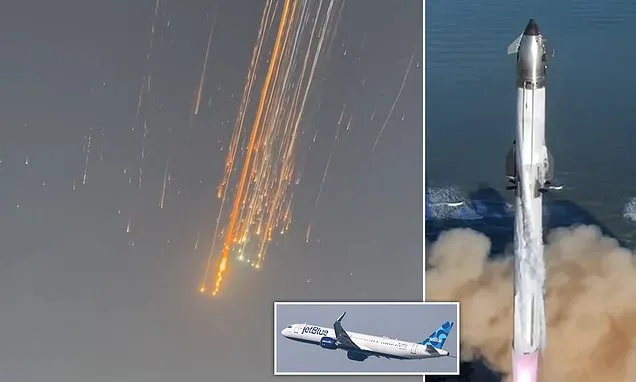
A SpaceX test flight that was 'destroyed' less than ten minutes after its launch in January put multiple passenger jets in serious danger while in flight over the Caribbean.
The seventh un-crewed Starship test flight was CEO Elon Musk's latest attempt to make life on Mars a reality and took place days before he launched the Department of Government Efficiency in President Donald Trump's White House.
Federal Aviation Administration documents now show the collateral peril the explosion put three flights in that evening, including a JetBlue trip to San Juan whose crew was told the journey could only be made 'at your own risk.'
Those risks included possible scattering of debris from the sky across the Caribbean for almost an hour.
A controller needed to intervene after two planes flew too close to one another following the explosion.
The three planes were carrying a total of 450 people and fortunately, able to land safely after declaring fuel emergencies and traveling through a temporary no-fly zone, WSJ reported.
Furthermore, the FAA claimed that SpaceX failed to immediately call an official hotline required for any failures to inform air traffic controllers.
In Miami, controllers only heard about the debris from the explosion from the pilots having to navigate through it.
A January SpaceX test flight that was 'destroyed' less than ten minutes after its launch put three passenger jets flying over the Caribbean in danger.
The seventh uncrewed Starship test flight was CEO Elon Musk's latest attempt to make life on Mars a reality.
The FAA began to investigate how to better deal with potential debris from explosions in February and became more determined after a SpaceX test vehicle exploded again in March.
However, the review was ended in March, with the FAA claiming it was because their recommendations had already been implemented and needed to go outside the US to consult other experts.
'The FAA will not hesitate to act if additional safety measures are required,' they said in a statement.
They will need to be active, as the agency has said it wants to run 200 to 400 rocket launches a year going forward, many of which could be run by Musk's SpaceX Starship, a 400-foot tall rocket described as the most powerful ever developed.
SpaceX declined comment, while a spokesperson for JetBlue said the airline was certain the flights avoided any areas where debris was seen.
The new-generation ship launched from Texas in January and successfully flew for around eight minutes, with the teams' second breathtaking booster catch, before contact was lost.
Officials confirmed that the spacecraft was destroyed.
'Starship experienced a rapid unscheduled disassembly during its ascent burn. Teams will continue to review data from today's flight test to better understand root cause,' SpaceX posted on X.
'Every Starship launch is one more step closer towards Mars,' Musk said before liftoff, as he hopes his ships will be the first to launch humanity into life on Mars.
The new-generation ship launched from Texas in January and successfully flew for around eight minutes, with the teams' second breathtaking booster catch, before contact was lost.
A Federal Aviation Administration now shows the collateral peril the explosion put three flights in that evening, including a JetBlue trip to San Juan whose crew was told could only be made 'at your own risk.'
'With a test like this, success comes from what we learn, and today's flight will help us improve Starship's reliability.'
Debris, with unclear relations to the spacecraft, was captured on camera flying across the Caribbean just minutes after the flight test.
'Every Starship launch is one more step closer towards Mars,' Musk said before liftoff, as he hopes his ships will be the first to launch humanity into life on Mars.
SpaceX posted on X that the test flight featured 'significant upgrades.'
The new Starship was rolled out taller - now standing at 403 feet - and with about 300 more tons of propellant than the last test flight ship, with added upgrades for 'reliability and performance.'
SpaceX announced there would be 'hardware upgrades to the launch and catch tower to increase reliability for booster catch,' including enhancements to sensor protections on the chopsticks damaged during the last launch.
As well as a redesigned upper-stage propulsion system that can carry 25 percent more propellant, along with slimmer, repositioned forward flaps to reduce exposure to heat during reentry.
The company also added ten dummy satellites, the same size as SpaceX's Starlink internet satellites, for release in space. They were due to follow the same flight path as the spacecraft, ending up destroyed upon entry.
The post added that the flight 'set out to attempt Starship's first payload deployment test, fly multiple reentry experiments geared towards ship catch and reuse, and launch and return the Super Heavy booster.'
'Today's flight test will launch a new generation ship with significant upgrades, attempt Starship's first payload deployment test, fly multiple reentry experiments geared towards ship catch and reuse, and launch and return the Super Heavy booster.'
SpaceX's last successful launch happened in October on its fifth flight test. The sixth, which was witnessed by President-elect Trump in November, made a controlled splashdown in the Gulf of Mexico.