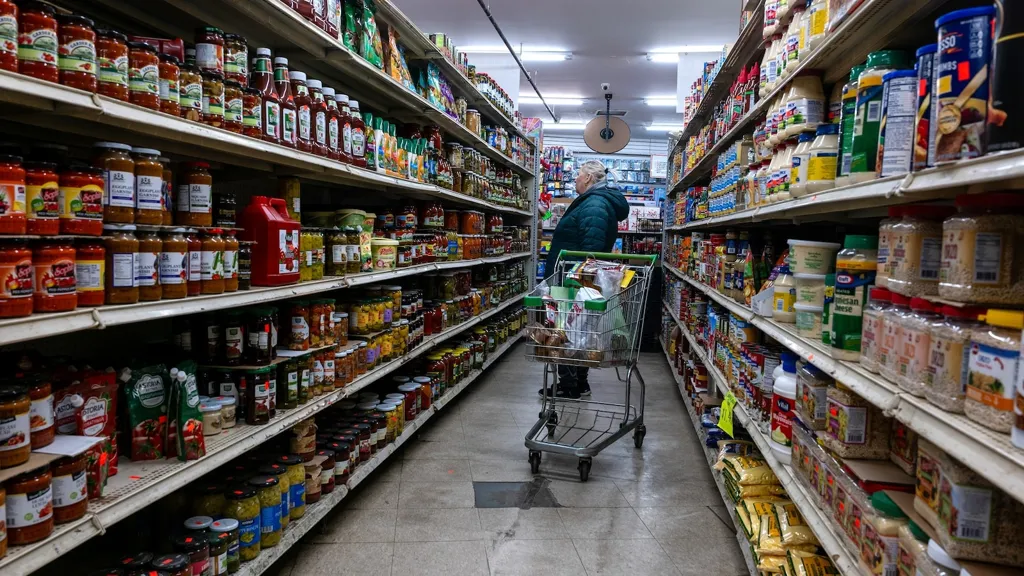
Food prices are rising at their fastest monthly pace since 2022, data showed.
President Donald Trump in recent days claimed progress in his administration's effort to tackle rising food prices. "Grocery prices are starting to go rapidly down," Trump told an audience at the Detroit Economic Club, without citing evidence.
Hours earlier, however, fresh government data refuted Trump's assertion, instead showing the largest monthly jump in food prices since 2022.
Prices for some household staples are soaring, a U.S. Bureau of Labor Statistics report on Tuesday showed. Coffee prices jumped nearly 20% in December compared to a year earlier, while ground beef prices climbed 15.5% over that span.
Analysts who spoke to ABC News primarily attributed the jump in food costs to a convergence of market factors, including weather-induced supply shortages for some raw goods and a surge in demand for the likes of coffee and beef. Those conditions can hardly be attributed to Trump, they added, but they noted the administration's tariff policy had likely pushed up prices for some products, including coffee and beef.
Grocery prices climbed 2.4% over the year ending in December, BLS data showed.
"Prices at the grocery store continue to be high," Naomi Blohm, a senior market adviser for Total Farm Marketing, told ABC News. "We're all feeling it."
Speaking at the Detroit Economic Club, Trump faulted his predecessor for stoking rapid price increases before Trump took office. The president baselessly asserted that he had "defeated" inflation.
"Joe Biden gave us a colossal stagflation catastrophe but my administration rapidly and very decisively ended that," Trump said last Tuesday.
Overall price increases stand below the 3% rate recorded in January, the month Trump took office, but they have hovered nearby for the majority of the year. Meanwhile, the current inflation rate of 2.7% exceeds the Federal Reserve's target level of 2%.
Like many economic problems, rising food prices come down to an imbalance between supply and demand, some analysts said. The spike in beef prices exemplifies this dynamic.
Current beef prices trace back to drought conditions that devastated the supply of cattle, David Ortega, a food economist at Michigan State University, told ABC News.
In 2022, a major drought in the beef-producing regions of the U.S. forced cattle herders to sell off more animals than usual, since the drought raised costs for cattle feed, which in turn made it more expensive for ranchers to maintain their herds, Ortega said.
Many of those ranchers, he added, sold off cattle necessary to produce future beef supply. Years later, cattle remain well below previous levels.
Alongside the shortfall of cattle, consumer demand for beef has grown, Blohm said. "It continues to be strong," Blohm added.
That disparity between supply and demand has taken a toll on prices for just about every beef product. Ground beef prices soared 15.5% in December compared to a year ago, while the costs of beef steaks increased 17.8% over that period, government data showed.
The array of products locked in a similar supply-demand crunch includes coffee and cocoa beans, which have led to an uptick in some candy prices.
Trump's tariff policy also played a role in the rise of food prices, some analysts said. They pointed especially to 50% tariffs on steel and aluminum, which have pushed up can and other packaging costs.
The price of steel cans has jumped 16% over the past year, according to government data on wholesale prices.
"Manufacturers are paying more for their packaging material," Jason Miller, a professor of supply chain management at Michigan State University, told ABC News. "Prices are going up."
In November, the Trump administration announced framework trade agreements with some Latin American countries in an effort to lower tariffs and ease prices for some heavily imported goods like bananas.
The policy change may succeed in cooling off banana prices but such shifts often take place after a lag of several months, Ortega said. In the meantime, price hikes for bananas remain elevated, climbing nearly 6% over the past year.
"It takes time for those inflationary pressures to work their way through the food system," Ortega said.
To be sure, some food prices are falling. Egg prices plummeted 20.9% in December compared to the previous year. Tomato and potato prices have also dropped over that period. Dairy prices ticked slightly down as well.
Still, Blohm said, the overall rise in food prices will likely persist over the next couple of years as farmers gradually address supply shortages and input costs for manufacturers come down.
"There's no easy fix, unfortunately," Blohm added.