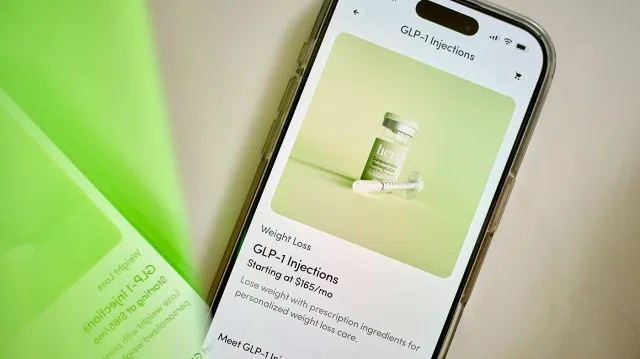
Hims & Hers is facing battles on multiple fronts as it seeks to maintain its lucrative business in copycat weight loss drugs.
Federal regulators are seeking to rein in the online telemedicine platform, which for years has been selling a non-Food and Drug Administration (FDA) approved version of GLP-1 medication semaglutide even though it is an exclusive property of Novo Nordisk.
And Novo Nordisk, which manufactures Ozempic and Wegovy, filed a lawsuit against Hims & Hers this month for allegedly "deceiving patients" with its compounded drugs.
The FDA announced its intentions this month to take "decisive steps to restrict GLP-1 active pharmaceutical ingredients" from being used in the kind of compounded drugs being sold by Hims & Hers and other online pharmacies.
The same day as the FDA's move, Health and Human Services General Counsel Mike Stuart said he had referred Hims & Hers to the Justice Department for potential violations of the Food, Drug & Cosmetics Act and potential "applicable" criminal violations. Stuart did not specify how the company might have violated the law.
"The government has finally recognized the threat, both to its authority and, more importantly, to the public health," said Peter Pitts, former FDA associate commissioner and president of the Center for Medicine in the Public Interest.
Pitts noted that Hims & Hers must have seen the writing on the wall as it reversed course on its plans to sell compounded versions of oral Wegovy following the FDA's announcement. The company told The Hill that no oral GLP-1 pills were ever shipped to patients.
"These are not companies behaving like compounding pharmacies," said Pitts. "These are companies behaving like pharmaceutical companies in every way, shape or form, right down to television advertising. They are illegal, unregulated pharmaceutical companies."
Michael Hinckle, a partner at the law firm K&L Gates who specializes in FDA regulatory matters, speculated that pharmaceutical industry pressure could be what pushed the agency to move on compounded drugs now.
Commenting on HHS's referral to the DOJ, Hinckle said, "Maybe they're just trying to send a message that, 'Hey, we're being serious about this.'"
"Normally, they don't publicly say that's what they're doing. That was a little strange or different," he noted.
Both Hinckle and Pitts noted that the rise of online compounded drugs coincided with the growing ubiquity of telemedicine platforms, which forgo traditional face-to-face interactions between patients and physicians.
"It's unsafe and it's unmonitored, and it's circumventing the conversation between doctors and their patients," said Pitts.
Platforms like Hims & Hers have sold compounded GLP-1s for years now, starting when drugs like semaglutide and tirzepatide went into shortage amid spiking demand. Federal regulations allow compounded pharmacies to sell copycat versions of branded drugs when they are in shortage.
While those shortages have been declared over, the Hims & Hers and other retailers have continued to sell compounded semaglutide.
Its ability to continue depends in part on what type of compounding pharmacy Hims & Hers is acting as, and what regulations apply.
Compounding pharmacies sell altered forms of drugs for patients to still have access to them. This often means changing the formulation so a patient can take the drug, i.e. turning a pill into a liquid if a patient struggles to swallow tablets.
There are two types of compounding pharmacies, 503A and 503B. The former fulfills patient-specific prescriptions for compounded drugs, while the latter can also mass produce compounded drugs to be sold and used at healthcare facilities.
Because of the hyper-individualized nature of compounded drugs, they are not FDA-approved products, with the agency unable to review each individual prescription -- though compounding pharmacies do still fall under agency oversight.
During the shortage, online platforms like Hims & Hers and Ro.co acted as sellers for 503B compounded drugs, ostensibly to help ensure patients can still access their GLP-1 prescriptions while the drug is in shortage.
Novo had sought a partnership with Hims & Hers and other telemedicine companies when the semaglutide shortage ended, launching programs selling cheaper versions of its branded GLP-1s. This collaboration swiftly ended however when Hims & Hers continued to sell compounded semaglutide on its platform.
Hims & Hers maintains that it is now strictly selling personalized compounded GLP-1 products and has pushed back against claims that it is mass-marketing these drugs.
"Our track record speaks for itself and is why we've been able to help nearly 2.5M customers access care personalized to their needs," the company said in a statement after Novo's lawsuit was filed.
"This is not the first time (nor will it be the last time) a big pharma company has suggested taking an accessible, customer-first approach to healthcare is dangerous, illegal, or bad for the marketplace."
The company declined to give further comment on recent regulatory and legal developments.
Keith Wesley is a managing partner at the law firm Ellis George and has represented many compounding pharmacies in court, including those selling GLP-1s, though he is not working with Hims & Hers.
Wesley also views the FDA as trying to show compounders they're serious by referring Hims & Hers to the DOJ, but said it's too soon to tell what the effects of this action will be.
"I think that these issues are not going to be decided today, next week. Even if the FDA came out and said that they were severely limiting compounded versions of GLP ones, and here's how they're going to do it,"
wesley said, noting that there is some degree of ambiguity when it comes to how compounding pharmacies can operate.
"That's why the FDA has such a challenge,"
he added."If you cut off the compounded drugs altogether,you are going to see patients who cannot access -- or who,for whatever reason,cannot use the FDA-approved drugs --they're going to suffer.So,I think there's always going to be a world in which the compounded drugs need to be on the market,need to be accessible."