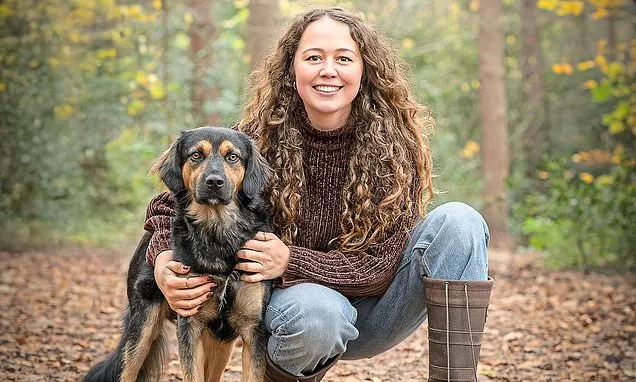
Last summer, Mirelle Radley was walking her dog Paddington in Cambridge when she noticed a car driving towards them, beeping.
'I thought we were about to get yelled at,' says Radley, speaking from her home in Sheffield. Instead, the woman driving stopped the car, rolled down the window and shouted, 'Is that Paddington?!' Radley said that it was. 'And then she just drove off going, "Ahhhhh!"'
This is not that surprising; Paddington is a kind of canine celebrity. He lived as a stray on the streets of Peru until Radley - a 30-year-old from South Yorkshire - found him while backpacking in South America last April. She decided to adopt him and documented the process on Instagram, where she gained 400,000 followers. Now Radley has written a book about the experience: Paddy From Peru.
Radley was always animal mad. She was a keen rider; did dog walking for pocket money; and, at 14, made a PowerPoint presentation to persuade her parents to get a cockapoo (it worked). By 18, she was studying Biovetinary Science at the University of Liverpool, and then for a PhD in Veterinary Medicine and Research at Nottingham.
After that, she got a research role at a biotech company in Cambridge. 'It was a cool [job] in premise but,' Radley pauses, 'I didn't find it that fulfilling.'
There were other things contributing to her unhappiness. In her early 20s she had broken up with a boyfriend who proceeded to stalk her; then, when she was 25, her brother died by suicide. It all meant that, by 29, Radley was 'actually, really depressed'. She decided to take a sabbatical from work and go travelling with her cousin Adam.
The next day, he was still waiting outside her door
They met Paddington in a village near Cusco. Radley was reading in a hammock when she felt a small paw tap against her side. She looked down, and there was a dog.
He was black and brown, and about the size of a border collie. His fur was thick and disguised the fact that underneath it he was horribly thin. 'He looked a little gross,' says Radley. Dusty, matted, paws covered in dirt, ultimately sort of smelly.
'I mean, you could tell he lived outside.' Radley couldn't be sure of his breed and she guessed from his teeth that he was still young - maybe six or seven months. She also noticed that the dog had scars down the inside of his legs. 'I don't know if they were from fights, or if he once got stuck in some fencing.'
Peru is full of street dogs and most of them have short, hard lives. 'They get hit by cars. They get diseases easily. They get into fights.' Lots of these downtrodden animals 'don't want to interact', but this one was different. 'He hadn't had the zest for life beaten out of him.'
From her hammock, Radley gave the dog a pat and didn't think much of it. Then, when she got up and walked into town to get an ice cream, he followed her at her heel. And again when she went to dinner. And again when she returned to the cabin where she was staying. ‘I didn’t feed him, as he was so friendly I thought he must have been owned, because [in Peru] people let [their dogs] out on the street and then they come back at night for food.’ So Radley went to sleep and thought this puzzling animal would trot off to his real life. But, in the morning, the dog was still there; he had sat all night outside her door.
Adam suggested they call him Paddington but Radley refused - naming him would mean getting attached. But, as several days passed, and the dog continued following her, an attachment formed regardless.
On day four, the cousins were due to go horse riding in the mountains and Radley worried that the dog would follow them. So she bought some bones, put them in front of the dog and, while he was distracted, left for the ride. When they returned, the dog was there - his now clean bones stacked neatly beside him. Radley remembers being relieved to see him. ‘That was when I was like, “Ah. This does feel like he’s my dog now and maybe I need to see if it is possible [to take him home].”’
It was also at this time that she relented and began calling him Paddington - Paddy for short.
It turns out transporting a stray dog from Peru to Britain is tricky. Radley found a local animal shelter to look after Paddington while she went to the UK and plotted his return. Then, she had to arrange his passport, vaccinations, vet checks, blood tests and lots of paperwork.
At a certain point she set up her Instagram, detailing the effort it was taking to get Paddington home. People really like dogs; within less than a month, she had 100,000 followers.
Those followers became instrumental. The cost of canine travel varies, but, in Paddington's case, it was thousands. Radley didn't have that sort of money, so she set up a GoFundMe page, asking her followers for donations. Within two months, she had raised £18,000. Most of the donations were between £10 and £40, but there were a few from America, from total strangers, of $500 each. (The remaining money was given to the Peruvian shelter, who then used it to rehome two other dogs.)
She also made an Amazon 'wish list', where people could order things like dog food and toys for Paddington’s arrival. ‘I didn’t realise that you have to toggle off the option where people can send extra stuff,’ says Radley. Quickly, she became inundated with dog supplies: seven beds, endless toys, bags of food, treats, supplements, fish oil tablets. ‘My Amazon man was like, “Is this a joke?”’ (Radley donated the surplus to a local animal shelter.)
After three months, Paddington was permitted to fly. Radley had decided it wouldn't be safe to put him in the hold, so she got special paperwork allowing him to sit next to her on the plane, and travelled to Cusco to collect him.
She was somewhat worried he wouldn't remember who she was. And it didn't help that there was also now a 300,000-person audience waiting for a video of their reunion. 'I said to [the women who ran the shelter], we're going to have to stage it or something, because what if he just doesn't give a st?'
He did. The video (which now has 1.9 million views on Instagram) shows Paddington spot Radley and come barrelling towards her. He jumps up. He licks her face. His tail wags. He runs around in celebratory circles. Most of the 4,907 comments say similar things: 'Sobbing', 'I am in literal TEARS', ' '.
On the plane, Paddington sat on a blanket by Radley's feet and slept. She is still staggered by how adaptable and unfazed he is. (He also didn't wee once during the entire 16-hour flight.)
Paddington's early life in the UK was happy and intriguing. Radley remembers him watching the washing machine, mesmerised. He loved other dogs but could not understand British wildlife. 'Foxes were his sworn enemies,' and he was baffled by birds.
They don't have as many in Cusco. 'He really likes to just sit and watch them.'
Still, he adapted. He mastered the stairs within two weeks; has learnt commands and tricks; and he either sleeps in his dog bed or on Radley's human one. He does, however, remain anti-fox; suspicious about mud and puddles - 'which [as an owner] I love'.
Radley has changed Paddington's life, and he, she says, has changed hers. After he had been in the UK for a month, Radley decided to quit her biotech job; leave Cambridge for Sheffield; write her book; try to find work through her new online platform. (Recently, the duo have been sponsored by Ford to travel across the country in a camper van.) Radley doesn't know if the plan will work long-term but she's happy to risk it. She says she's braver now because of Paddington 'and so much happier too'.
Paddy From Peru will be published on Thursday by Harper Collins , £20 . To order a copy for £17 until May 17 , go to mailshop.co.uk/books or call 020 3176 2937 . Free UK delivery on orders over £25 .