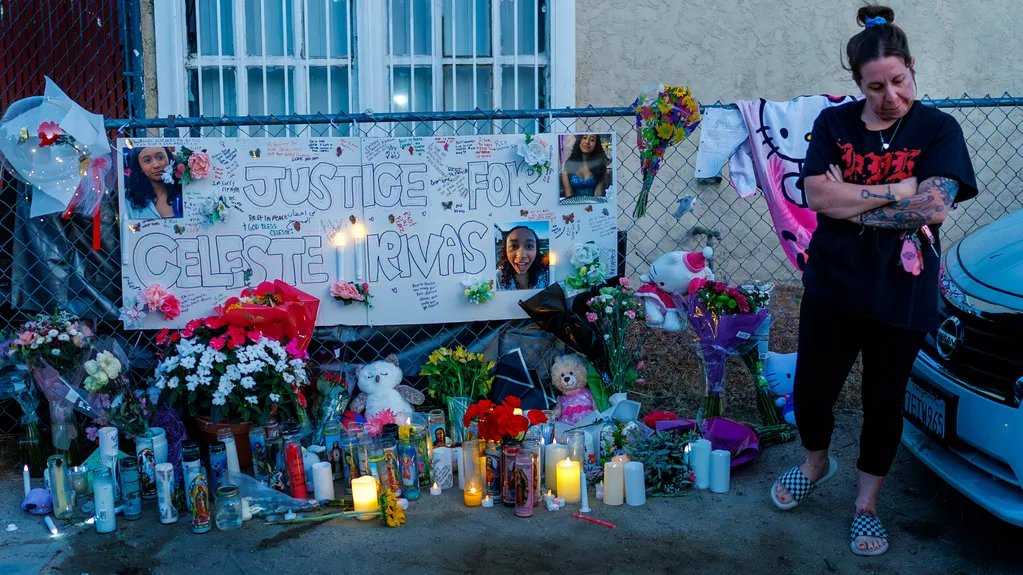
A teenage girl went missing. The police found her remains in a musician's car. Then the Los Angeles media machine got to work.
Ever since the police found the decomposed body of a teenage girl named Celeste Rivas Hernandez in a car belonging to the singer D4vd last fall, online sleuths have saturated the internet with theories about the case.
The local news media reported that the police viewed D4vd as a suspect, though the authorities did not confirm that. TMZ, Los Angeles's scoopiest celebrity news outlet, published dozens of updates about the case, including items on security camera footage, TikTok comments and the musings of one of the teenager's former boyfriends.
But one of TMZ's reports was so shocking that the police, who often ignore such accounts, felt compelled to publicly bat it down.
"Celeste's body was not frozen," Capt. Scot Williams, who leads the Los Angeles police division in charge of the investigation, said late last year. "She was not decapitated. The whole frozen thing doesn't even make sense."
Welcome to the wild world of Los Angeles media during a lurid celebrity crime story, when information leaks, misinformation often spreads and everyone wants to opine. The mostly anonymous reporting filled a monthslong vacuum before the authorities announced on Thursday that they had arrested D4vd, a 21-year-old rising music star whose real name is David Burke.
Sensational crimes and untimely deaths are woven into the fabric of Southern California. Los Angeles is intimately familiar with celebrity scandal. See, for instance, the Manson family murders in 1969; O.J. Simpson's low-speed chase in 1994; and the discovery of Matthew Perry's body in his Jacuzzi after a drug overdose in 2023.
But even by L.A. standards, the Rivas Hernandez case has been both unspeakably sad and unusually gripping -- so much so that it has thrust the city's very particular, very peculiar information ecosystem into overdrive.
What began as a routine parking citation in the Hollywood Hills sprawled, over more than six months, to involve a private investigator, power lawyers, podcasts and, yes, the police.
"This case is the quintessential L.A. story," said Mark Geragos, one of the city's power lawyers who has defended high-profile clients in Los Angeles such as the Menendez brothers. "The intersection of celebrity, intrigue, murder."
From the beginning, the Los Angeles Police Department severely limited the amount of information it released on the case, essentially saying only: A Tesla registered to D4vd was towed to an impound lot on Sept. 5 after officials received a complaint that it appeared to have been abandoned. Three days later, authorities responded to reports of an odor at the impound yard. There, they found the remains of a girl in a bag in the Tesla's front trunk. Officials eventually identified the body as that of Ms. Rivas Hernandez, who they said appeared to have been dead for an extended period of time. She had been found a day after what would have been her 15th birthday.
For months, Ms. Rivas Hernandez's death was not considered the result of a crime. That is because, as the authorities repeatedly insisted, until the Los Angeles County medical examiner determined the cause of her death, they could not definitively say whether a crime had been committed. And with no crime, there was no suspect. Nothing to see -- or tell -- here.
At the same time, no one heard from Mr. Burke's representatives. The New York Post, which recently started a sister publication in California, reported that one of the city's most powerful criminal defense lawyers had taken Mr. Burke's case. But not until this week did that lawyer, Blair Berk, speak out publicly to confirm her involvement. (She and Mr. Burke's other lawyers said that the evidence would show he did not murder Ms. Rivas Hernandez, and that they would "vigorously defend David's innocence.")
It was amid this information gap that drips of intel began leaking from other sources: a private investigator hired by the owner of a Hollywood Hills home that Mr. Burke had once rented; Mr. Geragos, the power lawyer; and even the founder of TMZ himself, Harvey Levin.
Early on, the man who owned the Hollywood Hills home, Malden Trifunovic, told The New York Times that he was cooperating with the police investigation. He emphasized that he had hired his own private investigator, whom he later identified as Steve Fischer. Mr. Fischer appeared on Court TV, NewsNation and other stations to discuss the case -- and share some of his findings.
He told the local ABC affiliate that Mr. Burke's Tesla had been parked "in a few different spots around the neighborhood" starting in May before arriving in the spot where it was ticketed on July 29. Mr. Fischer also said on his website that he had discovered who was driving the Tesla in late July (though he did not identify that person publicly), and said he believed that Ms. Rivas Hernandez might have died "back as far as February 2025." The police have not commented on any of these assertions.
Other scraps of information were making their way to TMZ, which reported on Mr. Burke's tattoos, using them to suggest a possible connection between the singer and Ms. Rivas Hernandez. Along with The Los Angeles Times, it revealed the existence of a grand jury proceeding that was supposed to be secret, whom was being called to testify and who was fighting the subpoenas. And it was TMZ, along with NBC Los Angeles, that in November first reported that Mr. Burke was a suspect.
So perhaps it should have been little surprise when Mr. Levin and Mr. Geragos hopped on a TMZ-owned podcast to riff on the case.
Mr. Geragos does not represent Mr. Burke. But he has defended high-profile clients, including the woman who pleaded guilty to having illegally provided ketamine to Mr. Perry. He also owns Los Angeles magazine, which itself has written about some of Mr. Fischer's more lurid claims concerning the Rivas Hernandez disappearance.
TMZ has its own reporters, but Mr. Levin made it clear in the podcast with Mr. Geragos: "I've been on the phone personally on this one."
Among the suggestions made by Mr. Levin and Mr. Geragos: The relationship between the L.A.P.D. and the medical examiner had frayed, and a trip that Mr. Burke took to a remote area of Santa Barbara County could be key to the investigation.
It was a newsy enough podcast that the police put out a statement confirming that it had evidence showing that Mr. Burke had traveled to the Santa Barbara area sometime in the spring of 2025. And the medical examiner's office, in a rare public statement, appeared to confirm that there was tension between the agency and the police.
Interest in the D4vd case resurged on Thursday when the police said that Mr. Burke had been arrested and was being held without bail and that his case would be presented to prosecutors on Monday. They fit all of that information within a 45-word statement.