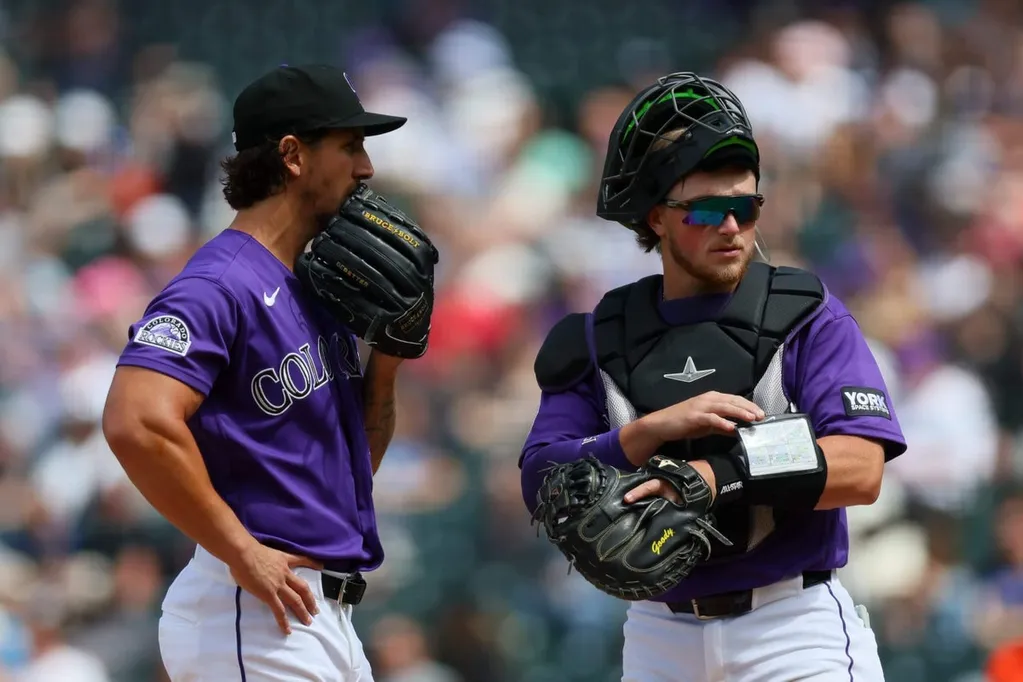
SAN DIEGO -- Before every pitch, Alon Leichman delivers a message.
The Colorado Rockies' first-year pitching coach stands on the top step of the dugout, glances at a card in front of him and flashes a sequence of numbers toward home plate. The catcher reads the signs, checks his wristband and punches a selection into his PitchCom device. Then the pitcher makes a decision.
"It's just a way for me to almost talk to them," Leichman said. "It's like, 'I'm thinking slider here.' Rather than 'Throw a slider.'"
Leichman is 36 years old, grew up in a kibbutz in Israel and never pitched professionally in North America. Through the first three weeks of this season, he has suggested virtually every pitch the Rockies throw, an analytically driven approach that has produced one of the more surprising early pitching performances in the National League.
In 2025, the Rockies finished with 119 losses and the worst ERA (5.97) by any big-league club this century. So far in 2026, Colorado has gone 7-12 while logging a much more respectable 4.00 ERA, including a 3.67 mark in its notoriously hitter-friendly home ballpark. On Friday, Shohei Ohtani and the Los Angeles Dodgers visit Coors Field for the start of a four-game series. It will be the toughest test yet of a practice that, until this season, no big-league team had attempted full-time.
"I'll steal this from Peter Bendix," Leichman said, referring to the Miami Marlins' president of baseball operations. "Within five years, two-thirds of the league could be doing this."
The pioneering strategy arrived in Denver via Miami, where, for the final nine games of last season, Leichman ran the same experiment as the Marlins' assistant pitching coach. Rockies interim manager Warren Schaeffer heard about it as it was getting underway; the two men, then acquaintances, spoke in the Coors Field outfield before a game in September.
Several weeks later, Schaeffer was retained as manager and tasked with assembling a coaching staff.
Leichman's name kept coming up. Then, in the interview process, so did the concept of calling pitches from the dugout.
"It was very obvious that this is something he believed in and wanted to do," Schaeffer said. "That being said, I wasn't convinced yet. We hired him with the premise that he was just going to be our pitching coach. That was it."
The convincing happened gradually during spring training, through conversations with starting catcher Hunter Goodman, the team's pitchers and an overhauled front office. The Rockies conducted a trial run over the final week of Cactus League play. Coming off three consecutive 100-loss seasons, they were not in a position to be precious about convention.
"You're open to a lot of things just because things have been going so poorly for us," said left-hander Kyle Freeland, the Rockies' longest-tenured player. "We're looking to go in different directions as a team and then throw out a lot of ideas and see what works."
The system is not entirely foreign. College baseball coaches have long called pitches from the dugout. Current Rockies assistant pitching coach Gabe Ribas called pitches for several years, most recently as the pitching coach at Santa Clara University. Before Colorado drafted him in the first round in 2023, right-hander Chase Dollander had most of his pitches for the University of Tennessee called by Frank Anderson, now the San Francisco Giants' director of pitching. (The Giants considered calling pitches from the dugout during spring training but ultimately didn't take the idea into the regular season.)
For now, though, the Rockies and the Marlins are the only clubs doing it under big-league scrutiny. At Coors Field, where the elevation turns fly outs into home runs, every pitch of every inning belongs to Leichman in a way that no coach at this level has experienced.
"You better be locked in for nine innings and every pitch," said Ribas, who charts each game as he stands beside Leichman in the dugout. "At the end of the day, he and I are both pretty wiped, and him more than me."
Leichman doesn't downplay the cost. "When things go well, it's a lot of fun. When games end like it did last night, it stings," he said last weekend after a walk-off loss to the San Diego Padres. "Sometimes I feel like I'm going (a complete game) every game. It feels like I'm in there with them, which I love and hate."
Even when he first raised the idea to the Rockies, Leichman acknowledged he didn't want to be the one suggesting pitches.
He has done it anyway.
"Does Alon think that this will help the Rockies?" Leichman remembers asking rhetorically. "Yes."
Leichman does not issue mandates; the word the Rockies consistently use is suggestion. Freeland recalls operating in a "Big Brother-type" environment while pitching at the University of Evansville, where he would have to explain himself in the dugout after shaking off a coach. In the big leagues, Freeland said, "that would never fly. And Alon, that was the first thing he said. Like, 'This is not me saying you have to throw this pitch or getting on your ass because you shook me off. It's strictly a suggestion.'"
Dollander, 24, has heard a similar message: "'Alon is like: Dude, if you want to shake, shake. You’re not going to hurt my feelings. I’d rather you throw a pitch you’re convicted in than one you’re not.'"
Goodman, who called his own games at the University of Memphis, said he doesn't "really look at it as the coach calling pitches. We're kind of doing it as a team. We've got Alon in the dugout, me behind the plate and the pitcher. If all three agree on one pitch, that's pretty good. If you get two out of three, that's good."
More often than not, all three seem to agree.
Leichman estimates he has been shaken off only once or twice per game. Although he does not have a catcher's view of pitch locations or swings, the Rockies have built in ways for their backstops to relay certain details to the dugout -- say, if a pitch missed badly, or if an opponent has moved up or back in the batter's box. And the card in Leichman's hands might provide what even the most experienced catchers cannot.
"You have nine hitters in a lineup, and then you have a starter, and then you have eight or nine guys in the 'pen," Goodman, 26, said. "You can't remember every bit of it. No matter what you do, you're not going to be able to hold all the information that you do in your pregame work and studying those lineups.
"Having that stuff in front of him makes it a little bit easier for him to see, like, this pitch is a little better to this guy, or let's stay away from this spot on this guy."
Michael Lorenzen, one of the oldest members of the roster, learned about the system in spring training after signing a free-agent deal with the Rockies. The right-hander was already friendly with Leichman; the two men met years ago through a shared interest in movement training and stayed in touch as Lorenzen moved through several organizations.
That hasn't guaranteed better results. Through five regular-season appearances, including four starts, Lorenzen has pitched to an 8.10 ERA. (Freeland, a fellow veteran, recorded a 2.30 ERA in three starts before landing on the injured list with shoulder inflammation.)
Meanwhile, no matter the outcome,Lorenzen’s relationship with Leichman creates permission for candor.
“We’re able to have honest conversations between innings,” Lorenzen said. “Not afraid to ruffle one another’s feathers. That’s a big deal because that’s how you get better.”
At the moment,theremaining 28 teams have yet to follow suit.
Germán Márquez,whopitched for the Rockies for a decade before signing with San Diego,facedhis former team for the first time Saturday,throwingfive innings of four-run ball in a 9-5 win.Thefollowing morning,theright-hander was asked about what Colorado is now trying.
"If it's working, it's going to be good," Márquez said. "But I feel like you have to have confidence in your catcher."
New York Yankees starter Carlos Rodón was more blunt.
"I think it's terrible,"the left-hander told The Athletic during a series this month against the Marlins, who now have assistant pitching coach Rob Marcello calling pitches from the dugout.
"When (Marlins catcher) Agustín Ramírez wants to be a free agent, and he's had every pitch called for him, who the hell is going to look at him and be like, 'Yeah, he's a catcher?' It's just taking away opportunities to learn."
Such criticism has not stopped the Rockies or the Marlins,whohave posted a 4.15 ERA.
"Water off our back.I think if they were here, they might have a different opinion of it,"said Ribas,who previously worked in player development forthe Detroit Tigersandthe Dodgers."But they're entitled to their opinion,too.I think a lot ofthe industryhas feelings about it,and that's fine,right?We're in it,and I thinkthe systemworks well for us."Once Miami broke through with doing it,everybody really started talking about it.I think you're going to see more and more orgs go to it,but I don't think it'll ever be everyone."
For some,skepticismis already giving way to curiosity.Padresstarter Michael King disliked what he initially believedtheRockies were up to."I thought it was like,'This isthepitch that you have to throw,and we’re taking over,’” King said.“But knowing that it’s just a suggestion ... and now you havetheanalytically best pitch to throw,it’sa little bit better.It could help you navigateapartofthe lineup that you weren’t expecting to get to.”